
The Social Routing Principle: Turning the Global Web into a Programmable Workforce
Web-Scale Workflow
The paper introduces the "Social Routing Principle," a novel architectural building block designed to integrate mobile apps and Web systems with social networks. It proposes a "Social Router" mechanism that enables tasks to be delegated across personal communities, context-based social networks, and crowdsourcing platforms (e.g., Amazon Mechanical Turk) to achieve Web-scale collaborative problem-solving.
TL;DR
The "Social Routing Principle" proposes a paradigm shift where mobile apps act as gateways to a global human workforce. By introducing a Social Router, tasks are no longer trapped within the silo of an individual's device; instead, they are dynamically delegated to personal networks, expert communities, or the crowd based on context and urgency.
Background & Motivation: Moving Beyond Vertical Silos
In the current digital landscape, our applications are "vertical." A calendar app manages time, a news app delivers content, and Facebook facilitates social chat. However, these tools rarely talk to each other to solve problems. When an individual is overwhelmed, their apps don't help them offload work.
The authors argue that social networks have become an infrastructure. Just as the Internet routes data packets, the "Social Web" should route tasks. The goal is to move from social computing for individuals to a system where an entire society can "program itself" to solve complex problems collaboratively.
The Core Concept: The Social Router
The heart of this proposal is the Social Router. In traditional networking, a router moves data between different network types. In this context, a Social Router moves work.
How It Works
- Task Definition: An app (like a calendar or email client) captures a task.
- Addressing & Context: The router analyzes the task’s context (Who is involved? What is the deadline? Is it private?).
- Routing Decision: Using a conceptual routing table, the system determines the best destination from three categories:
- Personal Communities: Friends or direct colleagues (high trust).
- Context-based Communities: Specialized groups (e.g., people currently at a specific conference or experts in a topic).
- The Crowd: Massive, anonymous platforms like Amazon Mechanical Turk (scale).
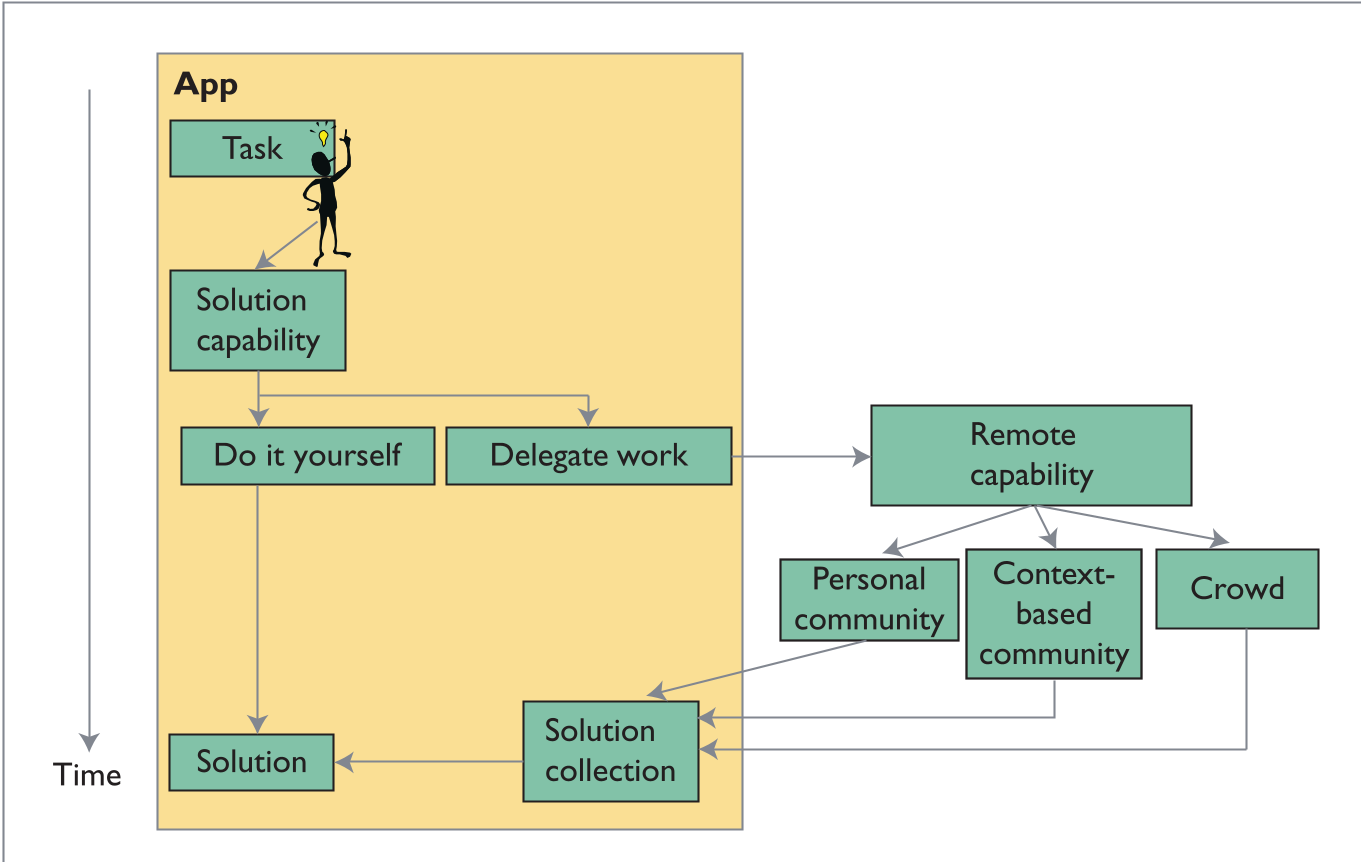 Figure 1: The dual pathway of solving tasks—either "Do It Yourself" or delegating through the Social Router to three remote tiers.
Methodology: The Mechanics of Delegation
To make this a reality, the router must handle complex "Address Schemes" and "API Contracts" for different social platforms. For instance, delegating a photo search to the "crowd" requires the router to automatically:
- Create a Human Intelligence Task (HIT).
- Set a price or incentive.
- Manage the return flow of data back to the original app.
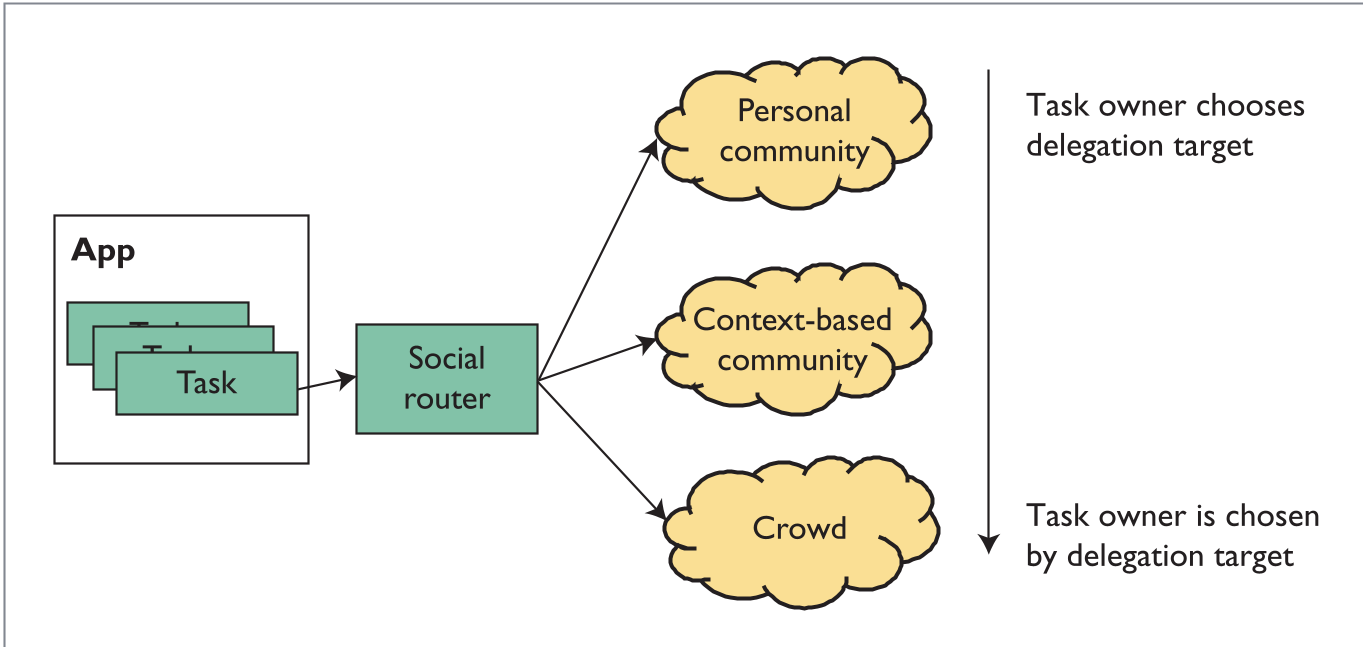 Figure 2: The Social Routing logic, showing how task owners choose capacity vs. how communities choose tasks.
Challenges: Trust, Privacy, and Incentives
The paper doesn't shy away from the immense technical and humanistic hurdles:
- Context Understanding: For a router to handle a request like "Check if this picture is compliant with partner rules," it must understand legal relationships and data privacy—knowing what cannot be sent to the public crowd.
- The Human Factor: Unlike data packets, humans need incentives. The router must manage "social currency," such as badges, points, or actual money, to ensure the task is prioritized by the recipient.
Critical Insight: Why This Matters
This work sits at the intersection of Service-Oriented Architecture (SOA) and Social Computing. Its true value lies in the "Horizontal" approach. Instead of building one app for crowdsourcing and one for social networking, the Social Routing Principle suggests a standardized layer that any app developer can use to invoke human intelligence as easily as an API call.
Conclusion & Future Outlook
The Social Routing Principle provides a blueprint for a more efficient, collaborative ecosystem. While the technical implementation of "automated trust" and "contextual understanding" remains a significant research frontier, the vision of a Web-scale workflow system where tasks flow seamlessly between humans and apps is a compelling precursor to modern AI-agent orchestrations.
Takeaway: Future productivity will not be measured by how well an individual uses an app, but by how effectively their apps leverage the global social fabric to delegate and solve problems.