
The Web Within: Unifying Institutional Data through Graph Topology and Spreading Activation
The Web Within: Leveraging Web Standards and Graph Analysis to Enable Application-Level Integration of Institutional Data
The paper introduces the Complex Data Management System (CDMS), a relationship-centric framework that integrates heterogeneous institutional data into a unifying RDF graph. Its core innovation is the "in*" query language extension, which enables declarative, topology-aware ranking (e.g., relevance, reputation, connectivity) across structured and unstructured data using Targeted Spreading Activation (TSA).
Executive Summary
TL;DR: The paper presents the Complex Data Management System (CDMS), a framework designed to treat institutional data as a "Large Local Graph." By extending SPARQL with a new grammar called in*, it allows developers to perform complex network analysis—such as calculating entity reputation or similarity—directly within a declarative query. It effectively merges the "deterministic" world of Databases with the "probabilistic" world of Information Retrieval.
Positioning: This work is a structural innovation in data integration. It moves beyond simple "data cleaning" (ETL) and instead focuses on Query Model Integration, providing a unified mathematical foundation (Targeted Spreading Activation) to solve diverse tasks like recommendation, search, and social discovery.
Problem & Motivation: The Silo Trap
In a typical enterprise, data is scattered. You might have customer info in a relational DB, transcripts in a text index, and social connections in a graph.
The authors argue that existing solutions are "modal":
- DB Approach: Great for structured filters but fails at "relevance."
- IR Approach: Great at keyword ranking but struggles with relational constraints.
- The Integration Gap: Try asking, "Find me tech documents related to 'AI' written by engineers with high reputation among their peers." Doing this today requires massive custom engineering because "reputation" and "keyword relevance" live in different software universes.
The insight here is that almost all these needs can be modeled as topological properties of a graph.
Methodology: The Core of CDMS
The CDMS architecture rests on three pillars: the Unifying Graph, Mappers, and Targeted Spreading Activation (TSA).
1. The Large Local Graph (LLG)
Instead of the "Giant Global Graph" (Semantic Web), the authors advocate for an LLG—applying Web standards (RDF, URIs) to internal data. This allows for high-performance, controlled semantic integration.
2. Mappers: The Bridges
Mappers are specialized triggers that transform data. For instance, a TokenMapper can take a document, tokenize it, and create links between the document node and "token" nodes.
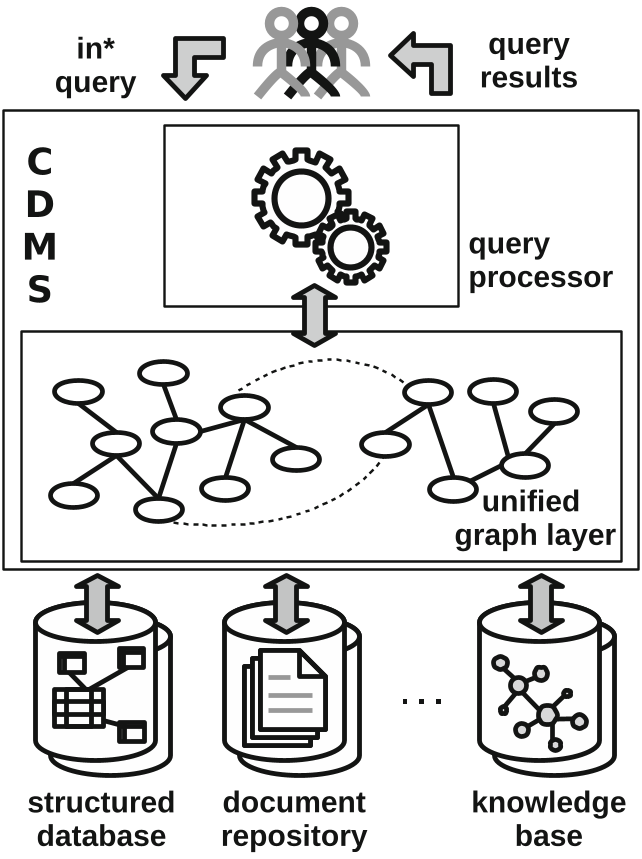 Figure 1: Comparison of heterogeneous data sources integrated into the unifying graph via CDMS.
3. Targeted Spreading Activation (TSA)
This is the "engine" of the query model. When you query for "relevance," the system starts with an "activation potential" at a source node and "spreads" it across the graph. The potential decays as it travels further, naturally capturing the intuition that closer nodes are more related.
The authors formalize metrics like:
- Relevance: Favors nodes reachable via "specific" (low-outdegree) paths.
- Reputation: Measures how effectively a node acts as a hub for information flow.
- Context/Similarity: Looks at common neighborhoods between two nodes.
Experiments: Real-World Movie Discovery
The researchers tested CDMS on the Linked Movie Data Base (LinkedMDB). They successfully demonstrated queries that were previously nearly impossible to write in standard SPARQL.
Example Query Logic: Rank movies based on two criteria:
- Relevance to the text "Virtual Reality."
- Connectivity to the specific subject node
:Virtual_Reality.
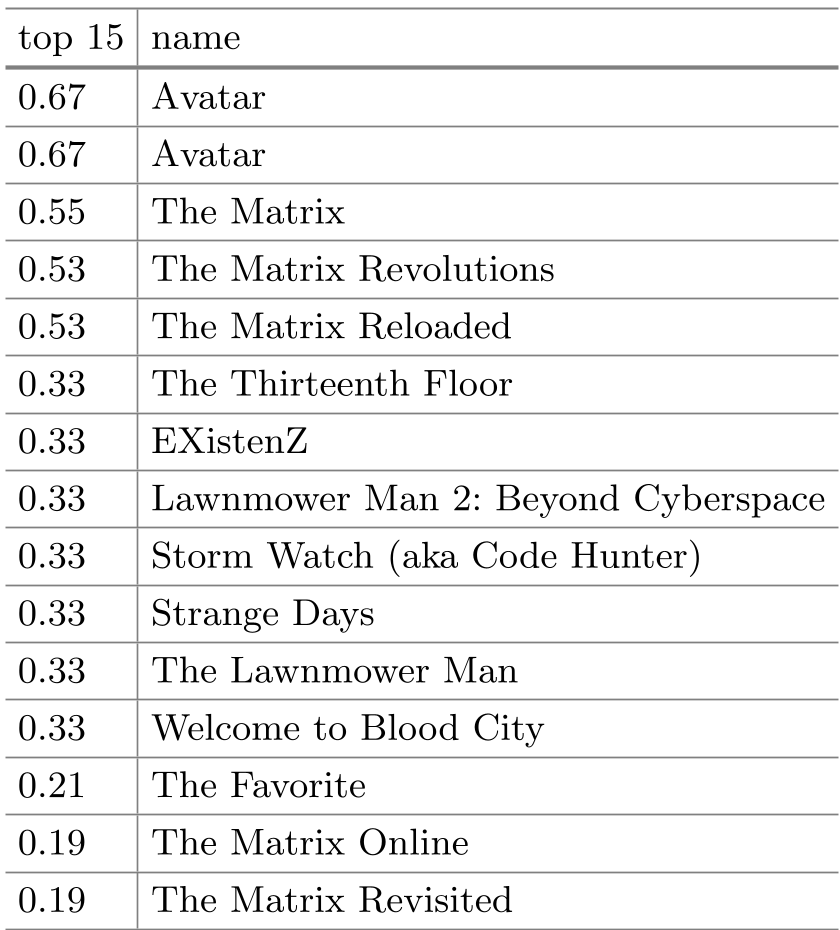 Table 2: Top results for a combined keyword and subject query. Note how 'Avatar' and 'The Matrix' surface based on different topological paths.
The results showed that the system didn't just find direct matches; it found semantically related entities by traversing the graph, even if the specific keyword wasn't present in every metadata field.
Critical Analysis & Conclusion
Takeaway
CDMS provides a Blueprint for the next generation of "Intelligent Data Warehouses." By making "relationships" first-class citizens in the query language, it allows applications to evolve from simple CRMs to proactive recommendation and analysis engines.
Limitations
- Computational Complexity: Spreading activation is expensive. While the authors mention "Targeted" SA to limit the search space, very large or dense graphs could still face latency issues during real-time querying.
- Mapper Maintenance: The quality of the "integrated graph" depends heavily on the accuracy of the Mappers.
Future Work
The next frontier is likely Automatic Mapping—using Large Language Models (LLMs) to automatically identify and create the relationships that the CDMS then queries. This would complete the vision of a truly "self-organizing" institutional graph.