
Weibo and Twitter: A Tale of Two Topological Worlds
Weibo, and a Tale of Two Worlds
This paper presents a comprehensive structural analysis of Sina Weibo using a massive dataset of 222 million users and 27 billion links. By comparing Weibo with Twitter, the study identifies unique topological signatures of the Chinese social media landscape, characterizing it more as an information dissemination platform than a pure social network.
In the realm of social computing, Sina Weibo is frequently dismissed as a mere "Twitter clone." However, a deep dive into its underlying graph structure reveals a fundamentally different beast. In this seminal study, researchers from Tsinghua University and the University of Windsor analyze 27 billion links to prove that while the interfaces are similar, the social fabric they weave is worlds apart.
TL;DR
By analyzing an almost complete crawl of Weibo (222M users), this research demonstrates that Weibo is significantly more "media-oriented" and "unequal" than Twitter. With a reciprocity rate 75% lower than Twitter and a higher Gini coefficient for follower distribution, Weibo operates as a broadcast-heavy platform where celebrities dominate more than they do on Western counterparts.
The Motivation: Moving Beyond Small Samples
Most academic insights into Chinese social media have been hindered by restricted API access and small-scale sampling. The authors overcame this by capturing a snapshot of 282 million users. Their goal was to answer a fundamental question: Does the same software architecture (Microblogging) result in the same social structure across different cultures?
The answer is a resounding "No."
Methodology: Scalable Graph Analytics
The team employed a BFS (Breadth-First Search) crawling strategy, leveraging the fact that Weibo's API was less restrictive in 2013. They calculated:
- Reciprocity: The ratio of mutual follows.
- Assortativity: Whether popular users follow other popular users.
- Node Centrality: Using PageRank to identify "true" influencers beyond simple follower counts.
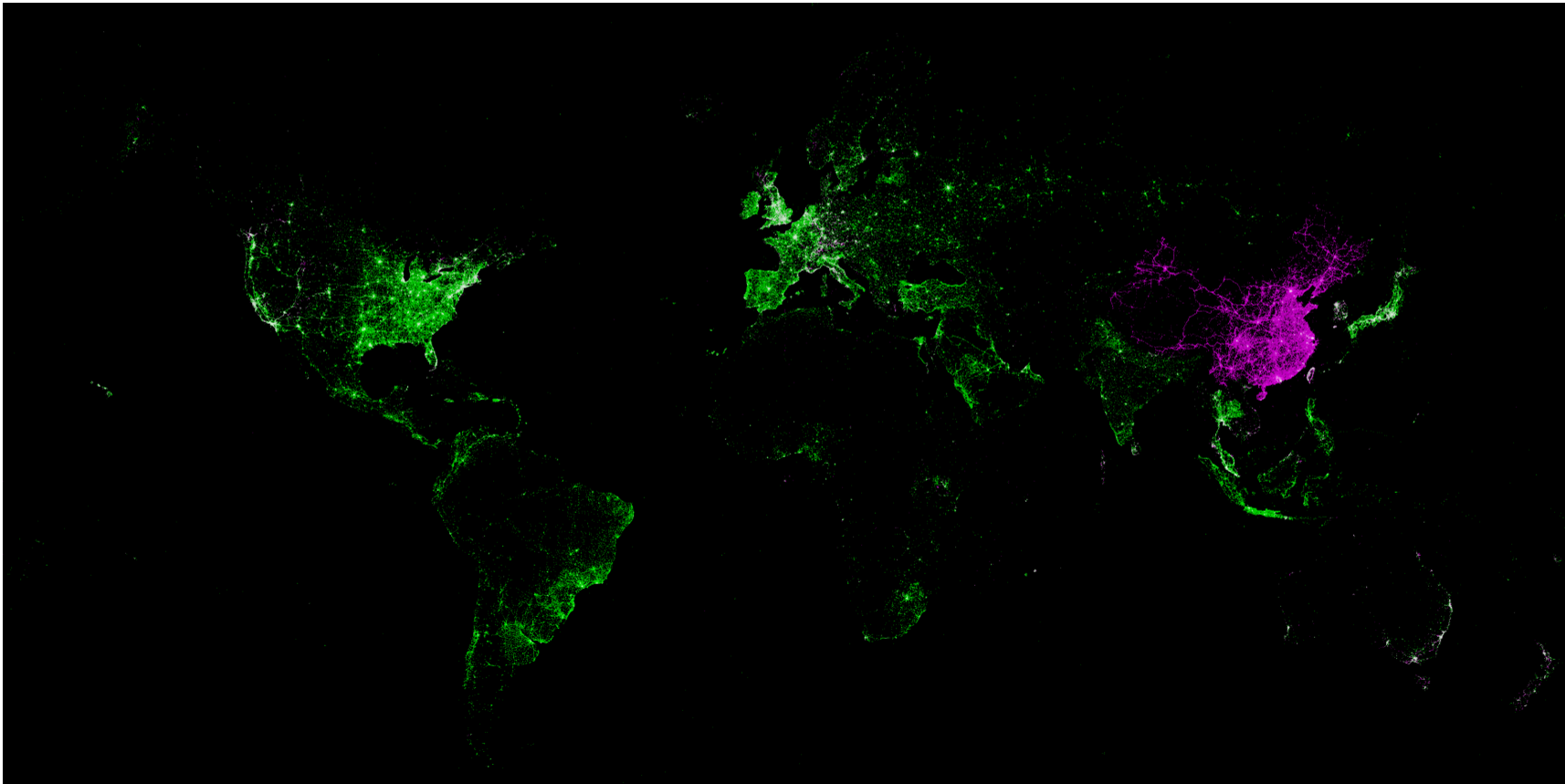 Fig 1: The Global Divide - Brightness indicates user density, showing a world nearly split between Weibo (Red) and Twitter (Green).
Core Insight 1: The Reciprocity Gap
The most shocking finding is the Reciprocity.
- Twitter (2009/2012): 36% - 42% reciprocity.
- Weibo: 10% reciprocity.
This suggests that on Weibo, the "follow" is a one-way street. Users consume content from stars, official accounts, and news outlets without expecting a follow-back. This cements Weibo’s status as a News Media platform rather than a Social Network (like Facebook).
Core Insight 2: Assortativity and the "V" Shape
A common debate in network science is whether "celebrities follow celebrities." Previous Twitter studies suggested negative assortativity (popular people following "nobodies"). This paper clarifies the phenomenon with a "V-shape" discovery:
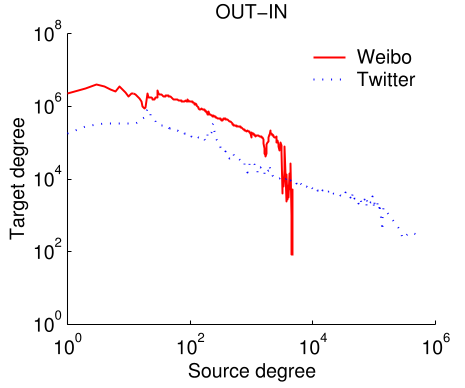 Fig 2: In-degree vs. Target In-degree. Notice the pivot at the 2000-follower mark.
The data shows that for ordinary users, as they get more followers, the popularity of those they follow decreases (they start following real-world friends). However, once a user crosses the 2000-follower threshold, the trend reverses: influencers begin following other high-status influencers.
Mapping the Real World: GDP and Mutual Information
The study brilliantly links digital bits to physical atoms. By using Point-wise Mutual Information (PMI), the authors mapped the "strength" of connections between Chinese provinces.
- Economic Correlation: Weibo penetration rate has a 0.76 correlation with regional GDP per capita. Wealthier provinces are more "connected" and have higher clustering coefficients.
- Cultural Clusters: The network structure accurately clustered provinces by dialect and history (e.g., Hong Kong and Guangdong), showcasing the network's ability to mirror sociological realities.
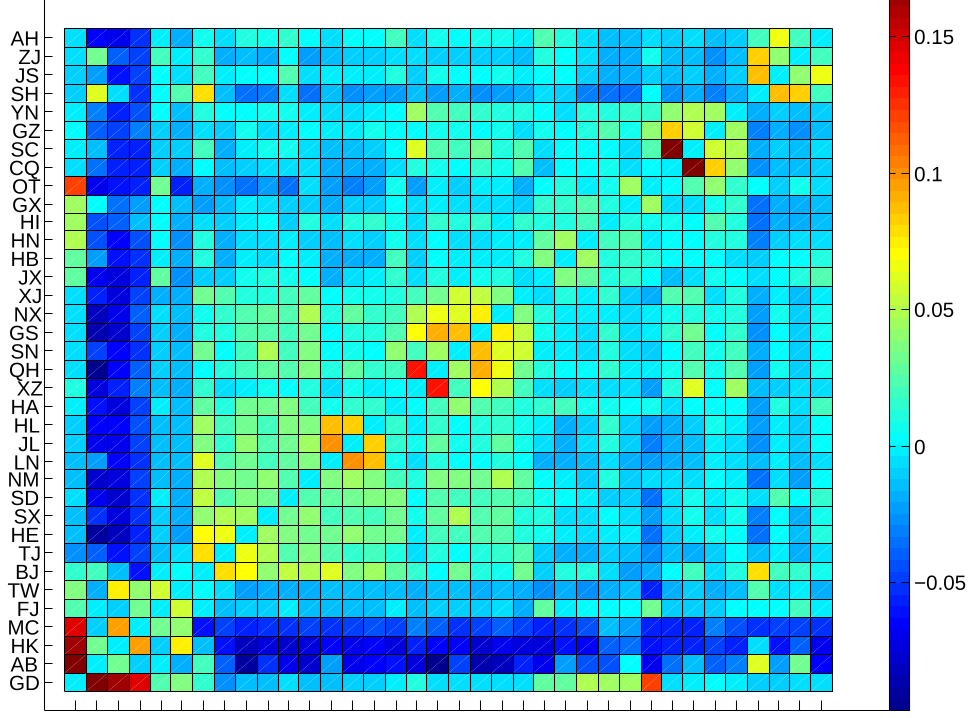 Fig 3: Hierarchical clustering of Chinese provinces based purely on following relationships.
Critical Analysis & Conclusion
The value of this paper lies in its scale and the "Tale of Two Worlds" narrative. It warns us that topology is not just about code; it's about culture.
Key Takeaways:
- Inequality is standard: The top 0.1% of Weibo users own 48% of the total followers.
- Platform Utility: Weibo serves as the "Digital Town Square" for news, while Twitter (at the time) had a more robust social interaction layer.
- Limitations: The study reflects a 2013 snapshot. Post-2013, the rise of WeChat shifted "pure social" interactions away from Weibo, likely driving these reciprocity numbers even lower in subsequent years.
In conclusion, the paper proves that while we use the same tools, the way we connect is deeply rooted in our economic and cultural geography.