
WAS: Elevating Private Social Matching with Weight-Aware Intelligence
Weight-aware private matching scheme for Proximity-based Mobile Social Networks
The paper introduces a Weight-Aware Private Matching scheme for Proximity-based Mobile Social Networks (PMSNs) using a novel Weighted Average Similarity (WAS) algorithm. It leverages Commutative Encryption to perform privacy-preserving profile matching that outperforms existing SOTA methods in both computational efficiency and matching accuracy.
TL;DR
In the world of Proximity-based Mobile Social Networks (PMSNs), finding the right friend shouldn't mean sacrificing your privacy or your battery. This paper introduces a Weight-Aware Private Matching scheme that uses the Weighted Average Similarity (WAS) algorithm. Unlike previous methods that just count common interests, WAS understands that some hobbies matter more than others. By leveraging efficient Commutative Encryption, it achieves SOTA performance, reducing execution time from seconds to milliseconds.
The "Interest Paradox" in Mobile Socializing
The fundamental motivation of this work stems from a simple observation: All interests are not created equal.
Imagine Alice, who loves Quantum Physics (High Weight) and occasionally watches Reality TV (Low Weight). Traditional Private Set Intersection (PSI) methods would treat these equally. If Bob shares her passion for physics, and Charles shares her fleeting interest in three different TV shows, a standard algorithm would rank Charles as a better match. This is the Interest Paradox.
Furthermore, existing solutions suffer from two major flaws:
- TTP Dependency: Relying on a Trusted Third Party is a security risk and a performance bottleneck.
- Binary Matching: Simply counting matches ignores the nuance of user preference, often leading to poor social outcomes.
Methodology: High-Level Similarity via Commutative Encryption
The core innovation lies in the Weighted Average Similarity (WAS) algorithm. Instead of a flat list, interests are mapped into priority levels.
The Cryptographic Engine
To ensure privacy without a central server, the authors use Commutative Encryption. The magic of this technique is the property: This allows two users to verify a match by comparing encrypted values without ever decrypting the underlying data.
The WAS Algorithm Flow
- Level Assignment: Users group interests into levels (e.g., Extreme, Normal, Little).
- Encrypted Exchange: Users exchange hashes of their interests, doubly encrypted by both parties' secret keys.
- Weighted Computation: The responder calculates the number of common interests () between levels and computes the final similarity score : where represents the weighted similarity of level .
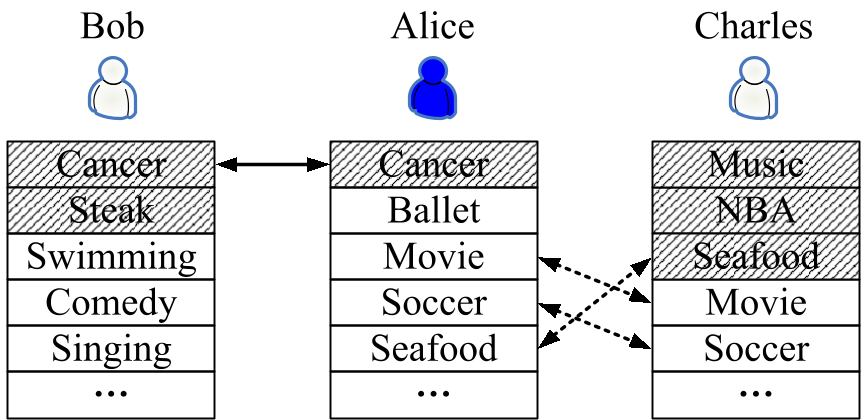 Fig 1: The motivation for weighted matching—Bob is a better match for Alice than Charles, despite having fewer total common interests.
Clinical Performance: Seconds to Milliseconds
The most striking part of this research is the performance gain. In mobile environments, latency and energy are the ultimate constraints.
1. Execution Efficiency
When tested with 200 interests, the WAS scheme completed in roughly 183 ms. In comparison, the De Cristofaro (ASIACRYPT '10) and Xie (PST '11) schemes took over 15 seconds and 4 seconds respectively. This represents a massive leap in usability for real-time Bluetooth/WiFi discovery.
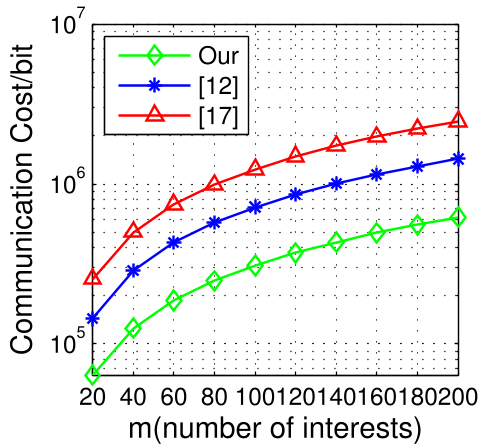 Fig 2: Total protocol execution time vs. number of interests.
2. Energy Consumption
Mobile devices live and die by their battery. The energy cost for the initiator in WAS is significantly lower than previous iterations, mostly due to the reduced online computation requirements (only exponentiation operations).
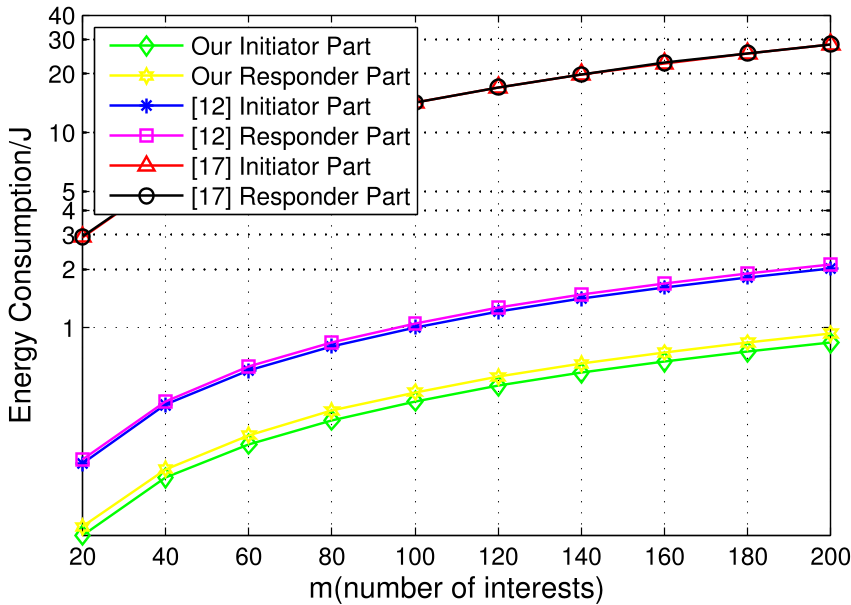 Fig 3: Energy consumption comparison—WAS shows a clear advantage as the interest list grows.
Critical Insight & Future Outlook
The WAS scheme proves that complexity in logic (adding weights) does not have to mean complexity in computation. By simplifying the interaction between levels and using commutative properties, the authors created a "Fine-Grained" matching system that is faster than "Coarse-Grained" predecessors.
Limitations: While the system is robust against honest-but-curious adversaries, it still faces challenges if an initiator has only one interest (Theorem 2). In such a niche edge case, a binary "match/no match" could still reveal a specific interest.
Takeaway: This work provides a blueprint for next-generation decentralized social apps. By moving away from TTPs and embracing weighted similarity, we can build social discovery tools that are both smarter and more private.