
EWDCR: Solving the Bottleneck of Social Opportunistic Networks through Community Reconstitution
Weight distribution and community reconstitution based on communities communications in social opportunistic networks
This paper introduces the Effective Weight Distribution and Communities Reconstitution (EWDCR) algorithm for social opportunistic networks. It optimizes message delivery by dynamically managing node weights and community structures to prevent bottlenecking at overloaded nodes, achieving SOTA performance in delivery ratios and energy efficiency.
TL;DR
In the world of Social Opportunistic Networks (SONs), connectivity is intermittent and reliable end-to-end paths are rare. This paper presents EWDCR, an algorithm that moves beyond simple flooding. By treating mobile devices as socialization nodes and dynamically adjusting community structures based on weight distribution, EWDCR reduces energy consumption and cuts end-to-end delay from 350s to just 50s.
Problem & Motivation: The "Hub Node" Trap
Opportunistic networks rely on the "store-carry-forward" paradigm. While classic algorithms like Epidemic or Spray-and-Wait work in vacuum-like topologies, they fail in human-centric social environments.
The core issue identified by the authors is the Hub Node dependency. Most social routing depends on one or two highly active nodes. When these "social butterflies" reach their cache limit or exhaust their battery due to over-flooding, the community's communication enters a deadlock. The authors argue that we need a way to redistribute the load by understanding the fluidity of social communities.
Methodology: Dynamic Modularity and Weight Distribution
The heart of EWDCR lies in its mathematical treatment of communities using Modularization degree ().
1. Defining Community Strength
The strength of a community at any given moment is calculated based on total edge weights () and community-specific weights ().
2. The Weight Distribution Mechanism
Unlike static graphs, EWDCR treats weights as dynamic variables influenced by:
- Connection Time (): Longer meetings imply stronger social ties.
- Blacklists & Error Lists: Filtering out unreliable nodes to prevent overhead.
3. Community Reconstitution (The "How")
The authors prove five theorems that dictate when a node should join or leave a community. For instance, Theorem 4 provides the logic for when an edge weight increase between two communities triggers a node to migrate, ensuring the network topology remains optimized for current traffic.
 Figure 1: Conceptual overview of socialization nodes and opportunistic delivery.
Experiments: Testing in Helsinki
The authors used the ONE Simulator (v1.56) to test EWDCR against industry baselines like PRoPHET and Epidemic using a real map of Helsinki.
Key Metrics:
- Delivery Ratio: EWDCR achieved >0.91, while Spray-and-Wait lagged at ~0.25. This is due to EWDCR's ability to accurately predict "neighbor relevance."
- End-to-End Delay: By balancing the load across communities, EWDCR stabilized delay at 50s, a massive improvement over Epidemic's 350s.
- Energy Efficiency: Because EWDCR uses "exclusive or" calculating and limits repetitive packets (over-flooding), it retained significantly more surplus energy per node.
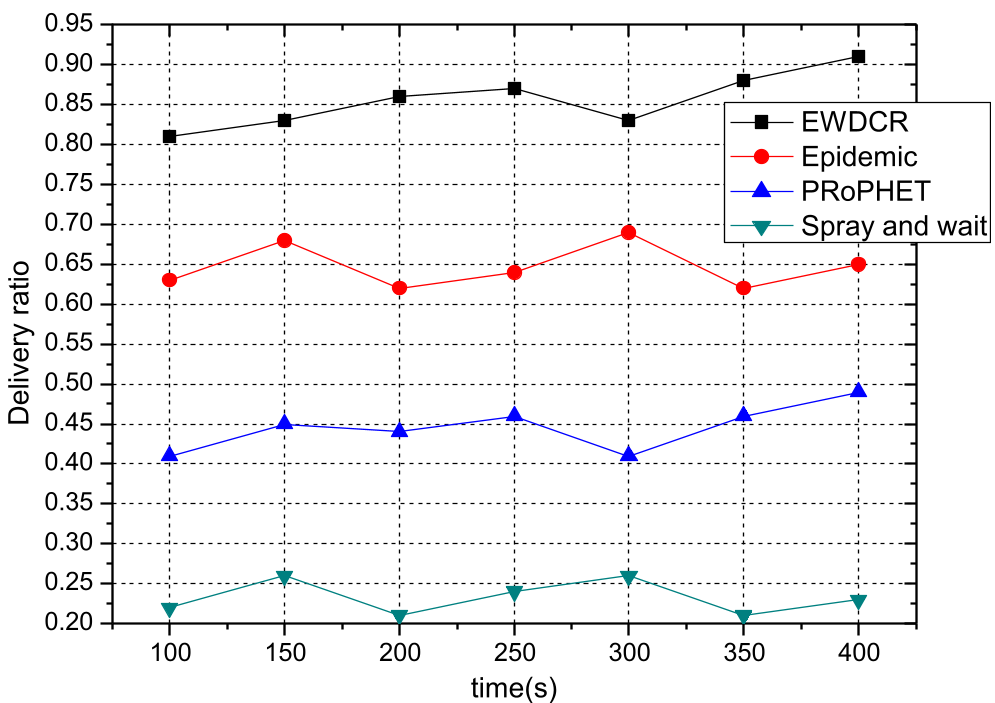 Figure 2: Delivery ratio comparison – EWDCR (highest) vs. PRoPHET, Spray and Wait, and Epidemic.
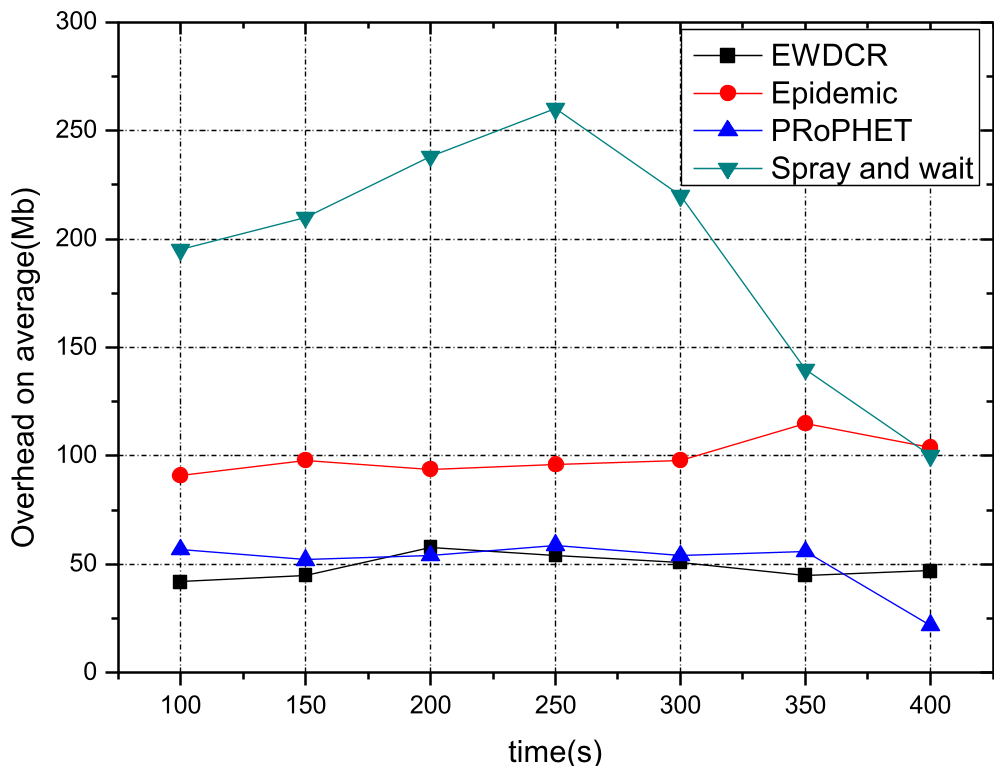 Figure 3: Surplus energy retention – EWDCR optimizes battery life through smarter routing.
Critical Insight & Conclusion
The true value of this work is the formalization of dynamic community membership. Most social routing treats community as a fixed attribute. EWDCR acknowledges that human social groups are transient. By using weight-based reconstitution, it prevents the "death" of central nodes and ensures the network remains resilient.
Limitations: The study assumes a relatively consistent mobility model (SPMBM). In highly chaotic scenarios (like emergency disasters), the weight calculation might struggle to converge fast enough.
Future Outlook: As we move toward 6G and the Internet of Everything (IoE), methods like EWDCR will be vital for decentralized edge computing where central base stations are unavailable.