
WAR: Boosting Crowdsourced Accuracy via Agreement-Based Weighted Aggregation
A Weighted Aggregation Rule in Crowdsourcing Systems for High Result Accuracy
The paper proposes a novel Weighted Aggregation Rule (WAR) for crowdsourcing systems. It classifies tasks into high-agreement and low-agreement categories, utilizing Simple Majority Voting for the former and a performance-based Weighted Majority Voting for the latter, significantly improving overall result accuracy.
TL;DR
Crowdsourcing platforms are powerful but messy. When workers disagree, the standard "majority rules" approach often fails. This paper introduces WAR (Weighted Aggregation Rule), a smart system that separates "easy" (high-agreement) tasks from "hard" (low-agreement) ones. It uses the easy tasks to grade the workers and then uses those grades to weight their votes on the hard tasks, significantly boosting final accuracy without needing massive amounts of pre-labeled data.
The "Spammer" Problem in Crowdsourcing
In systems like Amazon Mechanical Turk (AMT), the quality of results is often undermined by "spammers" or workers lacking specific expertise. While Simple Majority Voting (SMV) is the industry standard, it assumes all workers are equally competent—a dangerous assumption. Current alternatives involve complex machine learning models or "gold standards" (pre-answered questions), which are expensive and often unavailable.
The authors' core Insight: If a group of workers agrees almost unanimously on a set of tasks, those tasks are likely correct. We can use these "High-Agreement" tasks as a proxy for ground truth to measure worker ability on the fly.
Methodology: The Two-Stage Strategy
1. Classifying Task Difficulty
The authors use a Beta Distribution to model the probability that a worker provides a correct answer. By applying Bayesian analysis, they calculate the Consensus Number ().
- High-Agreement Tasks: If the number of workers choosing the majority answer exceeds , the task is deemed high-agreement.
- Low-Agreement Tasks: If the votes are split, the task is flagged for weighted intervention.
2. Bayesian Weight Estimation
For low-agreement tasks, the system doesn't treat every vote equally. Instead, it assigns a weight to each worker based on their historical accuracy on high-agreement tasks. The weight is defined by the log-odds of their accuracy: .
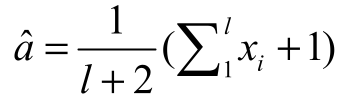 The formula above shows the posterior expected estimate of worker accuracy used for weight assignment.
Experimental Proof
The authors tested WAR across three diverse real-world datasets:
- TSA (Sentiment Analysis): High agreement tasks were common (80%).
- SOT (Image Recognition): Found significant gaps between high and low agreement task accuracy.
- GH (Gender Hobby): A difficult dataset where only 30% of tasks had high initial agreement.
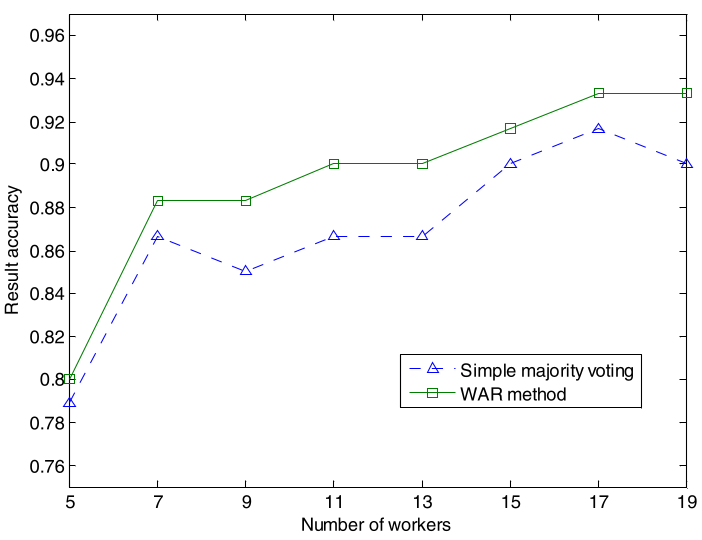 Fig 2: In the TSA dataset, high-agreement tasks (red line) consistently maintain accuracy above the 0.85 threshold, validating the classification model.
The most compelling result came from the GH dataset (Fig 9), where WAR achieved 0.91 accuracy with 21 workers, whereas SMV struggled to maintain a stable lead as more workers (potentially noise) were added.
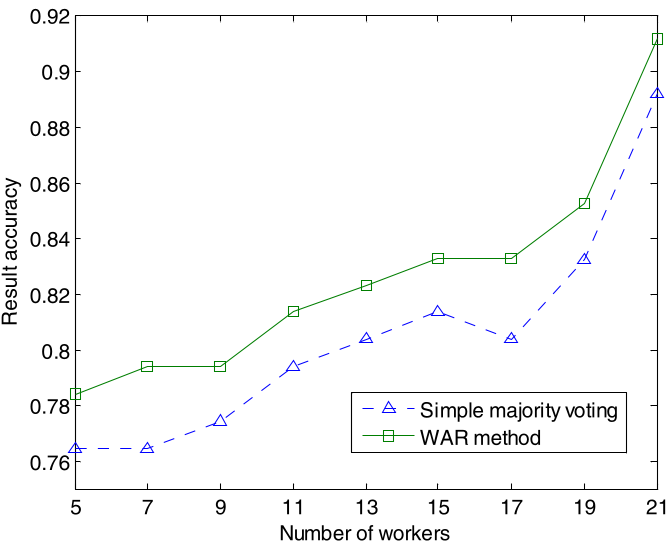 Fig 9: Accuracy comparison on the GH dataset. WAR (black) consistently outperforms SMV (blue).
Critical Insight & Conclusion
The beauty of WAR lies in its efficiency. It addresses the "cold-start" problem of worker evaluation by using the crowd's own consensus as a training signal.
Takeaway: For technical leads building data annotation pipelines, this paper suggests that you don't always need "Golden Questions" to identify top-tier annotators. Monitoring local consensus clusters can provide a powerful, zero-cost metric for dynamic worker weighting.
Limitations: The current model focuses on binary (Yes/No) questions. Future iterations would need to adapt the Beta-Binomial framework to handle multi-label classification and more nuanced human inputs.