
Turning Noise into Insight: A Weighted Crowdsourcing Approach to Network Quality
A Weighted Crowdsourcing Approach for Network Quality Measurement in Cellular Data Networks
This paper introduces a novel weighted crowdsourcing framework for measuring cellular network quality. By aggregating measurements (RSCP, Ec/No) from individual end-users rather than relying on expensive "drive testing," the authors achieve cost-effective, real-time, and city-wide quality estimation through a joint optimization of user weights and aggregated results.
TL;DR
To move beyond expensive and low-coverage "drive testing," this paper proposes a weighted crowdsourcing framework that aggregates network quality data from millions of smartphones. By treating every user as a "sensor" with varying reliability, the system uses a joint optimization algorithm to filter out hardware/behavioral noise, delivering an accurate, real-time map of cellular performance across entire cities.
Background: The End of Drive Testing?
Historically, network providers assessed quality via Drive Testing—trucks loaded with expensive equipment roaming the streets. This methodology is fundamentally flawed for the modern era: it's expensive, reflects only a snapshot in time, and misses indoor performance.
The alternative is Crowdsourcing. However, not all users are equal. One user might have a high-end iPhone while another has a budget device with a weak antenna; one might be stationary while another is on a high-speed train. Simple majority voting fails to account for these user-related factors, leading to skewed quality reports.
The Core Innovation: Weighted Aggregation (Truth Discovery)
The authors' insight is that we don't need to know why a user's data is noisy (hardware, mobility, or habits); we only need to observe how often they disagree with the potential "truth."
The Optimization Framework
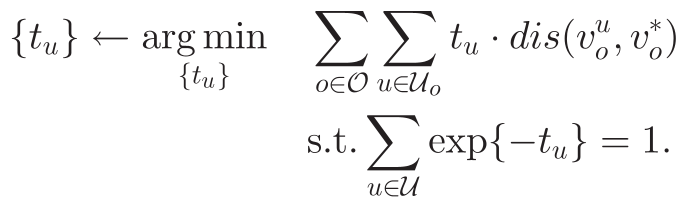
The problem is framed as a minimization of weighted distance: Where is the user weight and is the estimated "true" network quality.
The architecture uses a Block Coordinate Descent approach:
- Aggregation Step: Fix user weights and calculate the consensus quality using weighted voting.
- Estimation Step: Fix the quality results and update user weights. Users closer to the consensus get higher weights; outliers are penalized.
 Note: The iterative process mutualy enhances weights and quality estimates until convergence.
Experimental Validation: Real-World Scale
The researchers didn't just stay in the lab. They deployed this on two massive datasets from 3G networks in two different cities, involving over 193 million claims.
Key Findings:
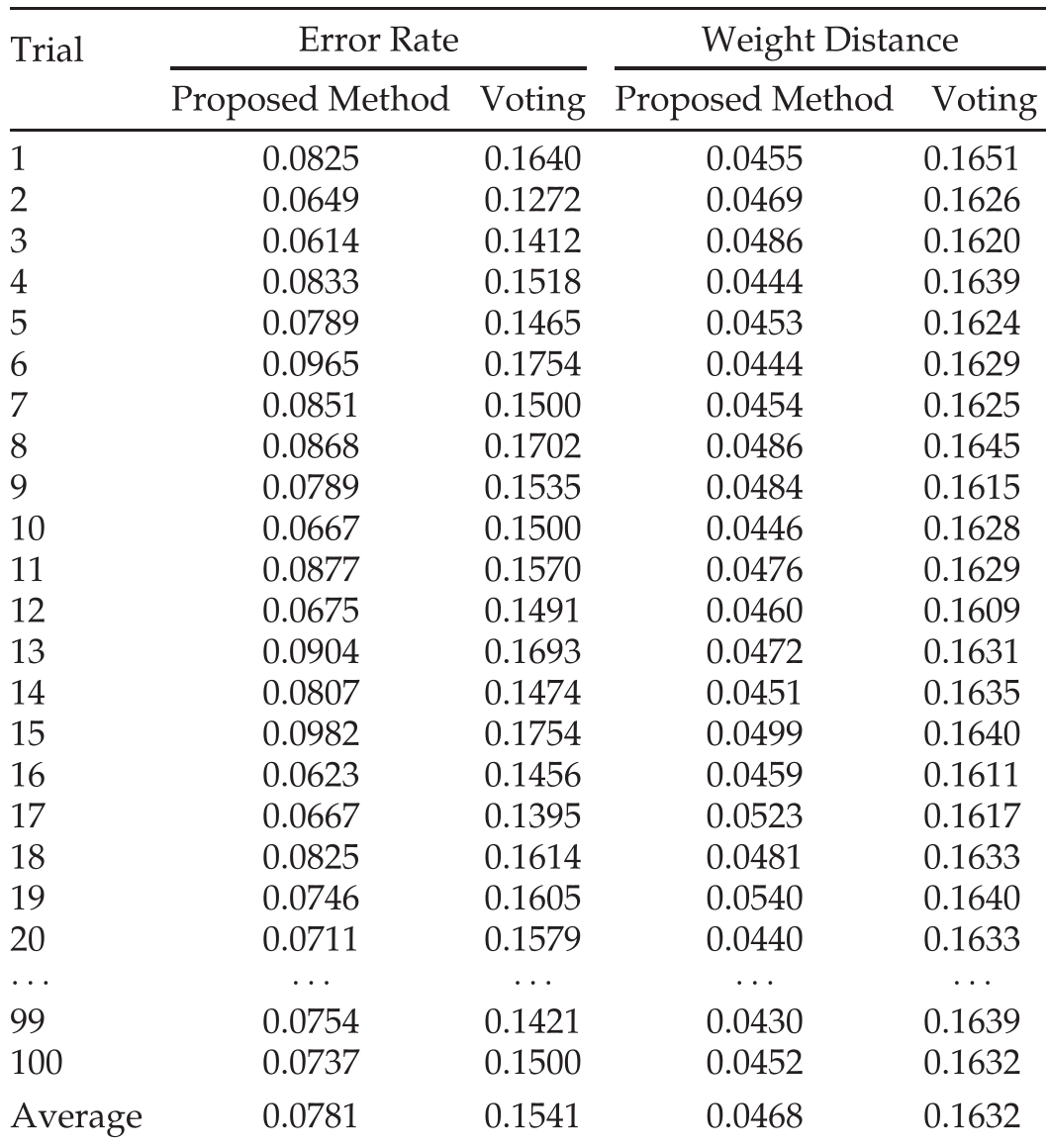
- Accuracy: In simulated trials where ground truth was known, the proposed method cut the error rate in half compared to majority voting.
- Diversity of Hardware: The study confirmed that different device brands (Nokia, Samsung, iPhone) show statistically significant differences in measurement reliability, justifying the need for per-user weighting.
- Scalability: By implementing the algorithm on Hadoop (MapReduce), they achieved a linear scaling property, making it viable for national-level real-time monitoring.
Deep Insights: Evolutionary Patterns
By applying this weighted aggregation, the authors uncovered fascinating "network signatures":
- Temporal Patterns: Quality in business districts drops during weekdays but spikes in residential areas during weekends.
- The "Data Plan" Effect: A massive quality dip is observed on the 1st of every month. Why? Users receive their new data quotas and immediately consume high-bandwidth content, creating a self-inflicted "crowded event."
- Weather Sensitivity: The system successfully detected quality degradation during heavy rain and fog, providing an automated way to correlate environmental factors with service drops.
Critical Analysis & Conclusion
This paper provides a robust bridge between Truth Discovery theory and Telecom Engineering. While the study focuses on 3G (RSCP and Ec/No metrics), the mathematical framework is agnostic to the underlying technology.
Future Outlook: As we move toward 5G and 6G, the density of cells increases, making traditional drive testing even more obsolete. The contribution of this paper—modeling the reliability of the crowd—will likely become a standard component of "Self-Organizing Networks" (SONs), allowing carriers to fix dead zones before the first customer even calls to complain.
Limitations: The model assumes user weights are relatively stable over a short period. In highly dynamic environments (e.g., a user moving between a stadium and a basement), a more granular, context-aware weight might be required.