
Weighted-Ring Similarity: Bridging the Gap Between Local and Global Community Detection
Weighted-Ring Similarity Measurement for Community Detection in Social Network
This paper introduces a "Weighted-Ring Similarity" measurement for community detection in social networks, utilizing Set Pair Analysis (SPA) to quantify node relationships. The authors propose the Two-Stage Community Detection Method (TSCDM), which combines ego-role-based initial partitioning with hierarchical clustering to achieve high-accuracy community mining at reduced computational costs.
TL;DR
Researchers have developed a new similarity metric called Weighted-Ring Similarity that considers not just direct neighbors, but also triangular, quadrilateral, and pentagonal loops in a network. Combined with a novel Two-Stage Community Detection Method (TSCDM), it enables faster and more accurate identification of community structures in complex social networks by balancing local efficiency with global structural insight.
The "Local vs. Global" Dilemma in Social Mining
Community detection is essentially a clustering problem: how do we group nodes that are more "similar" to each other than to the rest of the network?
- Global methods (like Katz or LHN index) look at all possible paths. They are accurate but fail on large networks due to high computational complexity.
- Local methods (like Jaccard or Cosine similarity) only look at immediate neighbors. They are fast but "blind" to the subtle structural ties that hold communities together.
The authors argue that the true "glue" of a social network lies in rings (loops). The more rings two people share, the closer their relationship. However, not all rings are equal.
Methodology: Set Pair Analysis & Weighted Rings
The core innovation lies in applying Set Pair Analysis (SPA) to graph topology. SPA treats node relationships as a combination of Identity (certainty), Diversity (uncertainty), and Opposition.
1. Defining the Rings
The paper defines four types of connections between nodes and :
- Bicyclic (): Direct connection.
- Triangular (): Shared neighbors.
- Quadrilateral (): Paths of length 3.
- Pentagonal (): Paths of length 4.
2. The Weighting Intuition
Simply counting rings isn't enough. The authors introduce the Aggregation Coefficient to weight these rings. If a node in a ring is highly "gregarious" (high clustering coefficient), its contribution to the similarity of that ring is weighted more heavily.
3. Two-Stage Algorithm (TSCDM)
To make this scalable, the authors propose a two-step process:
- Stage 1 (Ego-Role): Identify "Ego" nodes (central hubs) and perform a quick preliminary grouping. Complexity: .
- Stage 2 (Refinement): Use hierarchical clustering within these groups to finalize community boundaries.
(Note: The algorithm transitions from identifying an ego vertex to computing weighted-ring similarities for further division.)
Experimental Validation
The authors tested their approach on classic bencharks:
- Zachary’s Karate Club: A standard test for community detection.
- Dolphin Social Network: A graph of 62 dolphins and their associations.
Key Results:
| Network | Nodes/Edges | GN Modularity | TSCDM Modularity |
|---|---|---|---|
| Karate | 34/78 | 0.401 | 0.374 (3 comms) |
| USAir | 332/2126 | 0.136 | 0.323 |
| 1133/5451 | 0.532 | 0.506 |
While GN (Girvan-Newman) sometimes scores higher in pure modularity, TSCDM offers a significantly better balance of speed and accuracy, particularly on larger datasets like the USAir and Email networks where traditional GN becomes impractical.
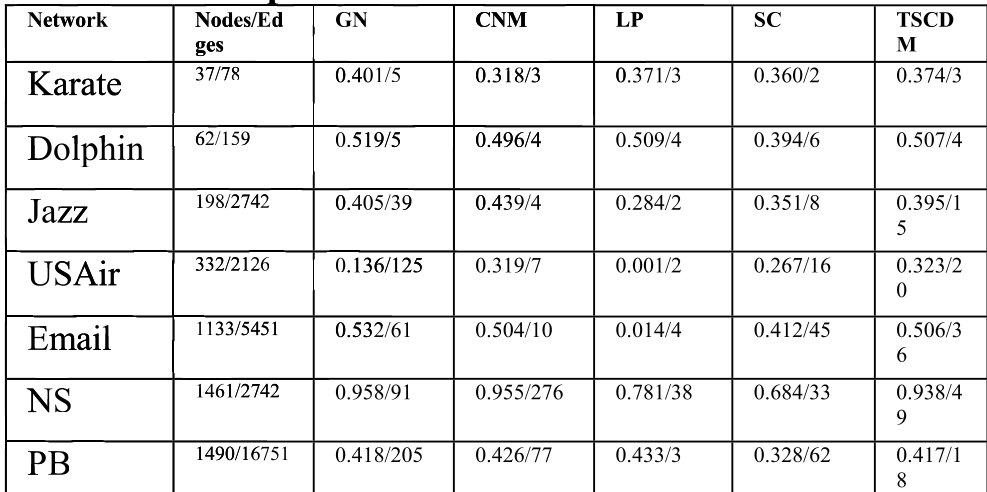 Table: Performance of TSCDM across various network scales.
Critical Insight & Future Work
The beauty of this work is its Inductive Bias: it assumes that social structures are built on "closure" (completing loops). By mathematically weighting these loops based on the local density of nodes, the model captures the "vibe" of a community better than simple neighbor counting.
Limitations:
- Complexity of Pentagons: Determining pentagonal rings significantly increases computation time.
- Trade-off: The first stage (Ego-detection) saves time but can slightly reduce precision if the pre-partitioning is too aggressive.
Future Outlook: Extending this to directed graphs and weighted edges (where link strength varies) is the next logical step for making this applicable to modern platforms like Twitter or LinkedIn.
Conclusion
The Weighted-Ring Similarity model proves that you don't need to see the "whole map" (global paths) to understand how communities form. By looking at local loops and weighting them intelligently, we can detect social clusters with high precision and efficiency.