
Wellness Representation in Social Media: Decoding Health through Heterogeneity and Time
Wellness Representation of Users in Social Media: Towards Joint Modelling of Heterogeneity and Temporality
The paper introduces a novel representation learning framework for Patient Generated Wellness Data (PGWD) from social media. It proposes a factorization-based approach that jointly models the heterogeneity of patient populations and the temporal progression of wellness attributes to learn low-dimensional user embeddings.
TL;DR
Social media is a goldmine for Patient Generated Wellness Data (PGWD), but mining it is notoriously difficult due to data sparsity and "noisy" user behavior. This paper proposes a specialized factorization framework that creates low-dimensional user embeddings by considering two critical biological priors: that health transitions are smooth over time (Temporality) and that every patient is unique even within the same disease category (Heterogeneity).
Background: The Hidden Value in Digital Health Footprints
When a diabetic user tweets their blood glucose levels or discusses a new medication, they contribute to a longitudinal record of their wellness. However, traditional machine learning views these as static snapshots. To truly understand a patient’s journey, we need a way to represent their state that accounts for the fact that health today depends on health yesterday, and that a Type I diabetic progresses differently than a Type II diabetic.
The Core Challenge: Why Standard Embedding Fails
Most representation learning (like PCA or standard NMF) assumes that samples are independent. In the wellness domain, this fails because:
- Longitudinality: Data is a sequence (a matrix per user), not a single vector.
- Heterogeneity: A "one-size-fits-all" latent space ignores the nuances of different patient cohorts.
- Sparsity/Missingness: Users don't post every day. Standard models treat missing data as zero, leading to biased results.
Methodology: The "Dirty Model" for Wellness
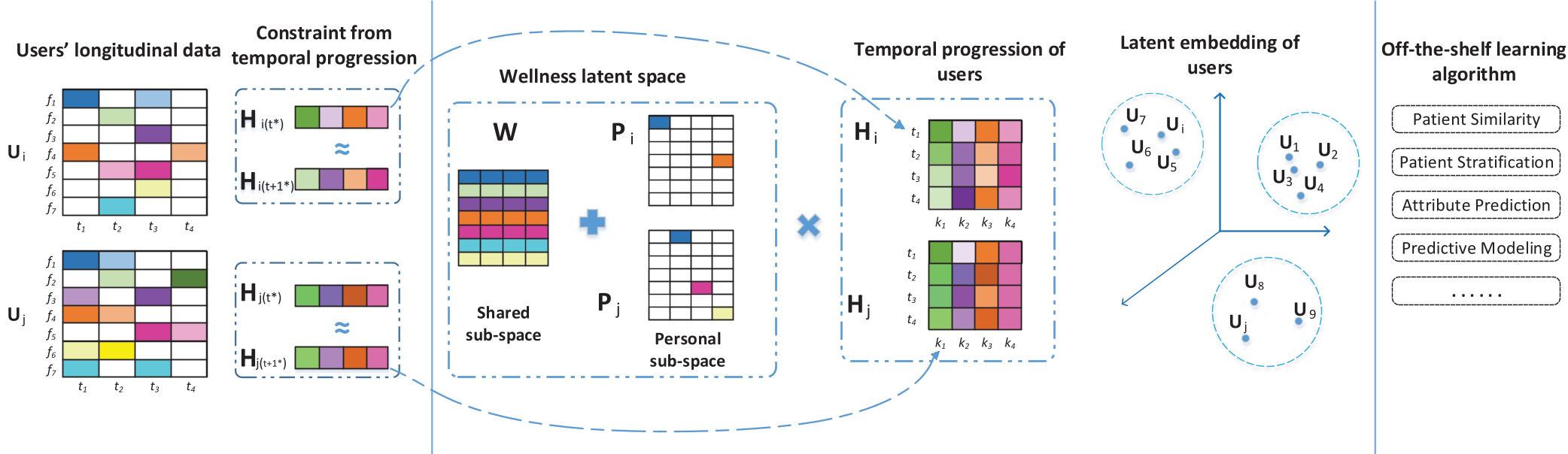
The authors propose a Personalized Latent Space (PLS) model. The mathematical intuition is to decompose the user’s longitudinal matrix () into a combination of a global wellness basis and a temporal progression matrix.
1. The Dual Latent Space
Instead of one global matrix , they use .
- (Shared): Captures the "consensus" features of the disease across the whole population.
- (Personalized): A sparse deviation matrix that captures a specific user's unique symptoms or reactions. This is inspired by the "dirty model" concept in multi-task learning, allowing the model to be both robust and specific.
2. Temporal Smoothing
To deal with missing data, the model includes a Temporal Smoothness Indicator (). It forces the representation at time to be close to time . This effectively "fills in the gaps" of missing tweets by assuming that wellness attributes don't change sporadically.
Experimental Battleground
The model was tested on two real-world datasets: a custom Twitter Diabetes Dataset (14k users) and a BG (Blood Glucose) Dataset.
Key Findings:
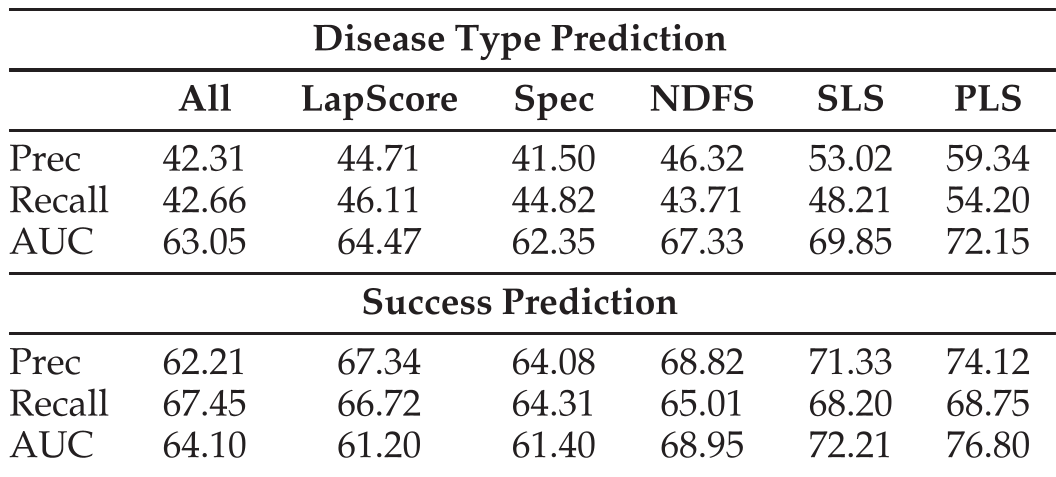
- Superior Accuracy: For Attribute Prediction (predicting Type I vs Type II), PLS achieved a Precision of roughly 59%, significantly higher than the 42% achieved using raw features (ALL).
- Success Prediction: When predicting if a user successfully manages their blood glucose, PLS outperformed standard feature selection methods (NDFS, LapScore) by a wide margin in AUC (76.8% vs 68.9% for the nearest competitor).
Ablation Study: What Matters Most?
The authors removed the temporal component (PLS-noTP) and the personalized component (SLS). The results confirmed that joint modeling is the key. Without temporal smoothing, precision dropped by nearly 10%, proving that "time" is a feature, not just a metadata field.
Visualizing the Latent Space
What does the model actually "see"? By looking at the top weights in the latent dimensions, the authors found clear clusters:
- Dimension 1 (Medication): Grouped terms like Insulin, Novolog, and Injection.
- Dimension 2 (Type II Specifics): Grouped Metformin, Weight loss, and Glucophage.
- Dimension 3 (Comorbidities): Grouped Heart disease, Surgery, and Hypertension.
Critical Insight & Conclusion
This paper demonstrates that the "Heterogeneity-Temporality" duo is essential for healthcare AI. By treating individual differences as sparse deviations from a shared norm, we can build models that are both globally informed and locally sensitive.
Limitations: The study relies on self-declared data for ground truth, which introduces a "survivor bias" (only users who talk about their disease are included). Future work could integrate multi-platform data (e.g., matching Twitter with Instagram) to provide a more holistic wellness profile.