
The Human Glue: How Migrants Literally Connect the Global Social Fabric
Who Ties the World Together? Evidence from a Large Online Social Network
2019-11-25
Summary
Problem
Method
Results
Takeaways
Abstract
This study utilizes de-identified data from billions of Facebook friendships to analyze the structure of global social ties. It demonstrates that migrants are the primary architects of international connectivity, with the "Who Ties the World Together" methodology revealing that long-term migration accounts for approximately 83% of all international social links.
## TL;DR
By analyzing billions of Facebook friendships, researchers have found that **83% of the world's international ties are formed by migrants**. Migrants act as "global brokers," significantly reducing the degrees of separation between humans across the planet. This study moves beyond trade and flight data to show that human mobility is the primary driver of a "smaller" world.
## The Invisible Architecture of Globalization
For decades, we’ve measured globalization through the movement of goods (trade) and money (FDI). But the true bedrock of international order is the **social tie**. Until now, we’ve seen the global network through a fog, using proxies like airline passenger counts or telecom traffic.
The central question of this research is: **Who actually ties the world together?** Using Facebook as a planetary-scale laboratory, the authors bridge the gap between individual behavior (micro) and global network structure (macro)—a challenge famously termed the "Coleman's Problem" in sociology.
## Methodology: Mapping the Global Broker
The study identifies migrants by comparing a user's self-reported "hometown" with their current geographic location (derived from IP signals). By categorizing ties into domestic and international, they analyzed:
1. **Network Integrity**: What happens to the global graph when migrants are removed?
2. **Betweenness Centrality**: Do migrants sit on the "highways" of information flow?
3. **Ego-Networks**: How do a migrant's personal friendships differ from a local's?
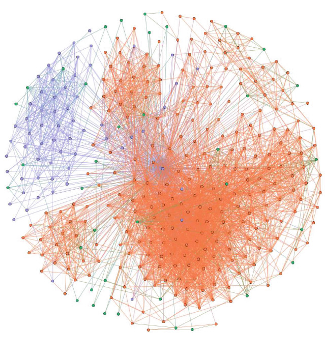
*Figure: Example ego networks showing how migrants bridge disjoint social clusters in two different countries.*
## Key Insights: The Migrant Advantage
The data reveals a striking bimodal distribution. Most locals have social circles that are almost entirely domestic (90%). In contrast, migrants are the "connective tissue" of the planet.
### 1. Scaling the "Small World"
The researchers performed a simulation: they created a "Locals-Only" graph and a "Locals + Migrants" graph. Even though the second graph had more nodes, its **average shortest path was shorter**. Adding migrants effectively "folds" the global graph, bringing distant nodes closer together.
### 2. Brokers of Information
While migrants often have a slightly lower total number of friends (lower degree), they possess much higher **Betweenness Centrality**. This means that if you want to send information from Country A to Country B, the shortest path almost certainly passes through a migrant.
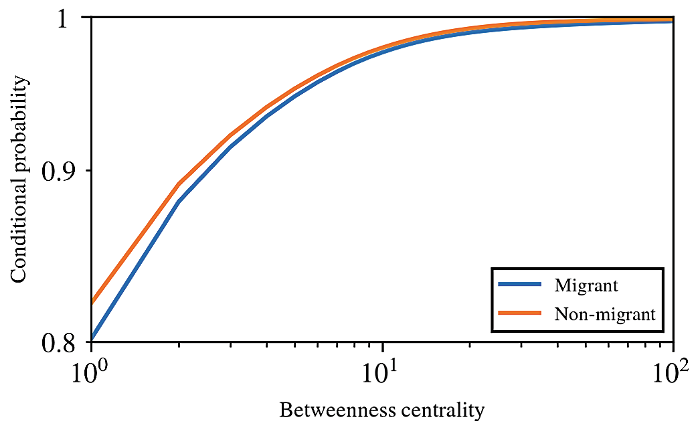
*Table: Migrants route significantly more inter-country shortest paths (6.25) compared to locals (3.79).*
### 3. Structural Holes and Triadic Closure
The researchers observed that migrants occupy "structural holes." Their networks are split between their origin and destination. While these two clusters are internally dense, they only meet at the migrant. This position allows migrants to act as local network bridges, facilitating the flow of diverse information that would otherwise remain trapped in regional silos.
## Critical Analysis & Future Outlook
This research confirms that migration is not just a demographic phenomenon—it is a structural necessity for a connected world. However, the study acknowledges a **privacy-reproducibility tension**: the data used is proprietary and highly sensitive, making it difficult for independent academics to verify every nuance without industry partnership.
**The Takeaway:** As we move into an era of potential "de-globalization," understanding that 83% of our international social fabric relies on human mobility is crucial. Any policy that restricts migration doesn't just change population counts; it effectively "widens" the distance between nations by severing the bridges that hold the global network together.
## Future Work
The authors suggest investigating how these social bridges influence other domains:
* **News Consumption**: Do migrants act as "gatekeepers" for international news?
* **Cultural Diffusion**: How do migrants help local artists achieve global popularity?
* **Economic Impact**: Tracking how these specific social ties translate into international trade opportunities.