
WiBro vs. TD-LTE: A Social Network Anatomy of a Standards War
Comparison of WiBro and TD-LTE through the social network analysis
This paper utilizes Social Network Analysis (SNA) to compare the global deployment of WiBro (Mobile WiMAX) and TD-LTE standards. It reveals that TD-LTE succeeded while WiBro failed due to the strategic involvement of massive stakeholders like China Mobile and top-tier global equipment vendors.
TL;DR
Why did WiBro, once the darling of the South Korean "IT powerhouse" era, lose to TD-LTE? This paper uses Social Network Analysis (SNA) to prove that TD-LTE's victory wasn't just about technology—it was about the quality and centrality of its allies. By securing China Mobile and global gear giants like Ericsson, TD-LTE created an unstoppable gravity well that WiBro's fragmented network could not match.
The Paradox of Widespread Failure
In 2007, WiBro (Mobile WiMAX) seemed destined for greatness. It was an ITU standard, had faster peak speeds than 3.5G HSPA, and was deployed across nearly every continent. However, by 2013, the market shifted decisively toward TD-LTE.
The authors identify a critical insight: Widespread deployment does not guarantee survival. WiBro's network was large but comprised many smaller players and Internet Service Providers (ISPs). In contrast, TD-LTE focused on the "structural holes" of the industry—connecting with the players who controlled the most resources.
Methodology: Mapping the Power Centers
The study uses two primary metrics to analyze the "form" of these industrial interactions:
- Degree Centrality: Simply counting how many partners a firm has (quantity).
- Eigenvector Centrality: Measuring how "connected" a firm's partners are (quality/influence).
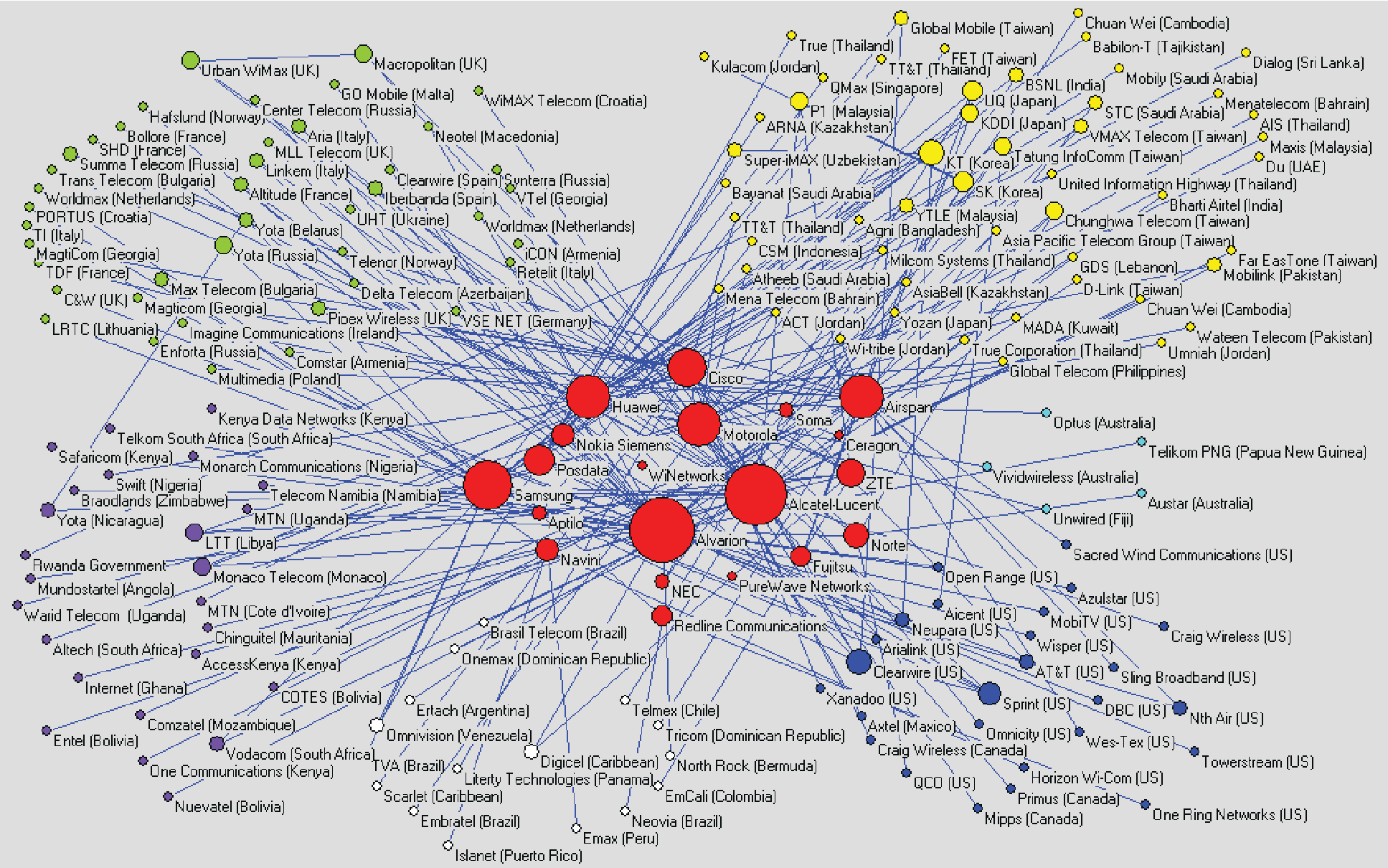 Figure 1: The WiBro network was broad but lacked a dominant, central gravitational force compared to TD-LTE.
The "China Factor" and Vendor Commitment
The data reveals three massive structural differences that led to TD-LTE's dominance:
1. The Power of China Mobile
The TD-LTE network is significantly more centralized (24% vs 19% for WiBro). At the heart is China Mobile, the world's largest operator. Their massive purchasing power (tendering for 207,000 base stations in a single go) forced global vendors to pivot.
2. Top-Tier Vendor Participation
Top-tier vendors like Ericsson and Nokia Siemens completely ignored WiBro but were central to TD-LTE. Why? Hardware compatibility. TD-LTE shares a high portion of software and hardware with LTE-FDD, making the "cost of entry" lower for these giants.
3. The Cannibalization Trap
In South Korea, incumbents like SK Telecom were passive about WiBro because they feared it would "cannibalize" their existing HSDPA voice revenue. Because TD-LTE was integrated into the LTE roadmap of the incumbents, this resistance was minimized.
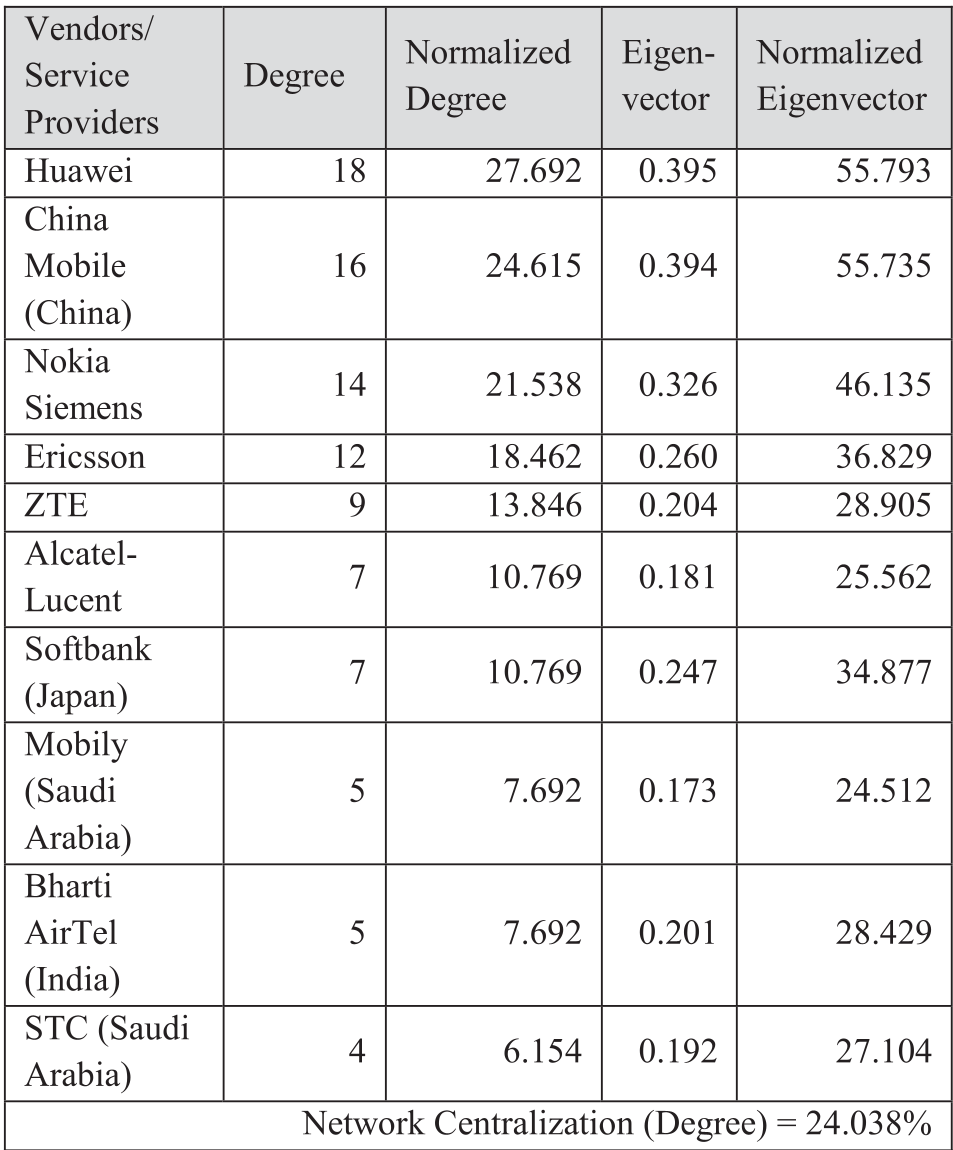 Table 1: Note the high Eigenvector Centrality for China Mobile and Huawei, indicating their role as "kingmakers" in the TD-LTE ecosystem.
Critical Insights & Future Outlook
The "takeaway" for policymakers and tech firms is clear: Network composition is a resource.
- Strategic Alliances: If you are launching a new standard, you must partner with players who have "Massive Purchasing Power."
- Incentive Alignment: Governments must grant licenses to operators who are not already invested in a competing standard to avoid the "incumbent's trap" of underinvestment.
As we move into the 6G era, this paper serves as a historical warning: technical superiority is secondary to the social and economic density of your alliance network.
Limitations
The study relies on publicly available transaction data (MOUs and contracts) which might not capture the full extent of internal R&D shifts. Future research involving direct interviews with CTOs from this era is needed to validate the "cannibalization" psychological factors.