
ECG Biometrics: The Heartbeat as Your Next Digital Signature
14992_Wide Machine Learning Algorithms Evaluation Applied to ECG Authentication and Gender Recognition.
The paper evaluates a wide range of Machine Learning algorithms for ECG-based personal authentication and gender recognition. Using two major datasets (ECG-ID and CYBHi), the authors achieved peak accuracies of 99.9% for authentication using Bagged Trees and 95.1% for gender recognition using Fine k-NN.
TL;DR
Researchers have successfully demonstrated that your heartbeat is as unique as a fingerprint but much harder to fake. By evaluating 20 different machine learning algorithms, this study achieved 99.9% accuracy in identifying individuals and 95.1% accuracy in recognizing their gender using nothing but ECG (Electrocardiogram) signals. This paves the way for "hidden biometrics" that can continuously authenticate you on your smartphone without you ever lifting a finger.
Context: Why Your Heart?
Standard biometrics like FaceID or TouchID have a fatal flaw: they are "static" and can often be spoofed with high-resolution photos or 3D molds. More importantly, they aren't "continuous"—once you unlock your phone, it stays unlocked.
ECG biometrics offer several unique advantages:
- Liveness Detection: An ECG signal inherently proves the user is alive.
- Difficulty to Copy: Unlike a face or voice, an interior cardiac signal cannot be captured from a distance.
- Continuous Authentication: As long as you are wearing a sensor (like a smartwatch), the system can keep verifying your identity in the background.
The Technical Challenge: Variability
The major hurdle in ECG processing is that the signal's amplitude changes depending on where the electrodes are placed and the user's physical state. Previous works often used complex, high-dimensional feature sets that were too heavy for mobile processors.
The authors solved this by:
- Dynamic Thresholding: Implementing a median windowing technique that adjusts the R-peak detection based on the current sample's amplitude.
- Simplified Fiducials: Reducing the feature set to just 11 core temporal and amplitude points (the P-Q-R-S-T peaks).
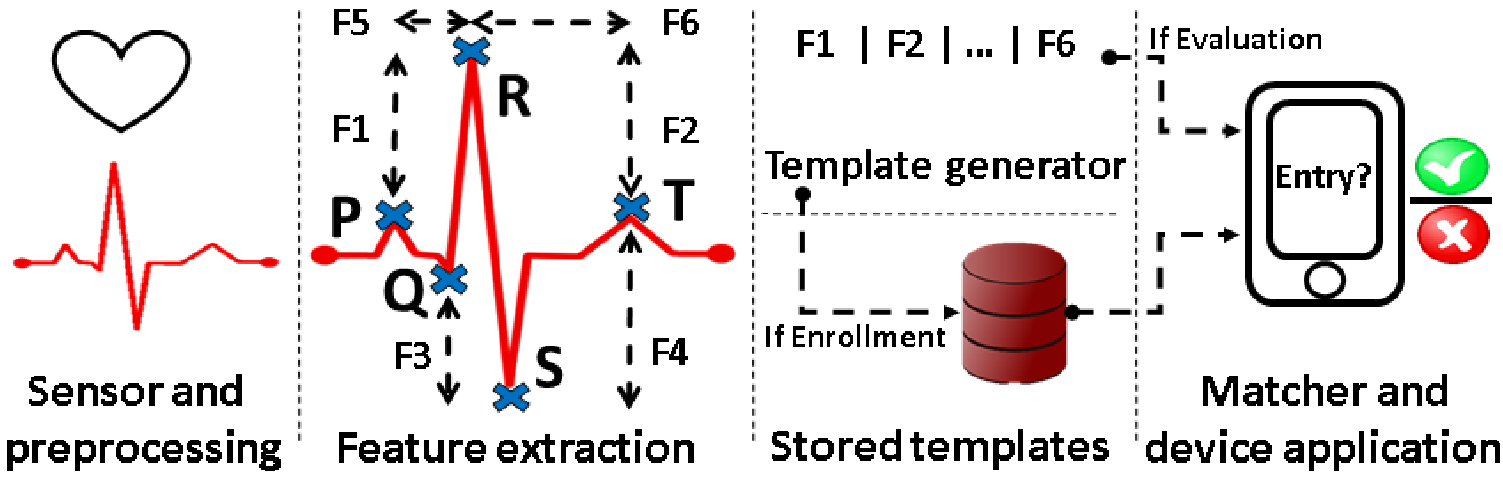
Methodology: The Workflow
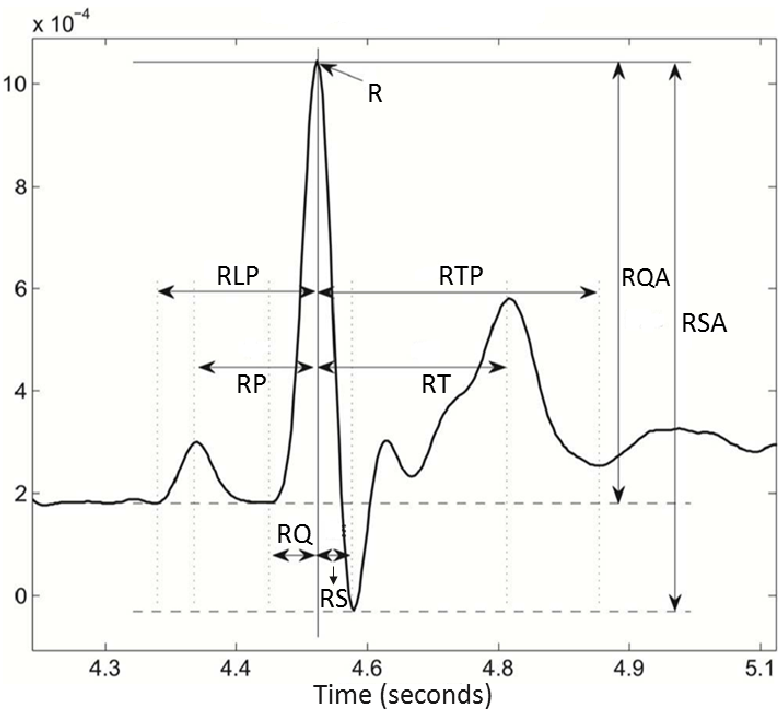
The researchers used the Pan-Tompkins algorithm for real-time QRS complex detection. After filtering out baseline noise and powerline interference, they extracted variables like the distance between the R-peak and the T-peak (RT) and the amplitude of the Q and S waves.
The Feature Set
The feature vector (FV) focuses on the geometry of the heartbeat:
- Temporal indices: RP, RQ, RS, RT, etc.
- Amplitude distances: RQA and RSA.
Benchmarking the Best Classifiers
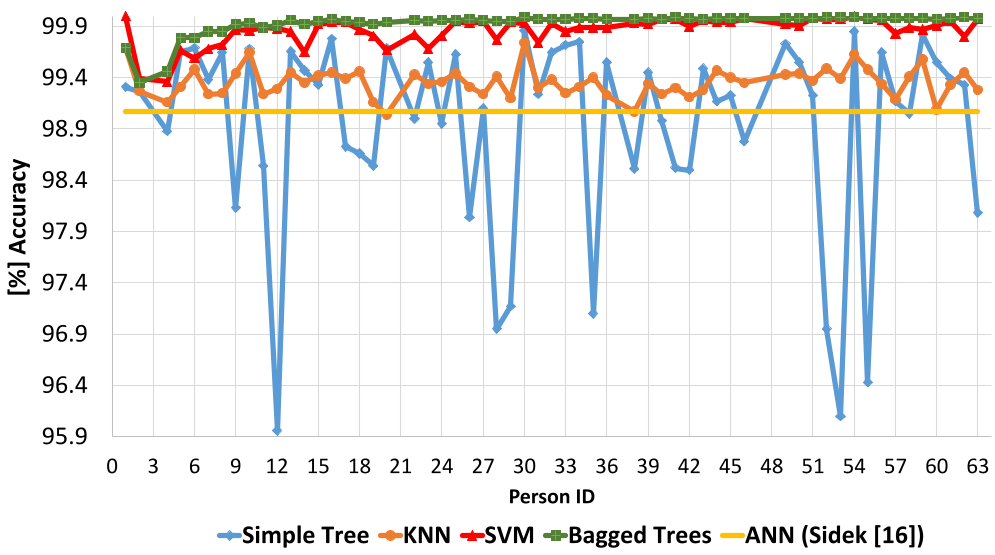
The study puts 20 algorithms to the test. While Bagged Trees achieved the absolute highest accuracy (99.93%), the authors noted its high computational cost. For real-world smartphone applications, they recommend Fine k-NN or Gaussian SVM, which provide comparable accuracy (99%+) with much lower complexity.
A Novel Twist: Gender Recognition
Perhaps the most innovative part of this research is the use of ECG for Gender Recognition. Men and women have subtle physiological differences in heart behavior. By applying the same 11 features to this task, the Fine k-NN model correctly identified gender with 95.1% accuracy. This "soft biometric" can be used to add an extra layer of security or to personalize user experiences in e-health applications.
Critical Insight & Conclusion
This paper proves that we don't need massive neural networks to achieve high-accuracy biometrics. By carefully selecting fiducial features and using traditional ML algorithms like SVM and k-NN, we can achieve nearly perfect authentication tailored for the low-power constraints of IoT and mobile devices.
Future Outlook: The next step for this technology is Multimodal Fusion—combining your identity, gender, and even your current stress level (heart rate variability) into a single, unbreakable digital identity.