
Resilience in the Dark: How Social-Aware P2P Overlays Survive National Internet Disconnection
Wide-Scale Internet Disconnection: Impact and Recovery on Social-Based P2P Overlays
This paper investigates the impact of wide-scale Internet disconnection (e.g., national censorship or disasters) on Peer-to-Peer (P2P) overlays. It proposes a "Social-aware" unstructured overlay that leverages social proximity and geographical routing, achieving superior resilience and routability compared to traditional structured overlays like Chord in extreme partition scenarios.
TL;DR
When a government pulls the "kill switch" on the Internet or a disaster severs a region's fiber optics, centralized services (Twitter, Facebook) vanish. This paper proves that traditional P2P systems like Chord fail in these isolated islands. However, by shifting to a Social-Aware Overlay—where links are based on trust and routing is guided by geography—we can recover up to 97% of local connectivity even when completely cut off from the global web.
The Problem: The "Kill Switch" and the Failure of Structure
We usually think of P2P networks (like BitTorrent or DHTs) as indestructible. While they handle random node departures well, they are surprisingly fragile against geographically correlated failures.
In a national blackout (e.g., Egypt 2011), a specific physical region is isolated. A node in Cairo using Chord (a structured DHT) might have "fingers" pointing to IDs in New York, London, or Tokyo. When the border is cut, nearly all those links break. The researchers found that if the isolated region represents less than 2.5% of the global network, the internal routability of Chord drops to zero.
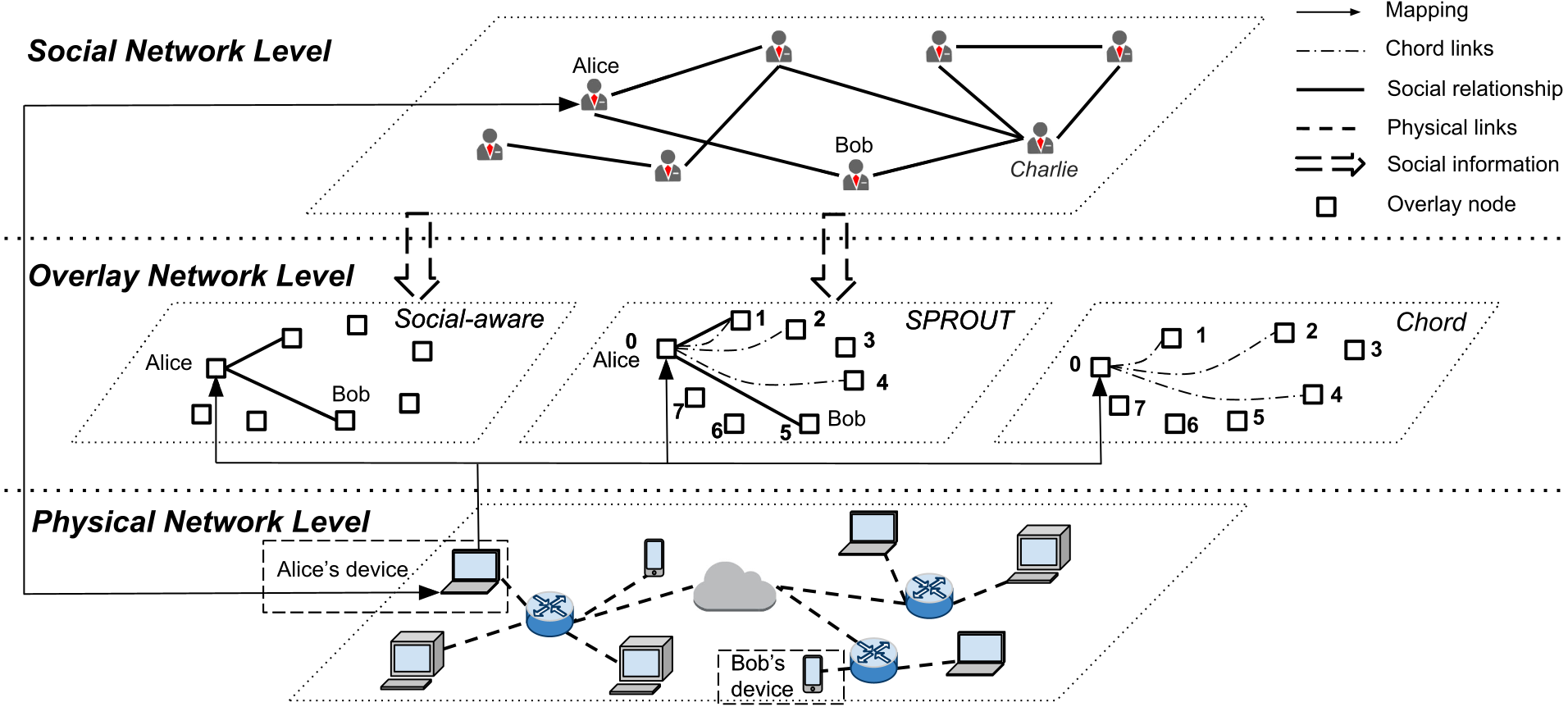
The Insight: Social Proximity is Geographical Proximity
The authors' core observation is that social networks follow spatial laws. You are significantly more likely to be friends with someone in your own city than someone across the globe. By building the P2P overlay on social links rather than random hashes:
- Connectivity Remains: Most "friend" links stay within the isolated region.
- Trust: It mitigates Sybil attacks (fake nodes) since links are based on real-world trust.
Methodology: Social-Aware Routing & Bootstrapping
The paper introduces the Social-aware overlay, an extension of SocialVPN. It departs from DHTs in two radical ways:
1. Geographical Routing
Instead of routing toward a "Key ID," the system routes toward a "Location." If Alice wants to message Bob, she forwards the packet to a friend who is geographically closer to Bob’s last known coordinates.
2. Social Bootstrapping under NAT
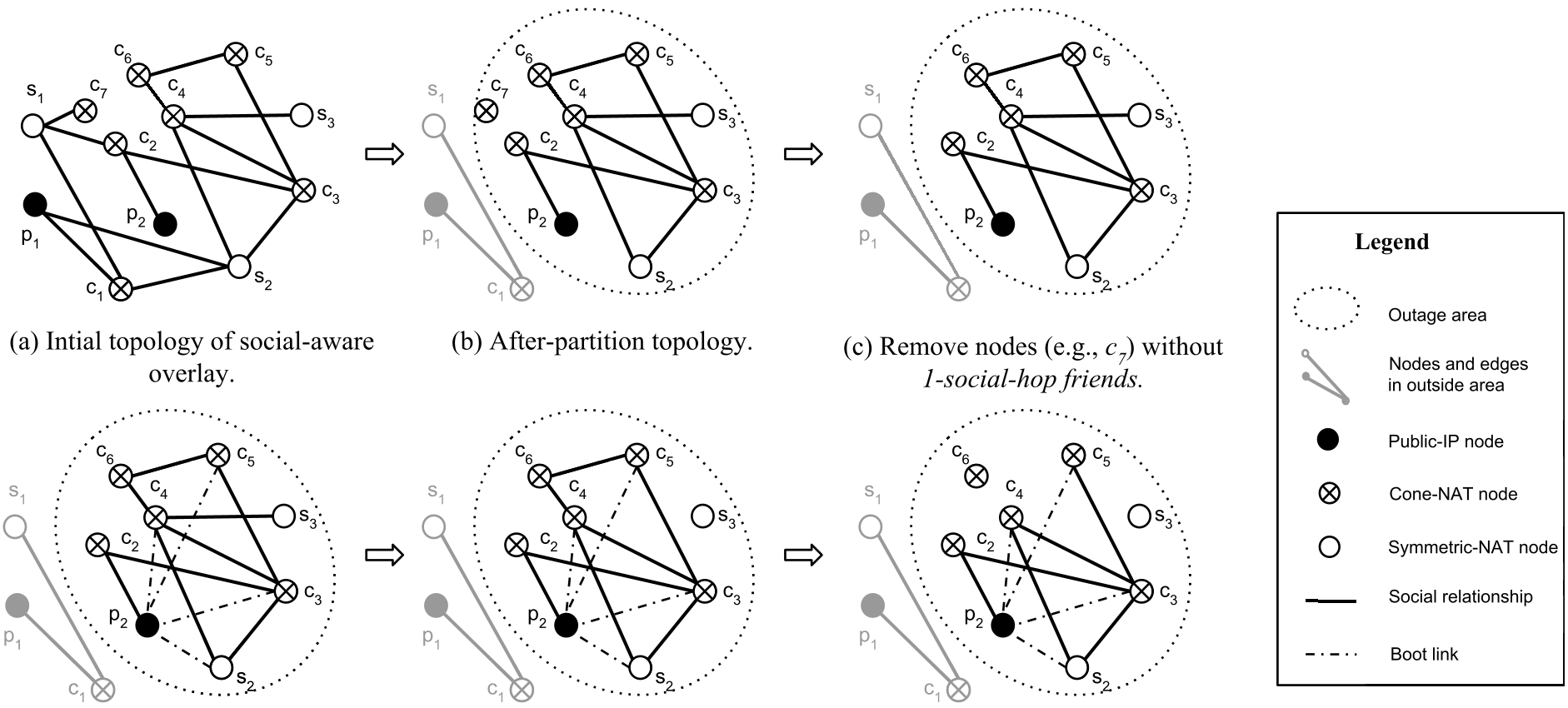
A major hurdle in P2P is NAT/Firewall traversal. Traditional STUN/TURN servers are usually hosted on the global Internet. If the global net is gone, nodes can't find each other. The authors propose that nodes maintain a "Boot-list" of socially trusted friends who have public IP addresses within their same region. These friends act as local STUN/TURN relays to bridge users behind NATs.
Performance: Can We Actually Talk?
The researchers used data from Foursquare to test these theories.
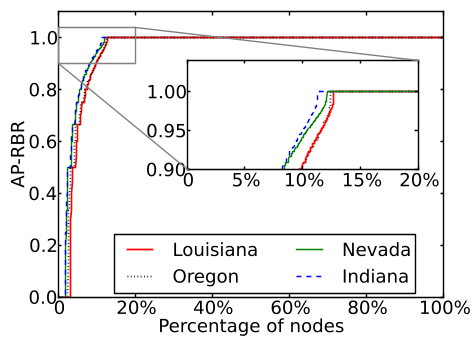
- Topological Connectivity (AP-TFP): While adding social links to Chord (SPROUT) helps, the unstructured Social-aware overlay provides a much more robust "mesh" for local communication.
- Routing Success (AP-RFP): In a partition like Indiana (1.2% of nodes), the Social-aware overlay maintained high reachability between n-hop friends, whereas Chord was a total failure.
- Bootstrapping: Even with 92% of nodes behind NATs, 90-97% of nodes could successfully enter the overlay and reach their neighbors using the local social boot-nodes.
Deep Insight & Conclusion
The real take-away from this work is a shift in P2P design philosophy. For a global system, structure (DHTs) provides efficiency. But for resilience and local survival, lack of structure (social meshes) is far superior.
Limitations: The study assumes we know our friends' locations and that some public-IP infrastructure remains functional within the blackout zone. In a total power failure or a complete local signal jam, even these social links would struggle.
Future Outlook: This research paves the way for "Civilian Mesh Networks"—applications that sit on your phone and automatically switch to social P2P mode the moment the main grid goes down, ensuring that at least our local communities remain connected.