
Wifigrams: Redefining Indoor Localization Through the Lens of Social Network Analysis
Wifigrams: Design of Hierarchical Wi-Fi Indoor Localization Systems Guided by Social Network Analysis
The paper introduces "Wifigrams," a novel graph-based framework for indoor Wi-Fi localization that treats physical locations as nodes in a social network. By applying Social Network Analysis (SNA) and community mining, it achieves a SOTA hierarchical classification accuracy of 73.62% using a Weighted Fast Modularity and SVM pipeline.
TL;DR
Researchers have developed a system called Wifigrams, which treats indoor physical locations like users in a social network. By analyzing how different spots "share" Wi-Fi Access Points (APs), the system automatically clusters an environment into logical zones. This hierarchical approach improves localization accuracy to 73.62%, significantly outperforming traditional clustering and flat classification methods.
The Problem: The "Expert" Bottleneck
Indoor localization using Wi-Fi fingerprinting is a standard task, but as environments scale (like university wings or hospitals), the classification problem becomes high-dimensional and messy. Usually, we solve this by dividing the building into sub-regions.
The catch? Doing this manually is a nightmare for developers, and simple geometric clustering (like K-means) doesn't account for how radio signals actually behave. Signals don't stop at arbitrary grid lines; they bleed through walls and create complex patterns of "co-visibility."
Methodology: Locations as Social Entities
The core innovation of this paper is the Wifigram. If two locations "see" the same set of Access Points, they are "friends" in the network.
- Visibility Matrix: First, the system tracks which APs are visible from each reference point ().
- Co-visibility Graph: A link is created between and based on the number of APs they both detect.
- Pathfinder Scaling: Since the initial graph is too dense (everyone is connected to everyone), the authors use the Pathfinder algorithm to prune redundant links that violate the triangle inequality.
- Community Mining: Here is the "Social" part. The Fast Modularity (FM) algorithm identifies groups of locations that are more densely connected to each other than to the rest of the building. These clusters naturally form the "zones" for a hierarchical classifier.
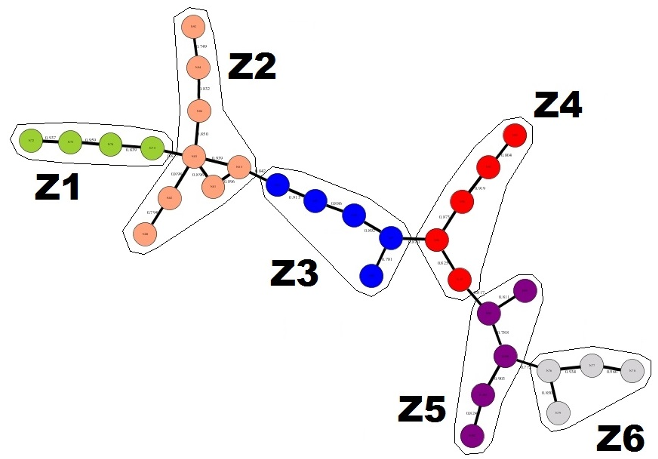 Figure: Wifigrams showing automatic zone discovery via Weighted FM community mining.
Experiments and Results
The authors tested this in the West Sector of the Polytechnic School at UAH, a complex environment with 31 topological locations. They compared several classifiers (K-NN, FURIA, and SVM) across different environment division strategies.
Key Breakthroughs:
- The Hierarchy Advantage: Moving from a "Flat" SVM (64.87%) to an SNA-based Hierarchical SVM (73.62%) provided a nearly 9% boost in accuracy.
- Better than K-means: While K-means is common, the Weighted FM approach yielded better spatial boundaries that align with actual signal propagation, resulting in higher precision.
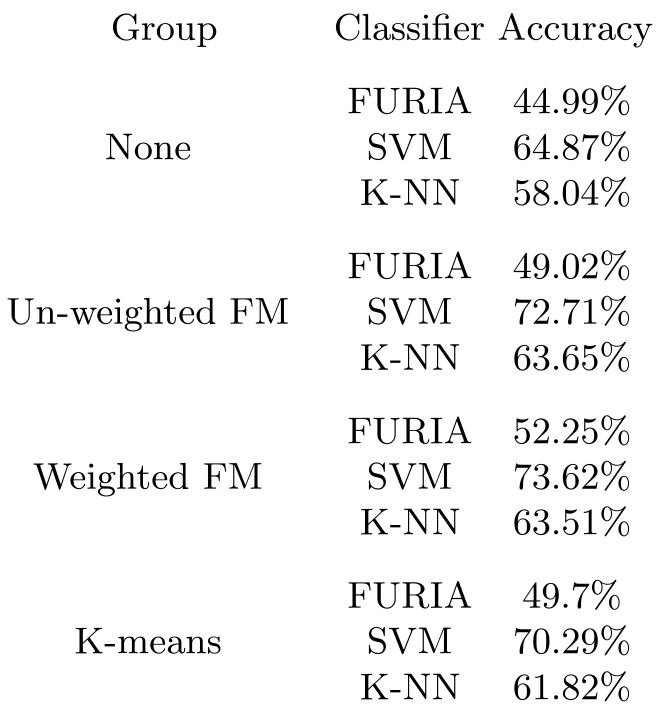 Table: Comparison of accuracy across different clustering and classification methods.
Critical Insight: Why Does This Work?
Traditional localization tries to map signals to coordinates. Wifigrams instead maps signals to topological relationships.
By using Social Network Analysis, the authors tap into the latent structure of the environment. The "communities" detected by the algorithm often correspond to physical corridors or rooms, but they are defined by radio reality rather than blueprints. This provides a "human-friendly" symbolic localization—robots and humans can both understand that a device is in "Zone A" (e.g., the north corridor) before pinpointing the exact meter.
Conclusion & Future Work
Wifigrams offer a powerful, automated way to design hierarchical localization systems. By removing the need for manual site partitioning, this method makes large-scale deployments much more feasible.
Future directions suggested by the authors include using centrality measures to identify "landmark" nodes—specific locations that are critical for navigation because they act as signal hubs. This could lead to even more adaptive and robust indoor GPS-like systems.