
BOK Constructor: Harnessing Collective Intelligence to Map New Academic Frontiers
A Wiki-based collective intelligence approach to formulate a body of knowledge (BOK) for a new discipline
This paper introduces the "BOK Constructor," a wiki-based collaborative environment designed to formulate a Body of Knowledge (BOK) for emerging disciplines like Social Informatics. It proposes the "BOK+" principle, leveraging Semantic MediaWiki (SMW) and collective intelligence to build academic structures through a bottom-up methodology.
TL;DR
When a new field of study emerges—like Social Informatics—no single expert holds the "master map." This paper proposes replacing traditional top-down curriculum design with the BOK Constructor, a semantic wiki-based system that allows a community to build a "Body of Knowledge" (BOK) from the ground up by linking raw research materials to conceptual trees.
The "New Discipline" Dilemma
In established fields like Computer Science, the CSBOK was created by a task force of authorities. They knew the boundaries of the field and could simply "break down" the knowledge into categories (Top-Down).
However, for a new discipline:
- Nobody has the full picture: Definitions are fluid and expertise is fragmented.
- Interdisciplinary Friction: Concepts from different fields (e.g., Sociology and IT) may overlap or conflict.
- The Cold Start Problem: Without a BOK, it is nearly impossible to design a standardized university curriculum.
The authors argue that we need a bottom-up approach, treating the definition of a discipline as an act of Collective Intelligence.
Methodology: The BOK+ Principle
The core innovation is BOK+, a triad of linked resources that transform raw data into a structured academic discipline.
- Material Class: The "Raw Evidence." These are PowerPoint slides, research articles, and books.
- Description Class: The "Knowledge Layer." Wiki pages where users describe academic topics based on the Materials.
- BOK Class: The "Structural Layer." A three-tiered conceptual tree (Area -> Unit -> Topic) that organizes the descriptions.
System Architecture
The BOK Constructor acts as an intelligent wrapper around Semantic MediaWiki (SMW). It doesn't just store text; it stores relationships.
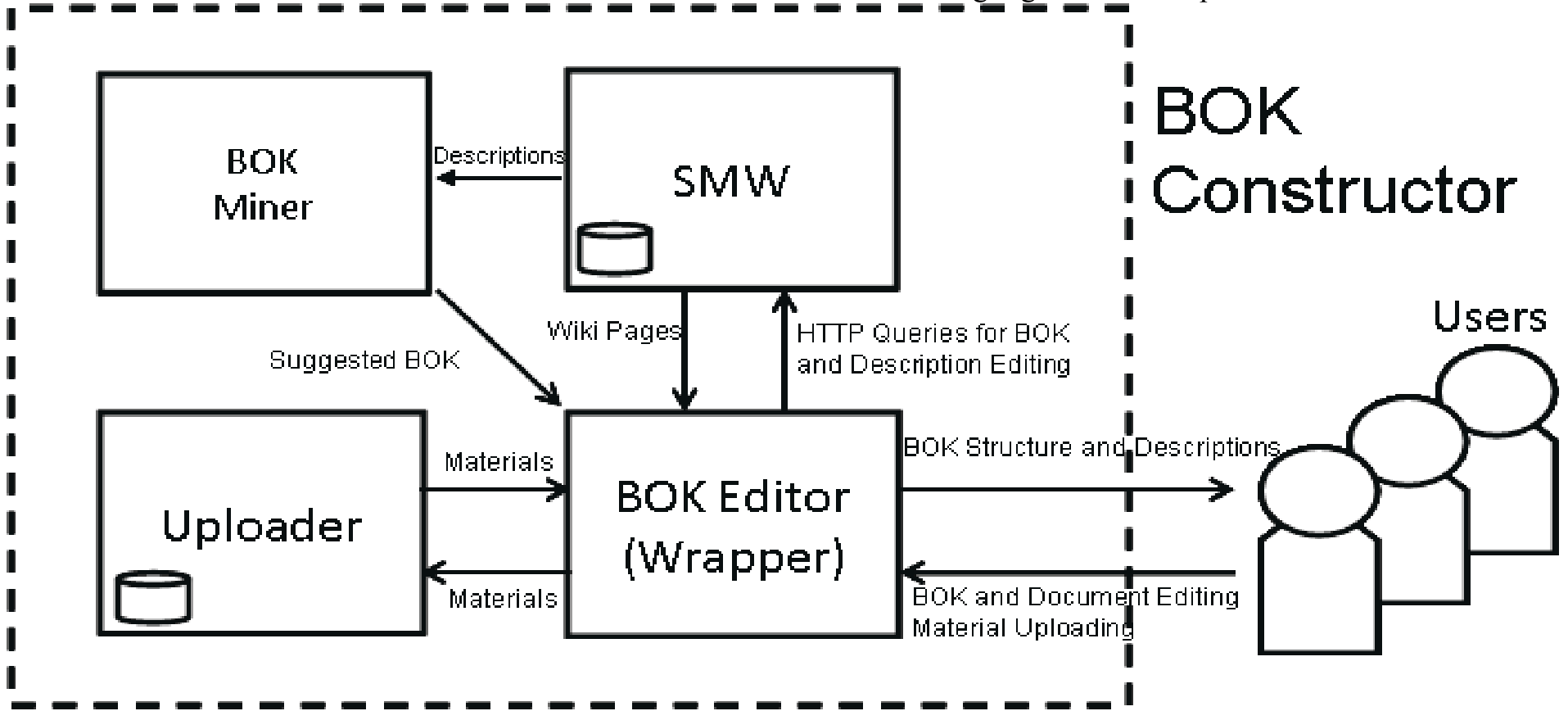 Figure 5: The BOK Constructor consists of an Editor, Uploader, and the SMW core.
Why This Works: Semantic Integration
The BOK Constructor doesn't just build a folder structure; it handles the complexities of language through three specialized views:
- Main Editor: A WYSIWYG interface for building the tree.
- Description-Material Linker: Ensuring every claims has "receipts" (linkage to actual research papers).
- BOK Nodes Linking: This is crucial for interdisciplinary work. It allows users to define Synonyms and Homonyms, preventing confusion when different departments use the same word to mean different things.
 Table 3: The metadata schema for BOK nodes, including Hypernyms and Hyponyms for semantic depth.
Experiments: Testing against the Giants
To prove the system's robustness, the authors didn't just test it on Social Informatics. They used it to model:
- CSBOK (Computer Science): Recreating the established 14-area tree.
- Library of Congress Classification (LCC): Modeling the "Social Sciences" (Class H) hierarchy.
The system handled hundreds of wiki pages and complex node moves without breaking the semantic integrity of the tree. This validation suggests that the tool is ready for "live" collaborative discipline formulation.
Critical Insight & Future Outlook
While the current prototype is powerful, its true potential lies in the proposed BOK Miner. The authors envision a future where Wikipedia Mining or AI could "seed" a BOK by analyzing existing web data, providing a draft for human experts to then refine.
The Takeaway: As the pace of technological change accelerates, new "hybrid" disciplines will emerge faster than committees can meet. Tools like the BOK Constructor provide the necessary infrastructure to democratize the definition of knowledge itself.
Disclaimer: This analysis is based on the 2010 WikiSym paper. Future iterations likely involve more advanced LLM-based mining techniques.