
The Corporate Wiki: Mirroring Wikipedia’s Success within the Enterprise Walls
13136_Wiki deployment in corporate settings.
This study investigates the deployment and adoption of wikis within a corporate setting, specifically benchmarking IBM's internal "wiki farm" against Wikipedia. The research demonstrates that corporate wikis can achieve rapid, voluntary growth comparable to public mass collaboration projects, achieving over 142,000 pages within 16 months of operation.
TL;DR
Can the "wild west" of collaborative editing succeed inside a structured corporation? This study analyzes IBM's massive internal wiki deployment, revealing that corporate wikis can actually grow faster than Wikipedia itself. The secret sauce isn't management pressure, but rather individual enjoyment and the flexibility of the platform to replace outdated communication tools.
Problem & Motivation: The Conflict of Cultures
The success of Wikipedia is often attributed to the "wisdom of crowds"—the idea that a massive, diverse population can self-regulate and create high-quality content. However, corporate environments are the polar opposite: they are typically small, homogeneous, and governed by "command-and-control" management.
The authors set out to solve a fundamental tension: Can a tool built on openness and non-attribution survive in an environment built on hierarchy and accountability? Before this study, data on corporate wiki adoption was anecdotal at best. IBM, with its 350,000+ employees and early-adopter culture, provided the perfect laboratory to test this.
Methodology: Benchmarking the Blue Giant
The researchers didn't just look at usage; they compared IBM’s internal trajectory directly against the gold standard of wikis: Wikipedia.
- Data Source: A survey of 919 IBMers across 486 wikis.
- Baseline: "Full operation" was defined as any point after the first 5,000 pages were created.
- Metrics: They measured "Job Impact," "Organizational Impact," and "Motivational Drivers" using 5-point Likert scales.
Architecture of Collaboration
IBM implemented a "wiki farm" model, allowing any employee to instantaneously spawn their own wiki instance. This decentralized approach bypassed traditional IT bottlenecks, mirroring the organic growth of the public internet.
Results: Faster than Wikipedia?
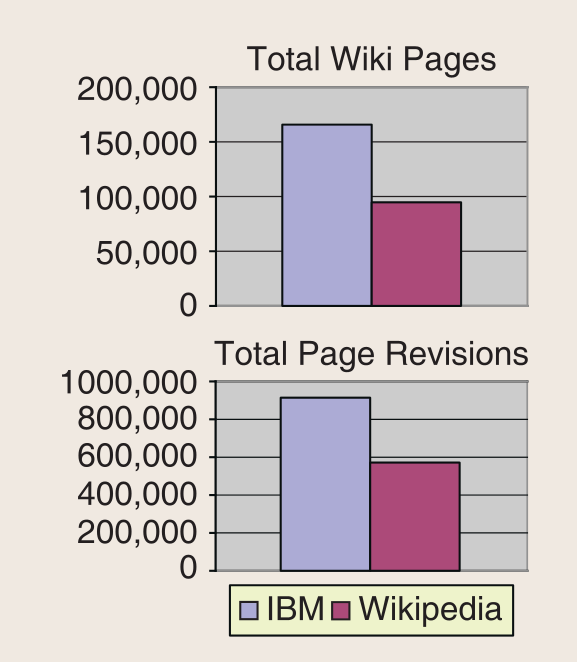
The results were staggering. In its first 16 months of active operation, IBM’s wiki ecosystem generated 142,000 pages and 920,000 revisions. For context, Wikipedia—at the same age—had only 94,000 pages and 570,000 revisions.
The "Enjoyment" Factor
Perhaps the most surprising finding was why people contributed. In public wikis, people contribute for fun or social standing. In corporations, we assume people contribute because they are told to. However, the study showed:
- Enjoyment (4.06/5): The single highest motivator.
- Social Pressure (2.73/5): Practically irrelevant.
- Job Impact (4.15/5): Users felt the wiki was essential for their daily tasks.
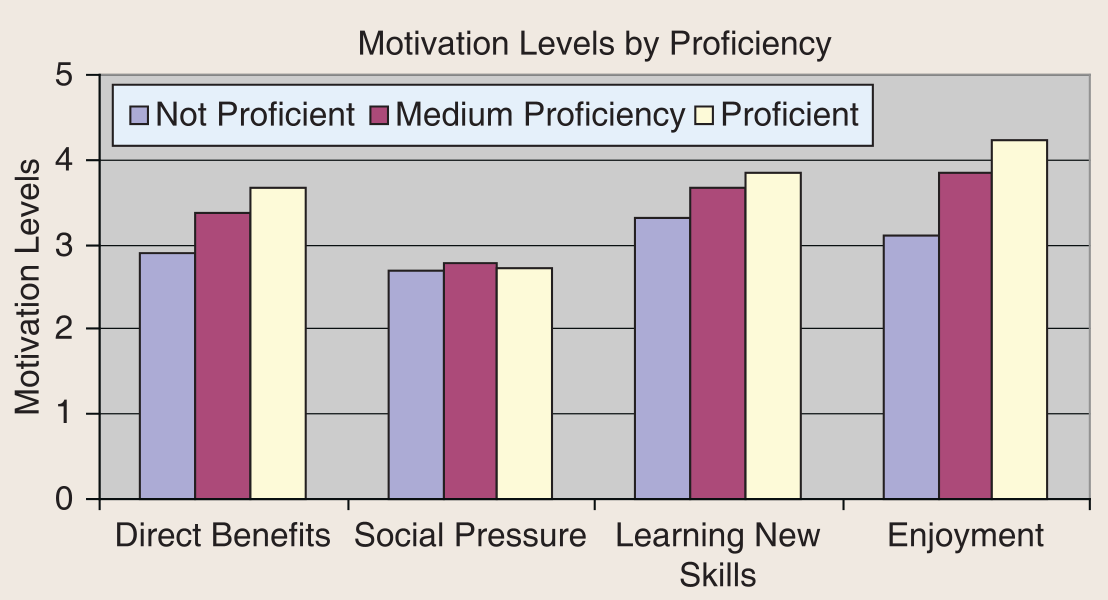
As shown above, as employees became more proficient with the technology, their motivation levels across all categories (except social pressure) effectively doubled, creating a virtuous cycle of adoption.
Critical Analysis & Conclusion
The study highlights that wikis succeed in corporations not just as encyclopedias, but as multi-purpose tools. IBMers used them for:
- Document Repositories (35%)
- Collaboration/Team Rooms (30%)
- Website Development (15%)
The Takeaway
The success of the "IBM Wiki Farm" proves that when barriers to entry are low (easy to use, no cost, no approval needed), employees will naturally gravitate toward tools that provide autonomy and freedom.
Limitations: The study notes a potential sample bias toward "early adopters" (65% of respondents). While the growth was impressive, the average time spent was only 1-3 hours per week—far less than the hardcore "Wikipedians" of the public domain.
Future Outlook: Transitioning from "early adopters" to "mass market" within a firm requires addressing "growing pains" like technical reliability and functionality gaps. However, the study essentially provides the blueprint for Enterprise 2.0: stop mandating tools from the top down, and start providing flexible platforms that employees actually enjoy using.