
Wikimarks: Bridging the Gap Between Social Sharing Chaos and Wiki Structure
Wikimarks: an approach proposition for generating collaborative, structured content from social networking sharing on the web
This paper introduces Wikimarks, a hybrid conceptual framework that merges the viral content-sharing dynamics of social networks with the structured knowledge organization of wikis. By implementing the UXmarks.com experimental platform, the authors demonstrate how automated data fetching combined with gamified user categorization can create sustainable, structured content repositories.
TL;DR
The Wikimarks approach tackles the "empty wiki" problem by harvesting the vast amount of content already being shared in social networks (Facebook, etc.) and funneling it into a structured taxonomy. By applying gamification and open-editing principles, it converts transient social posts into a permanent, categorized knowledge repository.
Background Positioning: This work represents an early-stage architectural proposition in the field of Computer-Supported Cooperative Work (CSCW), specifically targeting the intersection of User Experience (UX) and Social Content Management.
The Problem: The Participation Paradox
In the Web 2.0 era, we face a strange contradiction:
- Wikis (e.g., Wikipedia) provide excellent structure but require high effort, leading to a "participation desert" where only a tiny fraction of users contribute.
- Social Networks are hyper-active but "messy." Content shared there is ephemeral—once it scrolls off the feed, its value is often lost because it lacks taxonomy.
The authors' core insight is that we shouldn't try to change user behavior. Instead, we should harvest the behavior that already exists (sharing links in social groups) and provide a low-friction way to organize it.
Methodology: The Wikimark Pipeline
The framework is built on a "Cause-Effect" model for fostering participation, focusing on Social Interaction, Extrinsic Motivation (Gamification), and User Experience.
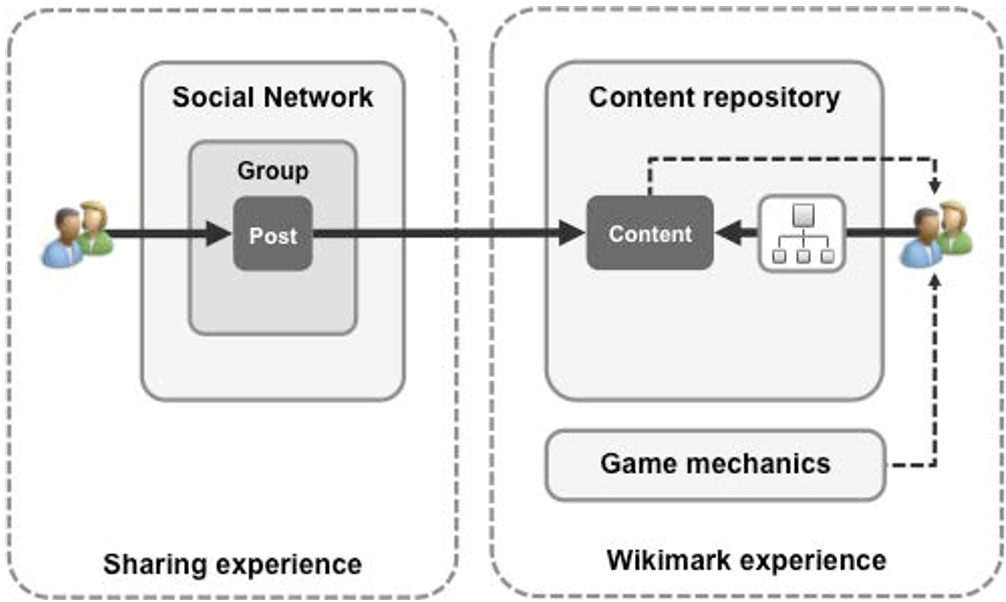
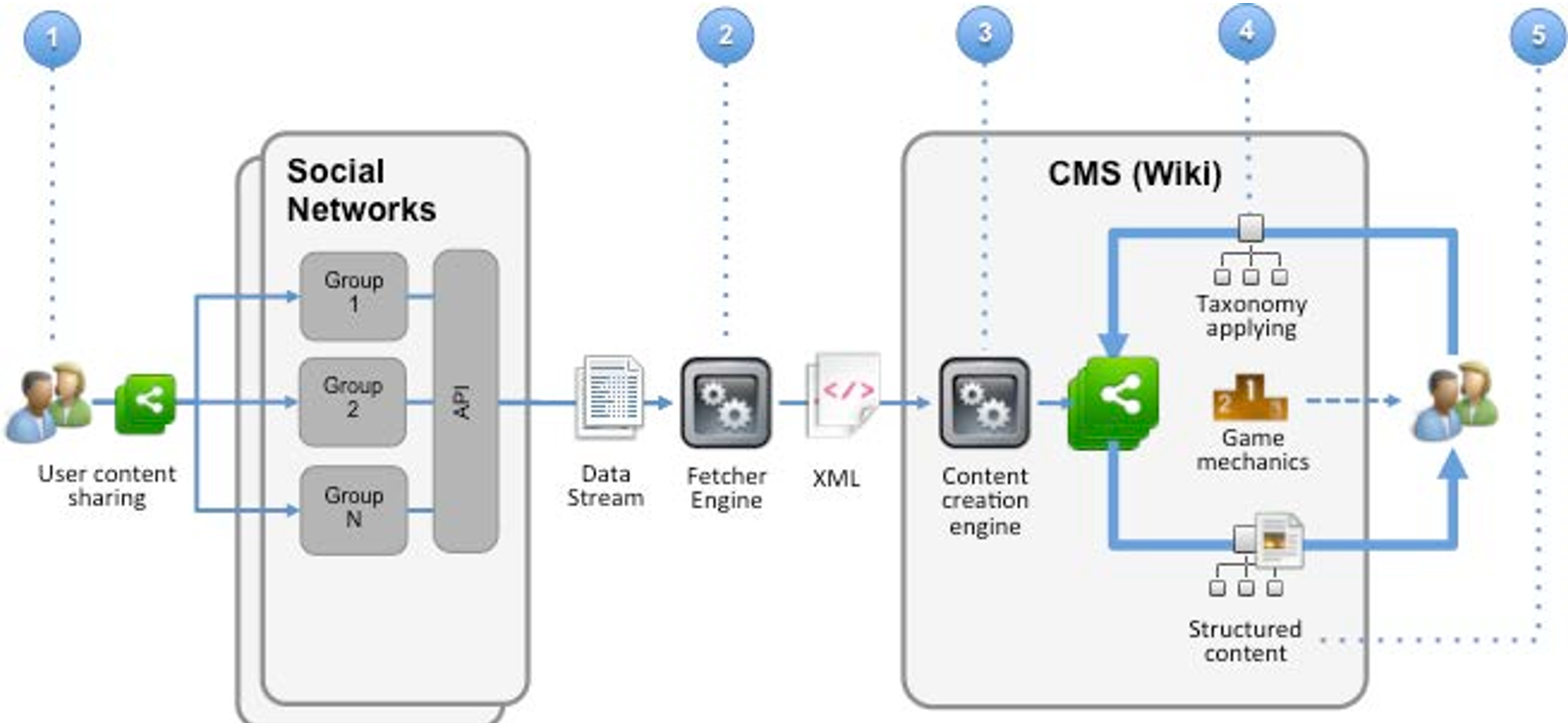
The technical implementation follows a 5-step workflow:
- Passive Acquisition: Users share content in their favorite social groups as they usually do.
- API Fetching: A custom "fetcher" pulls metadata (URLs, titles, thumbnails) via social APIs and converts them into XML formats.
- Content Injection: The metadata is automatically populated into a CMS.
- Collaborative Classification: This is the "Wiki" part. Users are encouraged (via a leaderboard) to tag and link these items to a structured taxonomy.
- Structured Consumption: The final output is an organized library that serves as a learning tool.
Real-World Experiment: UXmarks.com
To test this, the authors launched UXmarks.com, a repository specifically for the Portuguese-speaking UX community.
- The Gamification Layer: To solve the motivation gap, they implemented a point system. Every time a user categorizes an item, they earn points.
- Low Friction: Crucially, the system allows for anonymous categorization to lower the "barrier to entry," only requiring a Facebook login if the user wants to climb the leaderboard.

Critical Analysis & Conclusion
Takeaway
Wikimarks successfully shifts the burden of "content creation" from the user to the automation layer. The user's role is simplified from writer to editor or curator, which is a much lower cognitive load.
Limitations
- Quality Control: Relying on social sharing might introduce noise or "low-quality" links that require manual pruning.
- API Dependency: The system is heavily dependent on the openness of social network APIs (like Facebook or Google+), which have become increasingly restricted since this paper was published.
- Vandalism: While open editing reduces friction, it remains vulnerable to bad actors, a classic wiki challenge.
Future Outlook
While this paper was written in 2012, its core philosophy is more relevant than ever. In the age of AI, the "Wikimarks" concept could evolve: instead of manual categorization, Large Language Models (LLMs) could perform the initial taxonomy mapping, with users acting as high-level "validators" in a gamified loop.