
Maximizing Social Harmony: The WASO Approach to Automatic Activity Planning
A Comprehensive Study on Willingness Maximization for Social Activity Planning with Quality Guarantee
This paper introduces a novel optimization problem called Willingness mAximization for Social grOup (WASO), designed for automatic social activity planning. It proposes two randomized algorithms, CBAS and CBAS-ND, which leverage Optimal Computing Budget Allocation (OCBA) and the Cross-Entropy method to maximize the sum of user interests and social tightness with a connectivity guarantee.
Planning a group activity—whether a casual dinner or a massive corporate outing—is a logistical nightmare. You need to find people who actually like the activity (Interest) and ensure they are coming with people they actually like (Social Tightness).
The paper "A Comprehensive Study on Willingness Maximization for Social Activity Planning with Quality Guarantee" addresses this exact friction. It moves beyond simple "friend recommendations" to solve a complex optimization problem: How do we pick people to maximize the total group "Willingness" while ensuring everyone is socially connected?
TL;DR
The researchers formulate the WASO (Willingness mAximization for Social grOup) problem, prove its NP-hardness, and design a sophisticated randomized algorithm (CBAS-ND). This algorithm is not just a blind search; it uses "computational budget allocation" to focus on the most promising candidates and "Cross-Entropy" to learn the best group structure over time. The result? It breathes life into automated social planning, beating manual human coordination by over 50%.
The Core Conflict: Interest vs. Companionship
Existing social tools treat interest and connectivity as separate silos. However, psychology tells us that willingness to join depends on both.
- Interest Score (): Do you like the activity (e.g., Modern Art)?
- Social Tightness (): Do you have close friends joining as companions?
Maximizing these simultaneously is a nightmare because adding a high-interest person who is a "social hermit" might lower the overall group cohesion, while a "social butterfly" with zero interest in the activity might reduce the average enjoyment.
Methodology: The CBAS-ND Algorithm
The authors realized that a simple Deterministic Greedy (DGreedy) approach fails—it gets stuck in local optima by picking the "best" immediate neighbor, often missing a much better cluster just one step further away.
1. Optimal Budget Allocation (CBAS)
Instead of checking every possible group (which is mathematically impossible), the algorithm starts with different seeds (start nodes). Using the Optimal Computing Budget Allocation (OCBA) theory, it identifies which seeds are "blooming" successfully and starts shifting its computational power (more random trials) to those more promising seeds.
2. Neighbor Differentiation (ND) via Cross-Entropy
This is the "secret sauce." In typical randomized algorithms, you pick neighbors at random. In CBAS-ND, the algorithm uses a Cross-Entropy method to update a probability vector.
- If a specific node repeatedly appears in high-willingness samples, the algorithm "learns" to pick that node more often in the next stage.
- This importance sampling ensures the algorithm converges on the global optimum much faster than a standard Monte Carlo simulation.
 The objective function: Summing individual interests and all mutual social tightness pairs within the selected group.
Experiments: Beating the Humans
The researchers didn't just test on synthetic data; they went to Facebook, DBLP, and Flickr.
- User Study: 137 users were asked to plan activities manually. CBAS-ND scored 50.6% better than their manual configurations.
- Scalability: While exact solvers (IP via CPLEX) took forever on large groups, CBAS-ND provided nearly identical quality with a 100x decrease in running time.
- Acceptance: 98.5% of users found the algorithmic recommendations either better than or equal to their own configurations.
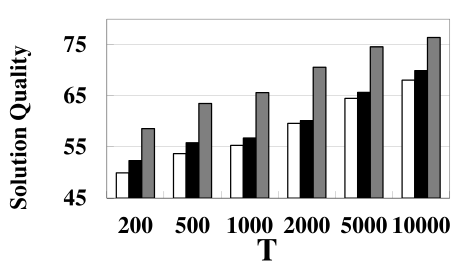 Comparison of CBAS-ND against Greedy and Randomized baselines across different group sizes.
Critical Insight: Why This Matters
The WASO problem is essentially a variation of the Dense k-Subgraph problem but with a connectivity requirement. The real innovation here is the bridge between Discrete Optimization and Probability Theory. By treating the group building as a sequence of importance-sampled events, the authors provide a template for solving other "social" problems, such as expert team formation or viral marketing set selection.
Limitations & Future Work
The current model assumes we have fixed interest scores. However, in reality:
- Dynamic Schedules: People might be interested but busy (the authors suggest Google Calendar integration).
- Diversity: Sometimes you want a group with diverse interests rather than shared ones.
- Negative Constraints: What if two people in the network have high social tightness but absolutely hate each other? (The "Ex-Partner" problem).
Conclusion
The study proves that social grouping is too complex for the human brain to handle at scale, but it's the perfect playground for adaptive randomized algorithms. As social networks evolve into "service networks," tools like CBAS-ND will likely become the backbone of how we organize our real-world lives.