
Bridging the Gap: How Facebook Friendships Predict Physical Proximity in Academic Environments
Wireless contacts, Facebook friendships and interests: Analysis of a multi-layer social network in an academic environment
The paper presents a comprehensive study of a multi-layer social network in an academic environment, analyzing the relationships between three distinct layers: Bluetooth proximity contacts, Facebook friendships, and self-reported interests. Through an experiment at the University of Calabria, the authors demonstrate that offline physical proximity patterns correlate strongly with online social structures.
TL;DR
Human sociality isn't flat—it's layered. This paper explores the "UNICAL14" dataset, uncovering a deep structural resonance between our physical encounters (Bluetooth), digital connections (Facebook), and cognitive alignments (Interests). The researchers found that your closest physical "contacts" in a campus setting are, more often than not, your Facebook friends, providing a blueprint for more efficient mobile communication systems.
Problem & Motivation
In the world of Delay Tolerant Networks (DTNs) and Opportunistic Networking, messages are passed like batons in a relay race, relying on the "store-carry-forward" paradigm. Traditionally, routing algorithms only looked at who you bumped into. However, the authors argue that "who we meet" is a byproduct of "who we are" and "who we know online."
The core challenge is that single-layer mobility traces are noisy and intermittent. By understanding the multi-layer nature of social networks, we can move from reactive routing (forwarding because of a chance encounter) to predictive routing (forwarding because a social tie suggests a future encounter).
Methodology: The Core
The researchers modeled a Multi-layer Social Network (MLSN) defined by three specific layers:
- L1 (Bluetooth): Physical proximity detected within a 10m range.
- L2 (Facebook): Explicit social ties via friend lists.
- L3 (Interests): Calculated via Jaccard similarity across categories like music, film, and hobbies.
To analyze the interplay, they used Closeness Error (CE) to measure how many edges differ between layers. A CE of 0 means identical graphs; 1 means total divergence. They also applied Normalized Mutual Information (NMI) to see if the "neighborhoods" or communities formed in one layer (e.g., a study group) actually persisted in another (e.g., a Facebook group).
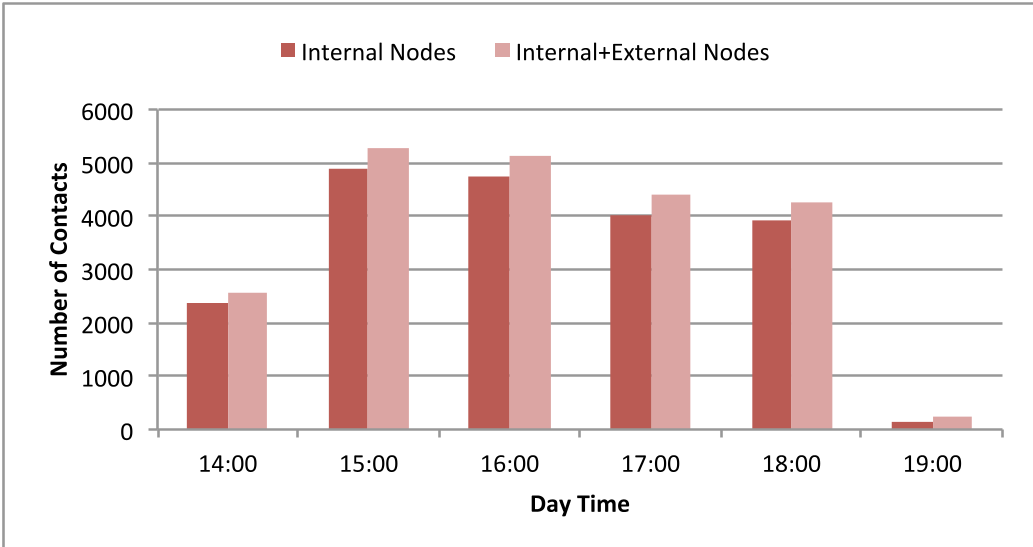 Figure 1: 3D Visualization of Bluetooth contacts over time, showing recurring temporal patterns.
Experiments & Results: The Strength of Ties
The study’s most compelling finding lies in the "Strong Ties" analysis. By ranking the top 20 node pairs by contact frequency and duration, the authors found a striking overlap with the digital world.
- Tie Consistency: 15 out of the top 20 physical "strong ties" were confirmed Facebook friends.
- Graph Similarity: The Facebook layer (L2) was consistently closer to the Bluetooth layer (L1) than the Interests layer (L3) was, suggesting that "social acquaintance" is a stronger driver of proximity than "shared hobbies."
- Community Stability: Using the Louvain method, the researchers found that during peak academic activity (group assignments), the communities formed by physical proximity matched Facebook communities with an NMI as high as 0.6792.
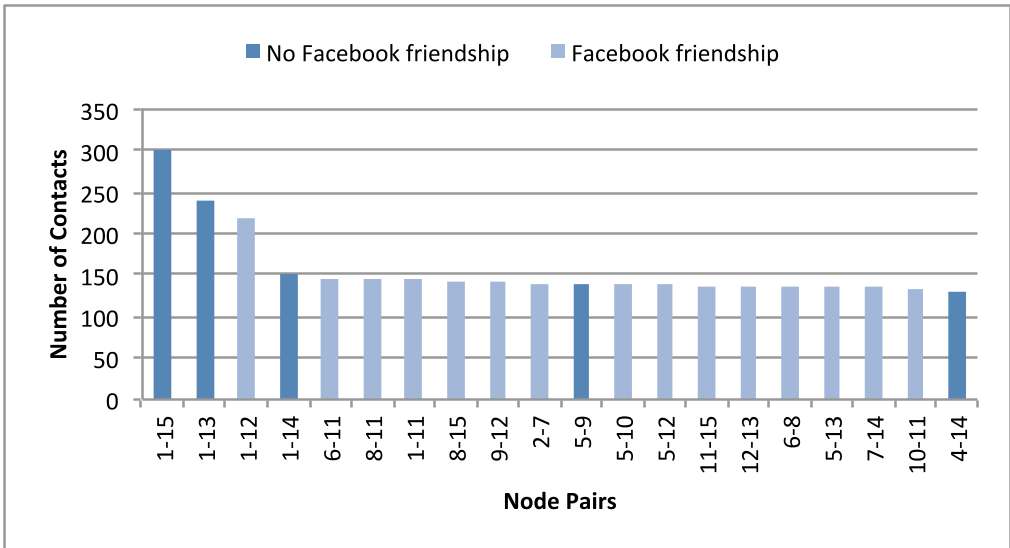 Figure 2: Matching strong physical ties (top 20 pairs) against online friendship status.
Critical Analysis & Conclusion
Takeaway
The research proves that the "offline" and "online" worlds are not separate silos but are structurally intertwined. For engineers building the next generation of 5G/6G opportunistic networks, this means OSN data can serve as a "hot-start" for routing tables.
Limitations
The primary limitation is the sample size. With only 15 active participants capturing 20 external devices over a one-week period, the dataset is "thin." While the results are statistically interesting, the academic environment is a "controlled" social bubble that might not translate perfectly to heterogeneous urban environments.
Future Outlook
The next logical step is Link Prediction. If we know two people are friends on Facebook and share an interest in "Mobile Multimedia," can we predict when and where they will meet next? As we move toward more privacy-preserving edge computing, using these multi-layer insights to optimize data dissemination without exposing raw location history will be the next frontier.