
Glimpse on Women in Entrepreneurship: A Machine Learning-Driven Mapping of 20 Years of Research
Glimpse on Women in Entrepreneurial Context A Machine Learning based Literature Review
This paper presents a Machine Learning-based Literature Review (MLR) of 7,320 academic articles concerning "women in entrepreneurial contexts" published between 2000 and 2020. Utilizing text mining and hierarchical clustering via the Orange software, the authors identified 41 thematic clusters and 11 superordinate topics (SOTs) to map the evolution of research attention in the field.
TL;DR
By processing over 7,000 journal articles through a machine learning pipeline, this study reveals that the academic conversation surrounding women in business is moving away from "family-work conflict" and toward "strategic performance" and "corporate governance." Research on Corporate Social Responsibility (CSR) and firm performance linked to female leadership has seen staggering growth (over 350%), signaling a paradigm shift in how gender diversity is valued in the corporate world.
Problem & Motivation: Beyond Manual Synthesis
The field of female entrepreneurship has exploded over the last two decades. However, this growth has led to a fragmented body of knowledge. Traditional systematic reviews are often restricted by the researcher's ability to read and categorize papers manually, often leading to a focus on narrow silos (e.g., only management or only regional barriers).
The authors argue that to see the "big picture," we must leverage Machine Learning-based Literature Review (MLR). The goal is not just to count papers, but to understand Research Attention—where is the scientific community actually looking? By using citation-weighted data, the authors distinguish between mere "interest" (publishing volume) and genuine "impact" (citation growth).
Methodology: The MLR Pipeline
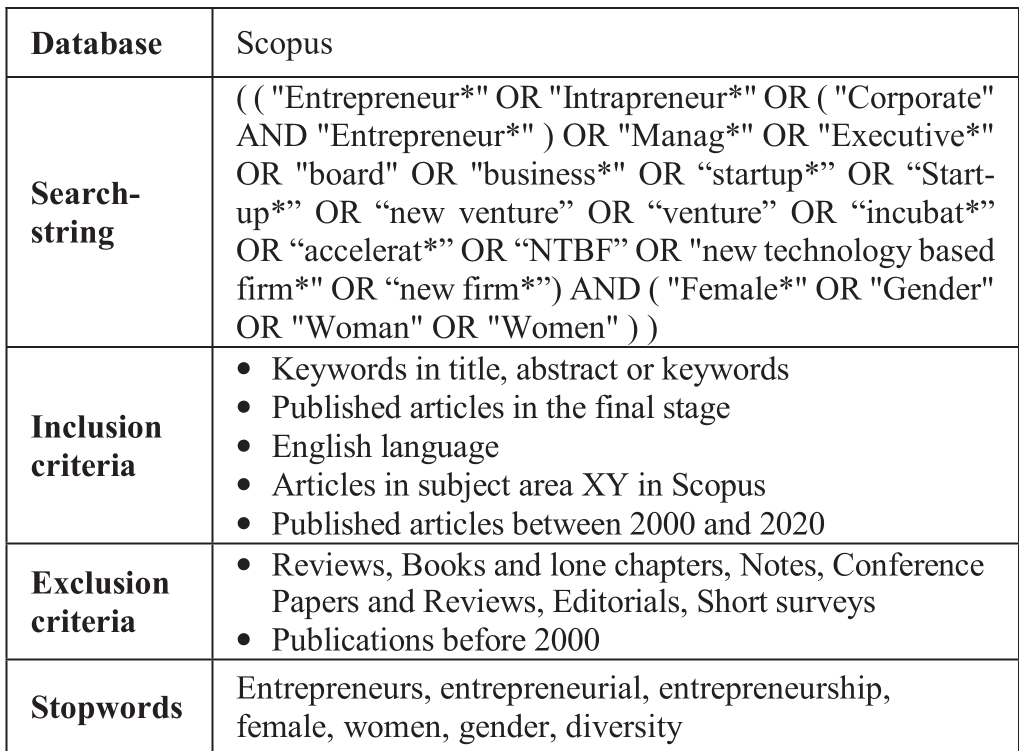
The researchers utilized a standardized protocol to extract 15,053 articles from Scopus, eventually pruning the set to 7,320 high-impact papers using a linear gradient citation model. This model ensures that older papers are only included if they have gained significant traction over time.
The Technical Workflow:
- Preprocessing: Text was stemmed using the Porter algorithm to normalize terms.
- Vectorization: Titles were transformed into a "Bag of Words" where each word represents a feature column.
- Clustering: Utilizing Orange software, the authors calculated Euclidean distances and applied Ward's method for hierarchical clustering.
- Taxonomy: 41 clusters were identified and then synthesized into 11 Superordinate Topics (SOTs).
Core Insights: What Is Trending?
The results provide a fascinating map of intellectual evolution. One of the most striking findings is the saturation of certain topics.
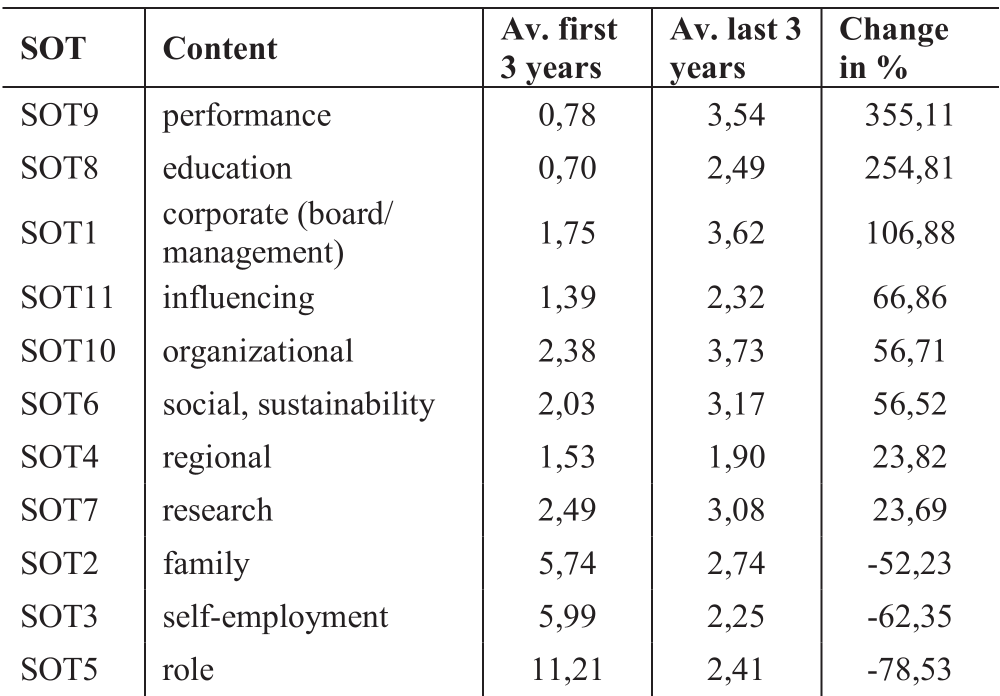
- The Decline of "Role" and "Conflict": Topics like Family-work conflict (C05) and Moderating roles (C08) show a negative trend in research attention. This suggests the community has reached a level of saturation where basic descriptions of gender-based hurdles are no longer the primary driver of new citations.
- The Rise of Strategic Performance: SOT 9 (Performance) and SOT 1 (Corporate Management) are the new frontiers.
- The Critical Mass Effect: The synthesis highlights that a minority of one or two women is often insufficient to overcome stereotypes; a "critical mass" of at least three women on a board is required to significantly impact firm innovation.
Deep Dive: Performance and Governance (SOT 1 & 9)
The synthesis of "SOT 9 - Performance" reveals a complex relationship between internal structures and external outcomes. Research now explores how female board members facilitate Corporate Philanthropy and Customer Loyalty.
Notably, Dezso and Ross (2012) found that female representation in Top Management Teams (TMT) enhances firm performance specifically in innovation-intensive firms. This suggests that the "feminine management style"—characterized as democratic and collaborative—is particularly effective in creative and entrepreneurial environments.
Critical Analysis & Conclusion
Takeaways
- Gender as a Performance Driver: The research focus has pivoted from "women as a minority needing support" to "women as a strategic resource for innovation and CSR."
- Methodological Innovation: This paper serves as a blueprint for researchers to use MLR to handle "Big Data" in the social sciences.
Limitations
- Title-Based Clustering: Clustering based solely on titles may lead to "fuzzy" clusters (like C21, which held nearly 48% of the data).
- Citation Lag: The use of citations as a metric for "attention" naturally disadvantages very recent publications (2019-2020), although the authors attempted to adjust for this via their gradient model.
Future Outlook: As NLP techniques like GPT-4 and LLM-based embeddings become more accessible, future MLRs might move beyond bag-of-words approaches to understand the semantic nuance and sentiment of research findings, offering even deeper insights into the "why" behind scientific trends.