
Beyond the Hub: Unpacking the Dual Dynamics of Word-of-Mouth in Digital Networks
Word-of-Mouth Effects on Social Networks
This paper proposes an agent-based model (ABM) to study the diffusion of innovation on online social networks. It distinguishes between the "informative effect" (access to data) and the "normative effect" (social pressure/imitation) within a synthesized scale-free and small-world network. The study demonstrates that complete product adoption requires a synergy between both effects rather than relying on one in isolation.
TL;DR
Is a social media "influencer" enough to make a product go viral? According to Kurahashi and Saito, the answer is a nuanced "No." Their research reveals that viral diffusion depends on two distinct mechanisms: the Informative Effect (discovering the product) and the Normative Effect (the pressure to conform). By simulating these on complex networks, they prove that while influencers (hubs) start the fire, it is the ordinary users (non-hubs) who keep it burning until the market is saturated.
The Missing Link in Diffusion Models
For decades, the Bass Model has been the gold standard for predicting how new products spread. It splits consumers into "innovators" and "imitators." However, it treats the market as a homogeneous mass, ignoring the reality of the Internet where some people have millions of followers and others have ten.
Previous agent-based models tried to fix this by using network theory, but they often stalled. Some worked for Small-World networks (where everyone is a few hops away) but failed on Scale-Free networks (where a few hubs dominate). The authors noticed a fundamental gap: we were treating "Word-of-Mouth" as a single force, when it is actually two different behaviors traveling along different paths.
Methodology: The Informative vs. The Normative
The researchers proposed a decision-making model where an individual's probability of adopting a new product () is governed by:
- Informative Effect (): This is purely about awareness. If a certain number of your neighbors have the product, you now have enough information to consider it. It’s an exploratory, "information-seeking" style.
- Normative Effect (): This is about social norms and "keeping up with the Joneses." If a high percentage of your immediate circle adopts the product, you feel the social pressure to join in. This is a "self-contained" style involving close friends and family.
The Network Architecture
To mirror the real world, the authors synthesized a hybrid network called ScaleFreeC. It combines the "hub-and-spoke" nature of a scale-free network (BA model) with the "tightly-knit community" feel of a regular network (WS model).
 Table 1: Characteristics of the synthesized ScaleFreeC network vs. standard models.
Simulation Results: The Synergistic "Take-Off"
The most striking finding of the study is the failure of "pure" strategies:
- Informative Only: The product "takes off" quickly because hubs spread the word, but it never reaches everyone. It gets stuck in the "long tail" of the network.
- Normative Only: The product struggles to even start. Without enough initial exposure, the social pressure never builds up.
- The Hybrid Winner: When both effects are present, the informative effect acts as the spark, and the normative effect acts as the fuel.
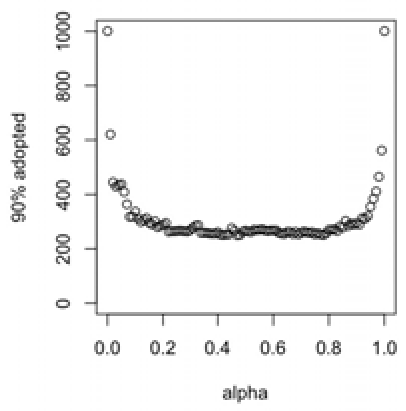 Fig 4: Diffusion velocity based on the weight of α (the balance between informative and normative effects).
Critical Insight: The Opinion Leader Fallacy
The paper challenges the "Opinion Leader" (OL) obsession in marketing. While OLs (hubs) are vital for the initial "two-step flow" of communication, they cannot drive a "cascade" alone. The authors align with Duncan Watts' theory: viral cascades are driven not by the influencer, but by the Critical Mass of easily influenced "ordinary" users.
Conclusion
This research provides a rigorous framework for understanding why some products stay niche despite massive ad spends, while others become global sensations through grassroots imitation.
Takeaways for the Industry:
- For Awareness: Target the "hubs" (Informative path).
- For Conversion/Stickiness: Target the "clusters" and tight-knit communities (Normative path).
- The Synthesis: A successful campaign must transition from "telling the many" to "convincing the group."
Limitations: The model assumes an SI (Susceptible-Infected) process where users never "stop" using a product. In the modern world of "churn" and "app fatigue," incorporating an SIR model (where users can recover/quit) would be the logical next step for this research.