
mmAOM: Decoding the Multimodal DNA of Social Media "Word-of-Mouth"
Word-of-Mouth Understanding: Entity-Centric Multimodal Aspect-Opinion Mining in Social Media
The paper introduces the multimodal Aspect-Opinion Model (mmAOM), a probabilistic generative framework designed for entity-centric mining of aspects and opinions from social media. It successfully integrates user-generated photos and text documents to categorize aspects into visual-representative and non-visual-representative types, achieving SOTA performance in aspect identification and opinion retrieval.
TL;DR
Understanding public opinion is no longer just about reading reviews; it's about seeing what they see. This paper introduces mmAOM (multimodal Aspect-Opinion Model), a sophisticated probabilistic framework that mines both photos and text to discover what people truly think about entities like Beijing, Adidas, or Steve Jobs. By distinguishing between aspects that are "visual" (like a sneaker's design) and "non-visual" (like a company's ethics), it achieves a more nuanced understanding of "Entity Associations" than ever before.
The "Blind Spot" in Modern Opinion Mining
Most sentiment analysis tools behave like they are reading a book, ignoring the rich visual context of Instagram or Flickr. However, when a user posts a photo of a hazy sky in Beijing with the caption "Another day here," the image itself is the aspect, and the caption is the opinion.
Previous SOTA methods (like Corr-LDA) struggled because they assumed every word must have a corresponding image. This paper identifies a critical reality: some things, like "economy" or "policy," simply don't have a specific "look." Forced correspondence leads to noise; mmAOM solves this by treating visual relevance as a dynamic variable.
Methodology: The Logic of mmAOM
The core innovation lies in the Binary Switch Mechanism. The model doesn't force a one-size-fits-all structure. Instead:
- Dual Aspect Spaces: It maintains two distinct spaces—Visual-Representative (shared by text and images) and Non-Visual-Representative (text only).
- Generative Flow: For every word or image patch, the model "tosses a coin" to decide which space it belongs to.
- Opinion-Aspect Coupling: Opinions aren't just floating sentiments; they are generated based on the specific aspect identified.
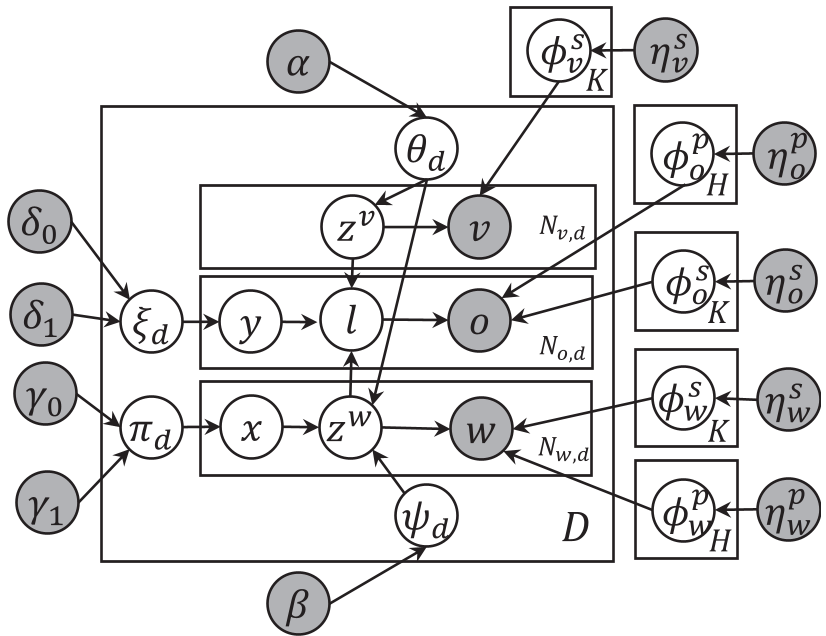 The graphical representation of mmAOM showcasing the dependency between textual (w), visual (v), and opinion (o) components.
Visualizing "Entity Associations"
One of the most impressive applications of this paper is the Entity Association Map. By calculating the "Significance" (radial distance) and "Closeness" (angular distance), the authors can map out the entire "Brand DNA" of an entity.
For example, for Steve Jobs, the model identified clusters like "iPhone/iPad" (Visual) and "Visionary/Management" (Non-Visual), mapping them with sentiment-coded colors. This transforms raw social media noise into a strategic dashboard.
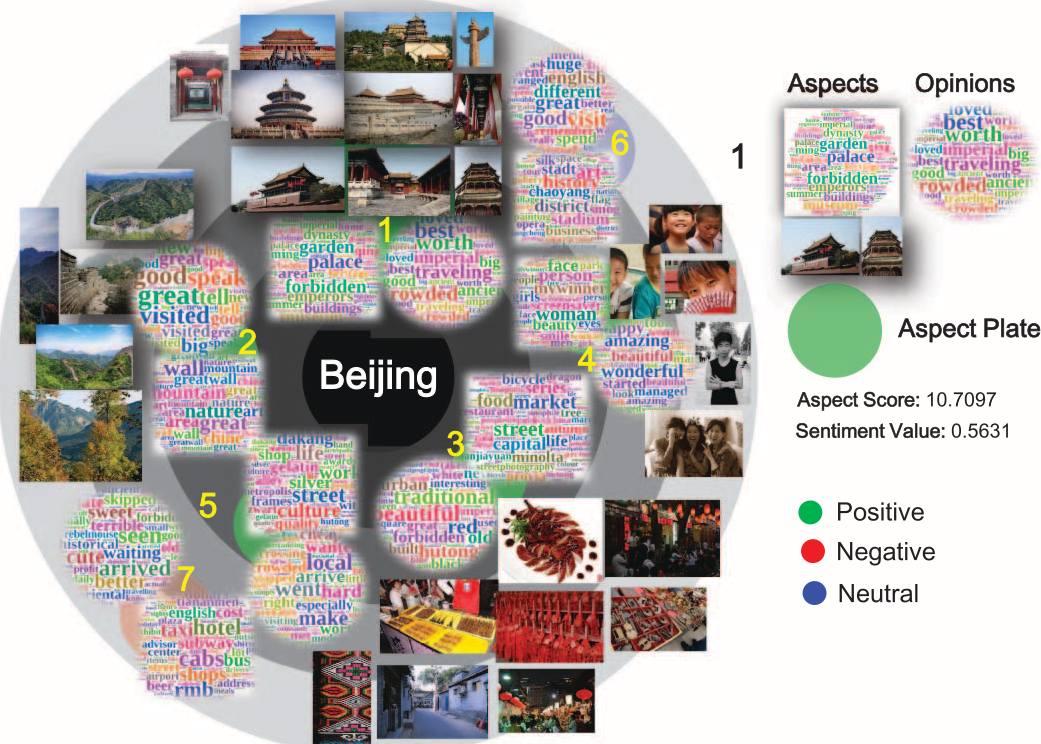 The association map for Beijing, clusters are placed based on significance and semantic similarity.
Experiments: Proving the Superiority
The authors didn't just test on one dataset; they tackled locations, people, and brands.
- Performance: mmAOM consistently achieved lower Perplexity scores (a measure of how well the model predicts new data) compared to standard LDA and multimodal baselines.
- Retrieval: In tasks like "Image Annotation" (predicting tags for a photo) and "Opinion Retrieval" (finding what users say about a specific visual feature), mmAOM showed a clear margin of victory in NDCG metrics.
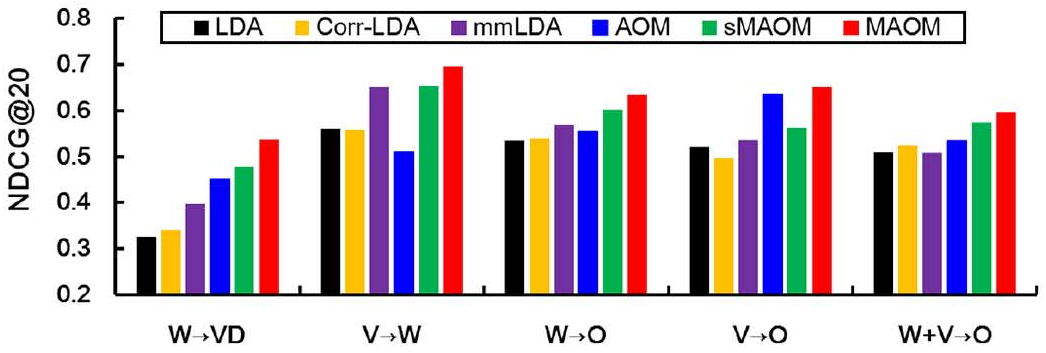 Performance of mmAOM across different retrieval tasks, showing consistent leads in NDCG scores.
Critical Insight & Future Outlook
While mmAOM is a milestone in probabilistic modeling, the field is rapidly moving toward Large Multimodal Models (LMMs). The "physics" of this paper—specifically the intuition that we must explicitly model the lack of visual evidence for certain concepts—remains a vital lesson for current prompt-engineered systems.
The model’s reliance on POS tagging (Nouns for aspects, Adjectives for opinions) is a classic but effective Inductive Bias. Future work could likely replace these manual heuristics with attention-based weights while maintaining the paper's brilliant "Entity Association" mapping logic.
Takeaway: If you want to know what a brand represents, don't just count mentions—map the multimodal associations.