
Twitter Mining for Drug Safety: Boosting ADR Extraction with Word Embeddings
Utilizing different word representation methods for twitter data in adverse drug reactions extraction
This paper presents a Named Entity Recognition (NER) system for extracting Adverse Drug Reactions (ADRs), indications, and drug names from Twitter data using Conditional Random Fields (CRFs). The researchers evaluate the impact of different word representation methods, specifically token normalization, word2vec, and GloVe, to address data sparsity in informal social media text.
TL;DR
Monitoring drug safety in the age of social media is a "needle in a haystack" problem. This study develops an automated pipeline using Conditional Random Fields (CRF) to identify Adverse Drug Reactions (ADRs) in tweets. By leveraging word2vec and GloVe embeddings to cluster similar informal terms, the researchers significantly improved the system's ability to "generalize" and catch mentioned side effects that standard dictionaries miss.
The Challenge: Why Twitter Data is "Dirty"
Pharmacovigilance (post-marketing drug monitoring) traditionally relies on clinical reports. However, patients often discuss real-world side effects on Twitter using non-standard language:
- Abbreviations: "Metho" instead of Methocarbamol.
- Narrative expressions: "Feel like shit" or "cantsleep" instead of "insomnia."
- Noise: Hashtags (#), mentions (@), and pervasive spelling errors.
Standard Named Entity Recognition (NER) fails here because it cannot map "binge eat" and "hyperphagia" to the same concept without massive amounts of labeled data, which is expensive to produce.
Methodology: From Raw Tweets to Semantic Clusters
The authors formulated the task as a sequence labeling problem (IOBES scheme) using a CRF model. The "secret sauce" is the Word Representation Strategy:
- Token Normalization: Stripping '#' and '@' tags and converting all digits to a generic '1mg' placeholder to reduce feature space.
- Word Embeddings (word2vec & GloVe): They trained these models on 100,000 tweets to create 200-dimensional vectors.
- K-Means Clustering: Instead of using raw vectors (which are high-dimensional), they grouped tokens into 200 clusters. These cluster IDs were fed into the CRF as features.
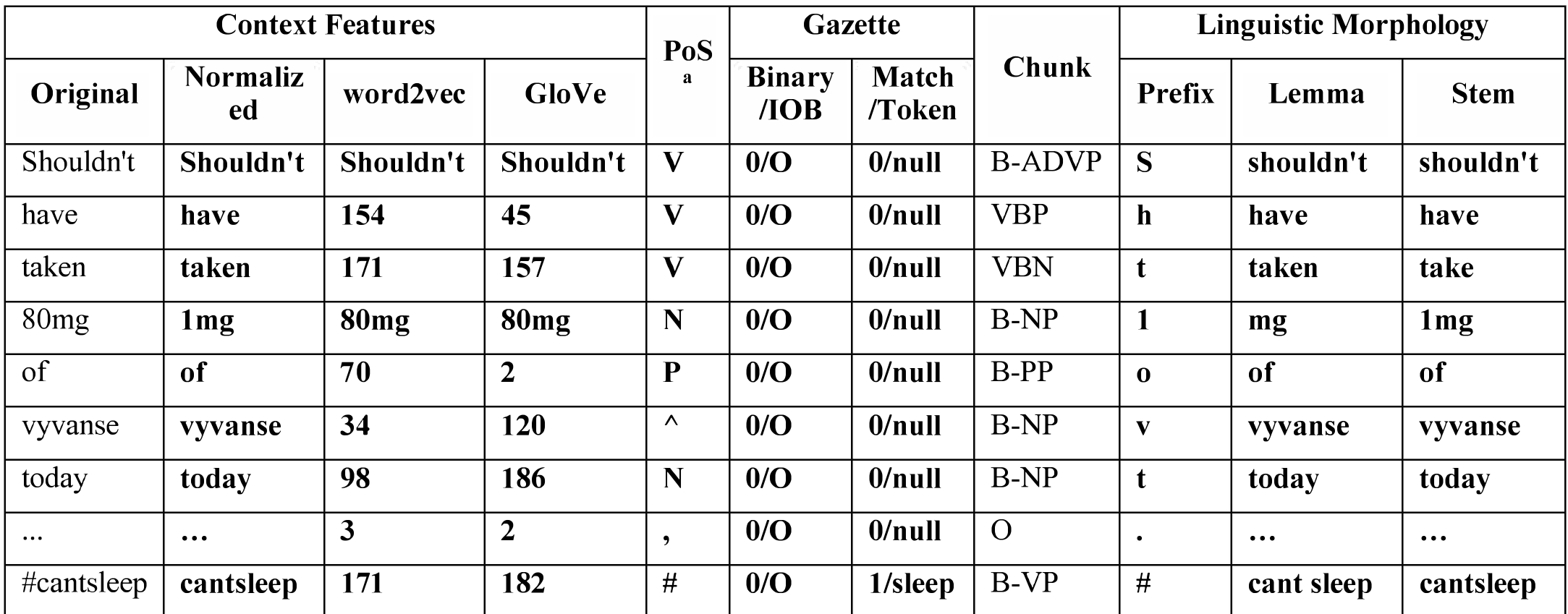 Figure 1: Illustration of the feature engineering pipeline, showing how context, POS, and word embedding clusters (word2vec/GloVe) are combined.
Experimental Results: Recall vs. Precision
The study highlights a classic trade-off in NLP. By using word embeddings, the model became much better at finding ADRs (Recall), but slightly more prone to false positives (Precision).
Key Findings:
- GloVe vs. word2vec: GloVe provided a higher F-measure boost (+10.9%), but manual analysis showed word2vec created "cleaner" clusters where 49% of tokens in specific clusters were purely ADR-related.
- Boundary Ambiguity: The model achieved an F-measure of 0.576 under "approximate match" but dropped notably under "exact match." This confirms that determining exactly where an ADR mention starts and ends in a tweet (e.g., "feeling tired all day" vs. "tired") is subjective even for humans.
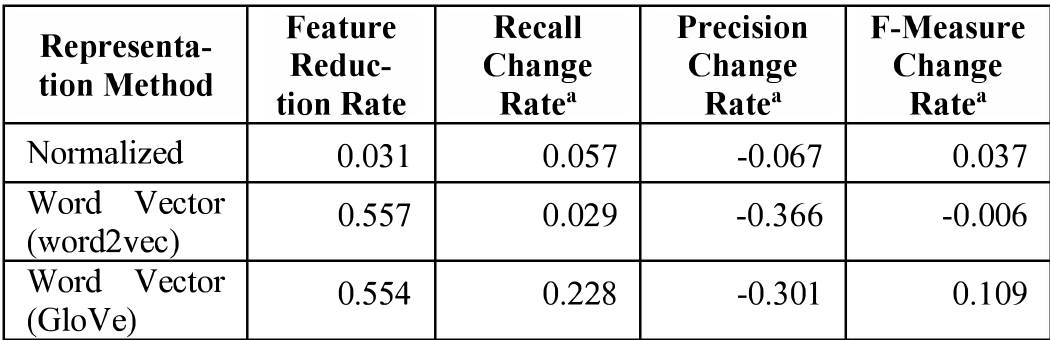 Figure 2: Rate of change in performance metrics when introducing normalized tokens and word embeddings.
Critical Analysis & Future Outlook
The study proves that unsupervised learning (embeddings) is a powerful ally for supervised learning (CRF) when data is sparse. However, the model completely failed to recognize "Drugs" in the test set because those specific drug names were not in the training data—a classic OOV (Out-of-Vocabulary) problem.
Takeaway for Practitioners: If you are building a social media monitor for health, don't rely on dictionaries alone. Using word clusters allows your model to understand that "shaky hands" and "tremors" belong to the same semantic neighborhood, even if the model has only ever seen one of those terms in its training history.
Future Path: Moving from CRFs to Transformer-based models (like BERT or BioBERT) could further refine these boundaries by capturing deeper contextual nuances than fixed-window clusters can provide.