
Game Theory in Spatial Crowdsourcing: Predicting Collaborative Worker Groups
Worker Collaborative group estimation in spatial crowdsourcing
This paper introduces the Worker Collaborative Group Estimation (WCGE) problem in spatial crowdsourcing (SC), aiming to predict which workers will join a specific task based on group tags and social relationships. The authors model user participation as a strategic game and propose the Spatial Adaptive Play (SAP) algorithm to find the Nash Equilibrium, achieving superior estimation of potential worker groups.
TL;DR
In the world of Spatial Crowdsourcing (SC), workers aren't just isolated units; they are social beings who prefer to work in teams. This paper introduces the Worker Collaborative Group Estimation (WCGE) problem, using game theory to predict team formation. By modeling the "joining decision" as a Nash Equilibrium game, the authors provide a way for task requesters to estimate who will actually show up when a task is published.
Context: Why Social Tie Matters in SC
Spatial Crowdsourcing platforms like Gigwalk and OpenStreetMap rely on workers traveling to specific locations. However, complex tasks—like collecting diverse geospatial data for self-driving cars—often require a team. Current systems struggle to predict group formation because the decision of worker A to join depends heavily on whether worker B (their friend) also joins. This interdependency makes traditional prediction models obsolete.
The "Joining New Group Game"
The authors define the WCGE problem by treating each worker as a rational player in a strategic game.
1. The Payoff Function
A worker's utility is determined by two factors:
- Attractiveness (Intrinsic): How much the task tags (e.g., "Photography", "Road Mapping") align with the worker's own interests.
- Social Influence (Extrinsic): The weight of friendship. If your friends choose to join, your payoff for joining increases.
2. The Global Benefit
The game is proven to be an exact potential game, meaning a single potential function captures the incentives of all players. Finding the state that maximizes this function is equivalent to reaching the best Nash Equilibrium—a stable state where no worker can improve their "happiness" by unilaterally changing their mind.
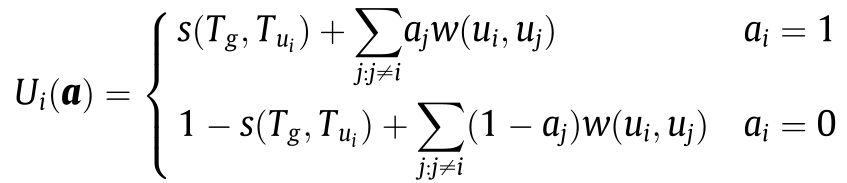 The core payoff function balancing tag similarity and social pressure.
Methodology: From Best Response to Spatial Adaptive Play
To solve the game, the paper compares two approaches:
- BestResponse (Baseline): Workers greedily pick the best choice. While fast, it often gets stuck in "local optima" (suboptimal Nash Equilibria).
- Spatial Adaptive Play (SAP): A more sophisticated stochastic algorithm. Unlike greedy methods, SAP updates strategies with a specific probability, allowing the system to "jump" out of local traps. The authors prove that SAP converges to the global optimal solution with arbitrarily high probability.
Experimental Validation
The researchers tested the algorithms using synthetic datasets, varying the number of workers (), graph density, and tag limits ().
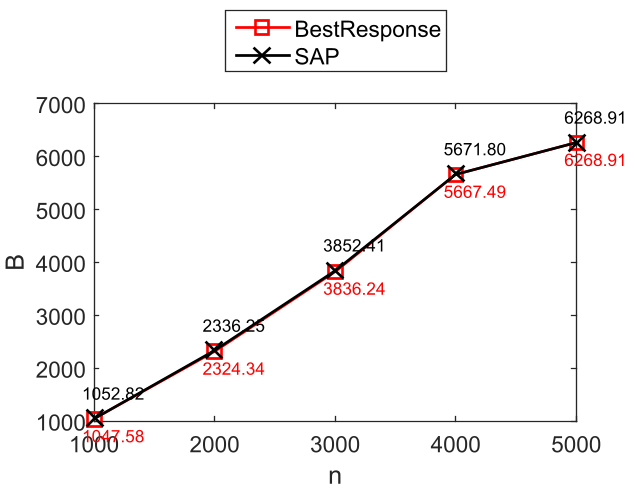 Fig 1: As the number of workers increases, SAP consistently delivers higher social benefit (better group estimation) than the BestResponse baseline.
Key Findings:
- Superiority of SAP: SAP yields higher overall benefit, particularly when social graphs are sparse.
- Efficiency: While SAP takes longer to converge than BestResponse (due to its iteration requirement), it remains highly feasible for large-scale applications, maintaining reasonable memory consumption.
- Tag Sensitivity: When tags become too specific (high ), the "dissimilarity" increases, changing how groups form—an insight crucial for task requesters when naming their tasks.
Critical Insight & Future Outlook
This work shifts the focus of SC from "assigning tasks to workers" to "understanding worker behavior." By recognizing that workers are influenced by their social environment, the WCGE model provides a realistic lens for platforms to optimize their recruitment strategies.
Limitations: The study relies on synthetic data and Jaccard similarity. Real-world social dynamics might include negative weights (workers avoiding rivals) or more complex interest models (semantic similarity instead of simple tag overlapping).
The Takeaway? If you want to predict who will work on your spatial task, don't just look at their skills—check their Facebook friends.