
WEO: Bridging the Gap Between Social and Physical Networks in Mobile Crowdsensing
Worker Recruitment Strategy for Self-Organized Mobile Social Crowdsensing
This paper introduces a Worker Recruitment strategy for self-organized Mobile Social Crowdsensing (MSC). It proposes the Worker Recruitment for Self-organized MSC (WEO) method, which leverages a dual-layer communication model (online social networks and offline physical encounters) to optimize the delivery ratio of sensing data to task requesters.
TL;DR
Mobile Crowdsensing (MCS) is evolving from simple physical data collection to a "socially-aware" paradigm. This paper introduces WEO, a recruitment strategy that picks the best workers for a task by looking at both who they might bump into on the street (offline) and who they are connected to on platforms like WeChat or Twitter (online). By using a Semi-Markov model and a submodular greedy algorithm, the researchers achieved a significantly higher data delivery ratio compared to traditional methods.
Background: The Limits of Physical-Only Sensing
In traditional MCS, a requester wants data from a Point of Interest (PoI)—say, the air quality at a specific park. They recruit workers who visit that park. However, getting that data back to the requester often relies on the worker physically meeting the requester again.
The authors argue this is "incomplete." In our modern world, if a worker collects data but doesn't see the requester, they can still transmit it through a social network. The core challenge is: How do we select a group of workers who collectively have the highest chance of reaching the requester through either path?
Motivation & Insights: The Dual-Layer Reality
The authors' primary insight is that a worker's value is the sum of their physical mobility and their social reach. This leads to three specific hurdles:
- Unpredictability: Requester locations are dynamic.
- Hybrid Utility: It's hard to mathematically balance a "physical encounter" against a "social connection."
- Complexity: Selecting the absolute "best" workers is an NP-hard problem.
Methodology: Semi-Markov Meets Social Graphs
1. Predicting Offline Encounters
The authors use a Semi-Markov model to track PoI transitions. Unlike a standard Markov chain, this model accounts for the duration a worker stays at a location. By calculating transition probabilities and holding times , they can predict the probability of a worker being at a specific spot at a future time.
2. Predicting Online Connections
For the social layer, they employ Two-Hop Routing theory. The intuition is that if worker knows , and knows the requester , there is a calculable probability of data delivery via this social path.
3. The WEO Algorithm
Instead of just picking the "best" individual workers (which leads to overlapping "coverage"), they use a Greedy Heuristic. They prove that the utility function is submodular—meaning there are diminishing returns to adding more workers. Their algorithm iteratively adds the worker who provides the highest marginal increase to the group's total success probability.
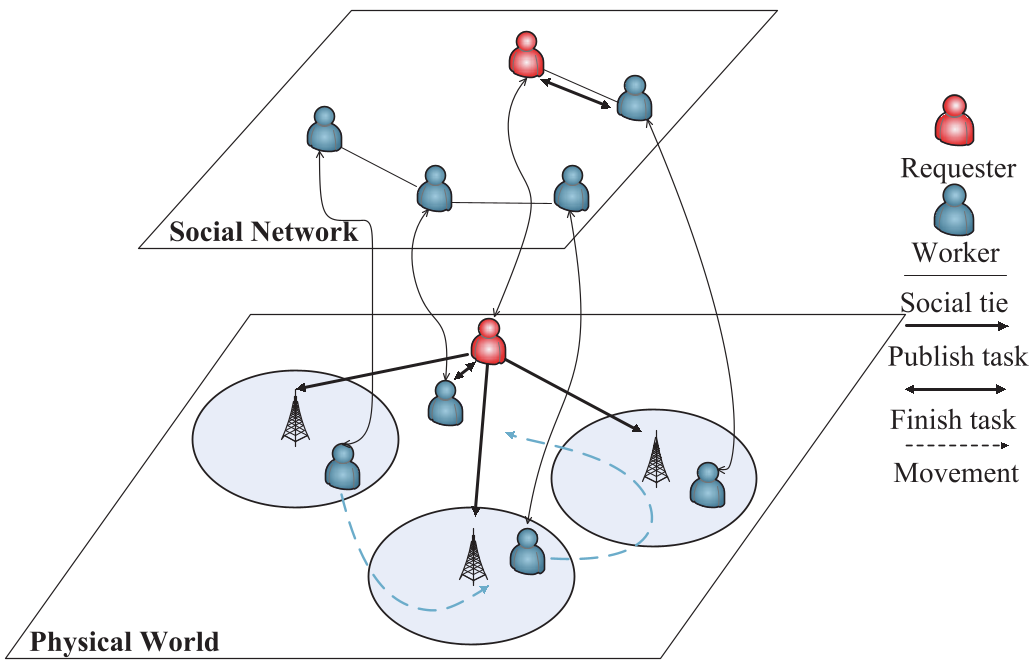 Fig 1. The dual-layer structure of Mobile Social Crowdsensing.
Experimental Results
The researchers tested WEO against real-world GPS traces from Rome (roma/taxi) and San Francisco (epfl).
- Delivery Ratio: WEO consistently surpassed "Random" and "Largest Individual Utility" strategies.
- Ablation Study: They compared WEO-on (online only) and WEO-off (offline only). Interestingly, the results showed that online social communication often played a more vital role in delivering data than physical encounters, though the combination of both (WEO) was the clear winner.
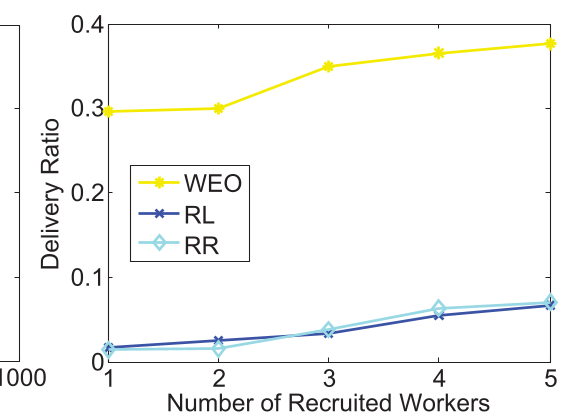 Fig 2. Performance comparison on the Roma/Taxi dataset showing the impact of worker set size and task deadlines on delivery ratio.
Critical Analysis & Takeaways
Key Contribution: The proof of submodularity for the hybrid utility function is a significant theoretical win. It guarantees that their greedy approach is within of the absolute optimal solution.
Limitations:
- The social network relationships were generated randomly in simulations; real-world social graphs (which are often power-law) might show even more extreme "super-connector" workers.
- The model assumes workers are always willing to share data via their social networks, ignoring potential privacy concerns or data costs.
Future Outlook: This work paves the way for "Self-Organized" sensing. Imagine a city-wide sensing network where your phone automatically decides to participate in a task because it knows you have a high "social-physical utility" for the person requesting the data. This significantly reduces the reliance on centralized servers and makes the network more resilient.