
Turning the Tide: Leveraging Social Topology for Fast Worm Containment
A Worm Containment Approach Towards Online Social Networks
This paper introduces a specialized worm containment strategy for Online Social Networks (OSNs) that leverages social topology to combat malware. By employing a weighted user relationship graph and a hierarchical partition algorithm, the method identifies influential "impact nodes" to distribute high-priority patches, effectively quenching worm propagation at exponential rates.
Executive Summary
TL;DR: This paper presents a strategic defense mechanism against Online Social Network (OSN) worms—malware that exploits friendship ties to spread. Instead of reactive, site-wide patching, the authors propose a hierarchical partition algorithm to identify "impact nodes" (influential users and bridges between communities). By patching these critical nodes first, the defense system turns the virus's own propagation highway into a rapid immunization network.
The work identifies as a systematic optimization of network defense, transitioning from blind patching to topology-aware containment, specifically tailored for the "small-world" nature of modern social platforms.
Problem & Motivation: The Trust Trap
OSN worms like Samy, Koobface, and Clickjacking have demonstrated an alarming ability to infect millions within hours. The authors highlight a fundamental shift in malware evolution: OSN worms are effectively topology worms.
The failure of prior work (often borrowed from cellular network defense) stems from two factors:
- Trust-Based Success: Unlike email spam, OSN messages from "friends" have nearly zero suspicion from users, leading to high infection rates.
- Scale-Free Concentration: OSNs center around "famous" users with massive follower counts. Traditional methods treat all nodes as roughly equal, whereas in OSNs, a single infected "hub" can compromise a huge segment of the network instantly.
The core insight is: If the worm uses the network structure to destroy, the defense must use the same structure to fix.
Methodology: Hierarchical Partitioning
The authors break the containment process into three distinct phases:
1. Weighted User Relationship Graph
A graph is constructed where nodes represent users and weights () represent the number of connections. This allows for the identification of potential "super-spreaders."
2. The Hierarchical Partition Algorithm
To prevent the worm from jumping between communities, the network is split into areas.
- Goal: Maximize internal spreading ability while minimizing cross-boundary links.
- The Innovation: Instead of a flat partition, they use a hierarchical approach to ensure high-weight nodes (impact nodes) are isolated into different areas. This prevents a "cluster of leaders" from all being infected simultaneously.
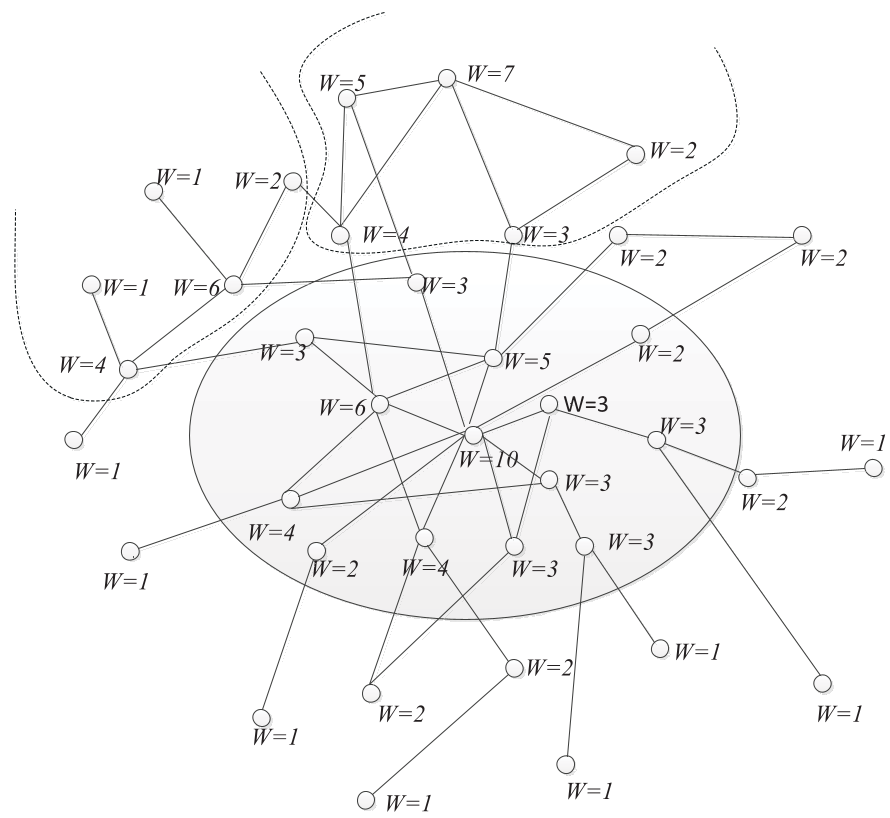 Fig 1: Dividing nodes into distinct areas based on spreading ability.
3. Impact Node Selection (Core vs. Boundary)
- Core Nodes: High-degree nodes that can spread a patch to the most neighbors.
- Boundary Nodes: The bridges between areas. Patching these "gatekeepers" effectively quarantines an infection within a single partition.
Experiments & Results
Using a subset of the Twitter Social Graph, the authors compared their targeted patching strategy (Impact Node Set - D1/D3) against random patching (D2/D4).
Key Findings:
- Spreading Efficiency: Patches distributed via Impact Nodes reached critical mass one full time-unit faster than random distribution.
- Containment Success: As shown in the experimental plots, when patches were deployed at , the infection curve for the targeted groups (D1/D3) plummeted significantly faster than the control groups.
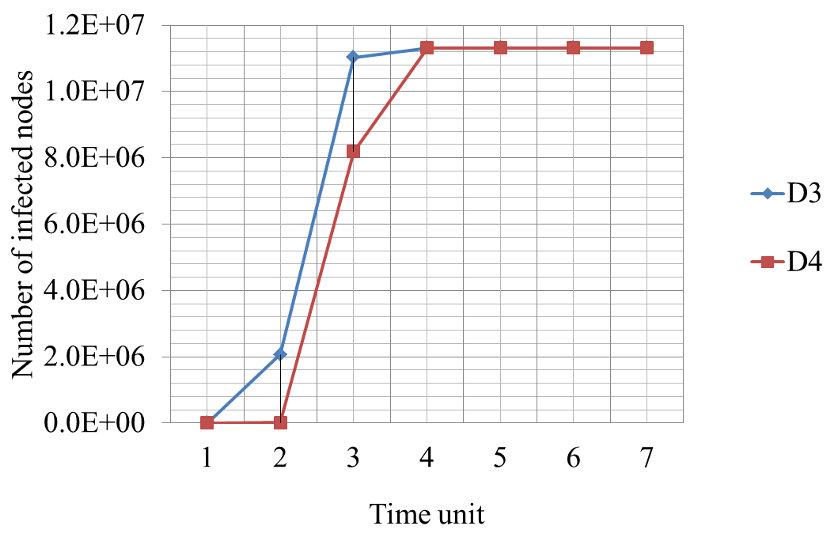 Fig 2: Comparison of network repair speed between impact node patching and random patching.
The "Early Bird" experiment (Fig 7 in the paper) further confirmed that the time-to-detection is the single most critical variable—patching at resulted in almost zero widespread infection compared to .
Critical Analysis & Conclusion
Takeaway
The paper successfully proves that topology awareness is the most potent weapon in OSN security. By focusing resources on "Boundary Nodes," defenders can effectively create virtual firewalls that the worm cannot cross, even if it has already compromised a local cluster.
Limitations
- Dynamic Environments: While the paper uses a Twitter dataset, social graphs are highly dynamic (new follows/unfollows). The overhead of re-calculating the hierarchical partition in real-time for billions of nodes remains a challenge.
- User Behavior: The assumption that (login probability) is 1 in some experiments simplifies the model, but in reality, time-zone differences and user activity patterns would create "latent periods" in patch propagation.
Future Outlook
Future iterations of this work could integrate Machine Learning to predict which boundary nodes are most likely to be targeted by a specific strain of worm, allowing for "proactive immunization" before the malware even launches.