
Bounding the Unpredictable: Deterministic Latency in Asynchronous Avionics Networks
3343_Worst Case Analysis of Packet Delay in Avionics Systems for Environmental Monitoring.
The paper presents a comprehensive framework for analyzing the Worst Case Traversal Time (WCTT) in avionics environmental monitoring systems. It introduces a novel real-time switching algorithm using clearance-time optimal policies and clock-driven scheduling to provide deterministic end-to-end delay bounds across asynchronous packet-switched networks.
TL;DR
Modern aircraft are moving away from heavy, point-to-point wiring toward packet-switched networks like AFDX. However, providing a mathematical guarantee for the Worst Case Traversal Time (WCTT) is notoriously difficult in asynchronous environments. This paper introduces a novel real-time switching algorithm and a compositional analysis framework that accurately predicts end-to-end delays by accounting for both internal bus interference (via the ASIIST tool) and unpredictable network arrival times.
Contextual Positioning
In the safety-critical world of avionics, "average performance" is irrelevant; only the "worst case" matters for certification. While previous research assumed perfectly synchronized global clocks—a laboratory fantasy—this work tackles the messy reality of asynchronous switches, positioning itself as a bridge between theoretical real-time scheduling and practical system integration.
The Problem: The Synchronization Trap
The transition to Integrated Modular Avionics (IMA) requires multiple applications to share hardware resources. The challenge is two-fold:
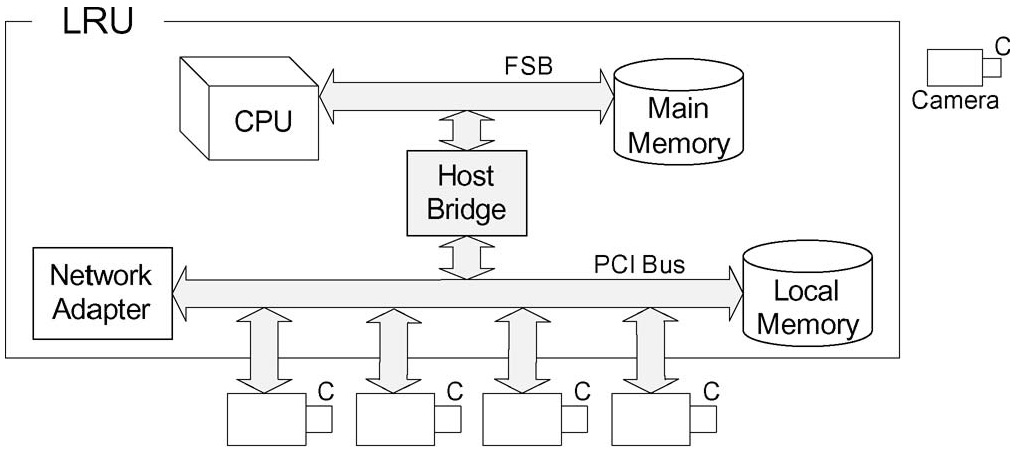
- Bus Interference: In an end node (LRU), the CPU, memory, and network adapter all compete for the PCI bus.
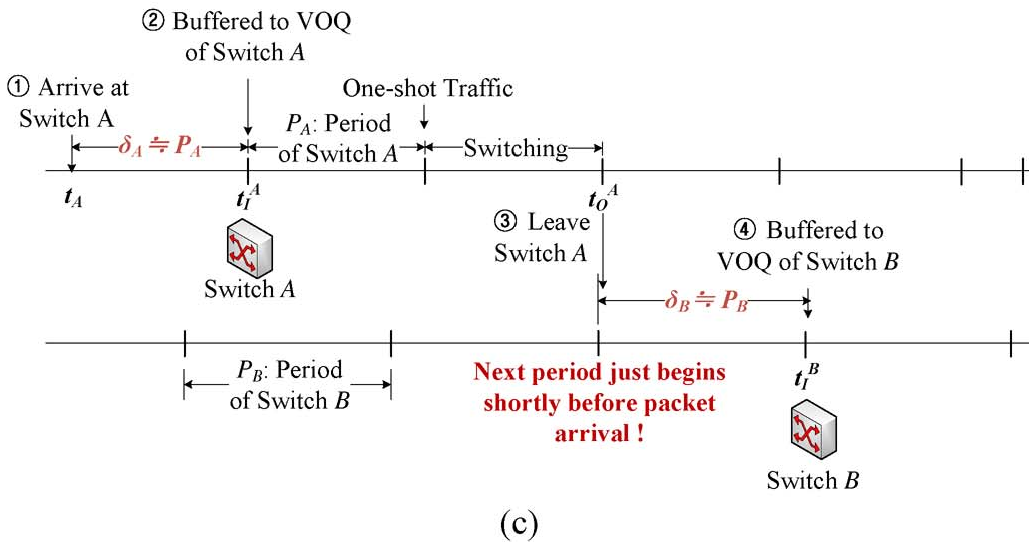
- Asynchonous Jitter: When a packet leaves Switch A, it might arrive at Switch B just after a new clock cycle has started, forced to wait for a full period. Most SOTA models fail to account for this cumulative "waiting buffer" effect.
Methodology: Compositional Delay Analysis
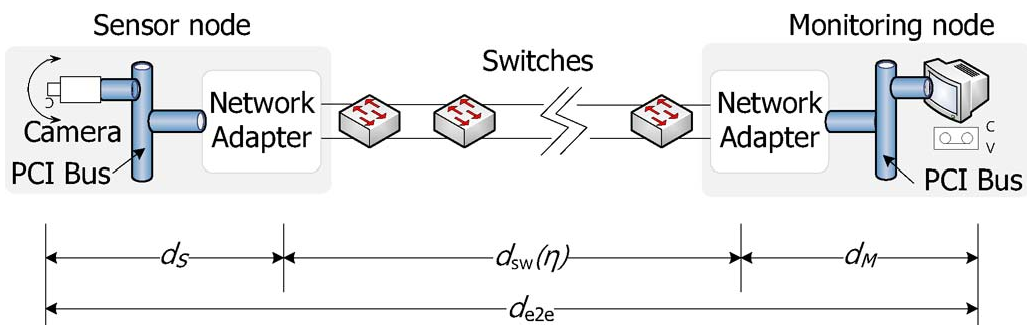
The authors divide the system into three delay components: (Sensor node), (Switched network), and (Monitoring node).
1. The Real-Time Switching Algorithm
To solve network unpredictability, the authors propose a Clearance-Time Optimal Policy. By treating traffic as "one-shot" (buffering traffic in period and switching it in ), they prove that any feasible traffic can be cleared in at most two clock periods.
2. Handling Asynchrony
In a world without a global clock, the authors derive a new bound. Because a packet may arrive at a switch just after a cycle starts, they add an extra clock period () to the delay. For switches, the WCTT formula becomes: This "3P" rule (1 period for buffer wait + 2 periods for switching) provides a robust upper bound regardless of clock drift.
3. End-Node Analysis with ASIIST
Using the Application Specific I/O Integration Support Tool (ASIIST), the authors model the PCI bus using Network Calculus. This allows them to calculate the exact micro-delays caused by bridge backlogs and bus arbitration between the camera and the network adapter.
Experimental Validation
The study analyzed a system with 5 sensor LRUs, 20 cameras, and 3 intermediate switches.
| Scenario Component | Average Delay | Worst Case Delay |
|---|---|---|
| Switched Network (LRU 3) | 10.2 ms | 18.0 ms |
| Total E2E (Pf=10ms) | - | 18.586 ms |
| Total E2E (Pf=100ms) | - | 23.863 ms |
The results (visualized below) show that the network delay dominates the total WCTT, while the internal bus delays of the LRUs remain relatively small but constant.
Depth Insight: The "3P" Tradeoff
The core "Why" behind this paper's effectiveness is the deliberate sacrifice of average latency for deterministic stability. By forcing a one-cycle buffer at every hop, the authors eliminate the complex "cascading jitter" that usually makes asynchronous networks impossible to analyze. While 18ms might seem high for a standard switch, in an aircraft's environmental monitoring system, a guaranteed 18ms is infinitely safer than an average 5ms with an occasional 500ms spike.
Critical Analysis & Conclusion
Takeaway: This framework allows avionics designers to identify "unsatisfactory designs" (where delays exceed safety bounds) during the CAD phase, long before a single wire is installed.
Limitations: The "3P" bound is over-conservative. In reality, it is statistically unlikely that a packet will hit the absolute worst-case timing at every single hop. Future work should investigate "probabilistic WCTT" to see if bounds can be tightened without compromising safety.
Future Outlook: As we move toward autonomous flight, the ability to compose timing analysis from disparate hardware components (CPUs, GPUs, and Switches) using tools like ASIIST will become the industry standard for certification.