
X-Hinter: Leveraging Social Affinity and Small-World Topology for Decentralized Recommendations
X-Hinter: a Framework for Implementing Social Oriented Recommender Systems
The paper introduces X-Hinter, a generalized framework and Java API for building social-oriented recommender systems. It leverages Small World network properties and "Affinity Networks" to provide recommendations in decentralized environments, demonstrated via a P2P file-sharing prototype called DeHinter.
TL;DR
X-Hinter is a Java-based framework designed to solve information overload through social connectivity. By modeling users as nodes in an Affinity Network that exhibits Small World characteristics, it provides localized recommendations without needing a central server or deep content analysis. Its prototype, DeHinter, proves its efficacy in the chaotic environment of P2P file-sharing.
Background: The Social Shift
In the late 2000s, the explosion of P2P networks (Gnutella, LimeWire) and early social sites (Flickr, MySpace) created a massive discovery problem. Traditional recommenders were "What-centric" (focusing on item content), but X-Hinter shifted the focus to "Who-centric" (focusing on user relationships). This work positions itself as a bridge between Social Network Analysis (SNA) and Collaborative Filtering.
Problem & Motivation
Standard recommendation engines often hit a wall in decentralized systems for two reasons:
- Content Opacity: In P2P systems, file metadata is often unreliable or missing.
- Centralization Bottlenecks: Users may not want to report their entire preference history to a central authority due to privacy or technical constraints.
The authors' insight was that Social Affinity—the spontaneous aggregation of like-minded people—contains enough structural information to predict preferences accurately, provided the network follows "Small World" principles (short paths and high clustering).
Methodology: The X-Hinter Engine
The core of X-Hinter is the Affinity Graph ().
1. The Affinity Function
For any two users (), the system calculates a similarity score (). If this score exceeds a threshold (), an edge is drawn. The authors argue that this threshold must be tuned to keep the network in a "Small World" state, where any user is just a few "hops" away from relevant content.
2. Computing Relevance
The engine determines an item's relevance () using a weighted combination of:
- Affinity: How similar is the source user to the target?
- Feedback Rating: What was the explicit rating given to the item?
- Tightness Coefficient: This is a local clustering metric. It measures the ratio of common neighbors between two users, effectively prioritizing "core" members of a social niche.
Implementation: DeHinter and the Social API
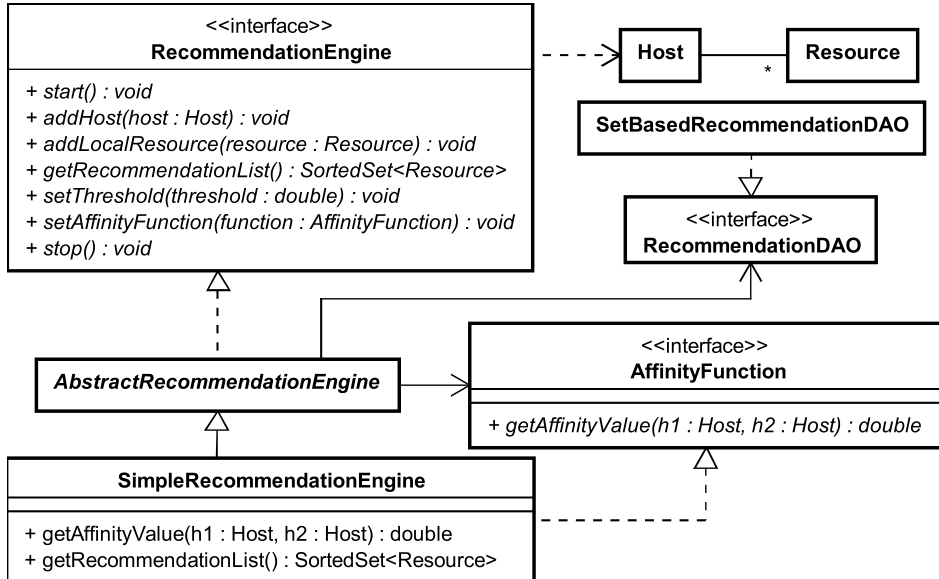
The X-Hinter framework is realized as a Java API, allowing developers to swap out data structures (Sets, Weighted Graphs, or Databases) and Affinity Functions.
To prove it works, the authors built DeHinter. Operating on the Gnutella network, DeHinter:
- Scans local files.
- Identifies peers with similar files.
- Incrementally builds a local recommendation list.
- Uses dynamic thresholding: if the peer count is low, it lowers to find more distant "friends"; if the peer count explodes, it raises to maintain performance.
Critical Analysis & Conclusion
Takeaway
X-Hinter demonstrates that social topology is a powerful proxy for item relevance. By focusing on the structure of interactions rather than the content of the items, it creates a robust, privacy-respecting recommendation layer.
Limitations
- Cold Start: The system relies on users already having some shared resources to establish the first "affinity" links.
- Dynamic Environments: In highly volatile P2P networks, maintaining a stable "Small World" graph as peers join and leave requires significant overhead.
Future Outlook
While the paper was written in the era of LimeWire, the logic is more relevant than ever in the age of Decentralized Social (DeSo) and Fediverse platforms like Mastodon. Using social graphs to filter content locally could be the key to scaling decentralized platforms without resorting to the algorithmic manipulation seen in centralized social media.