
Smart Photobooth: Bridging the Gap Between Neural Style Transfer and Art History through XAI
Toward XAI & Human Synergies to Explain the History of Art: The Smart Photobooth Project
The "Smart Photobooth" project introduces a human-agent architecture that leverages Neural Style Transfer (NST) and eXplainable AI (XAI) to disseminate art history knowledge. It combines AI-generated visual transformations with expert-curated historical context to create an interactive educational experience.
TL;DR
The "Smart Photobooth" is an ambitious outreach project that goes beyond simple "Snapchat-style" filters. By combining Generative Adversarial Networks (GANs) for Neural Style Transfer with eXplainable AI (XAI), it provides users with a personalized portrait alongside a deep-dive into the historical, political, and technical nuances of specific art movements like Impressionism or Cubism.
Problem & Motivation: The "Shallow" Interpretation of AI Art
In the current landscape, AI applications in art—such as style transfer—are often criticized for being purely cosmetic. While a model can "painterly" render a selfie, it cannot explain why Claude Monet chose specific brushstrokes or the political turmoil that influenced Picasso's Guernica.
The authors argue that art comprehension is an exclusively human capacity that requires a synergy between:
- Objective Features: Visual schemes like "Linear vs. Painterly."
- Subjective Context: Historical background and the artist’s intent.
Current XAI solutions are often too technical for the general public, and traditional art history education can be inaccessible. The Smart Photobooth aims to bridge this by acting as an "intelligent mediator."
Methodology: The Human-Agent Architecture
The core of this work is a multi-layered architecture that shifts from a "Black Box" model to a "Human-Centered" explanation system.
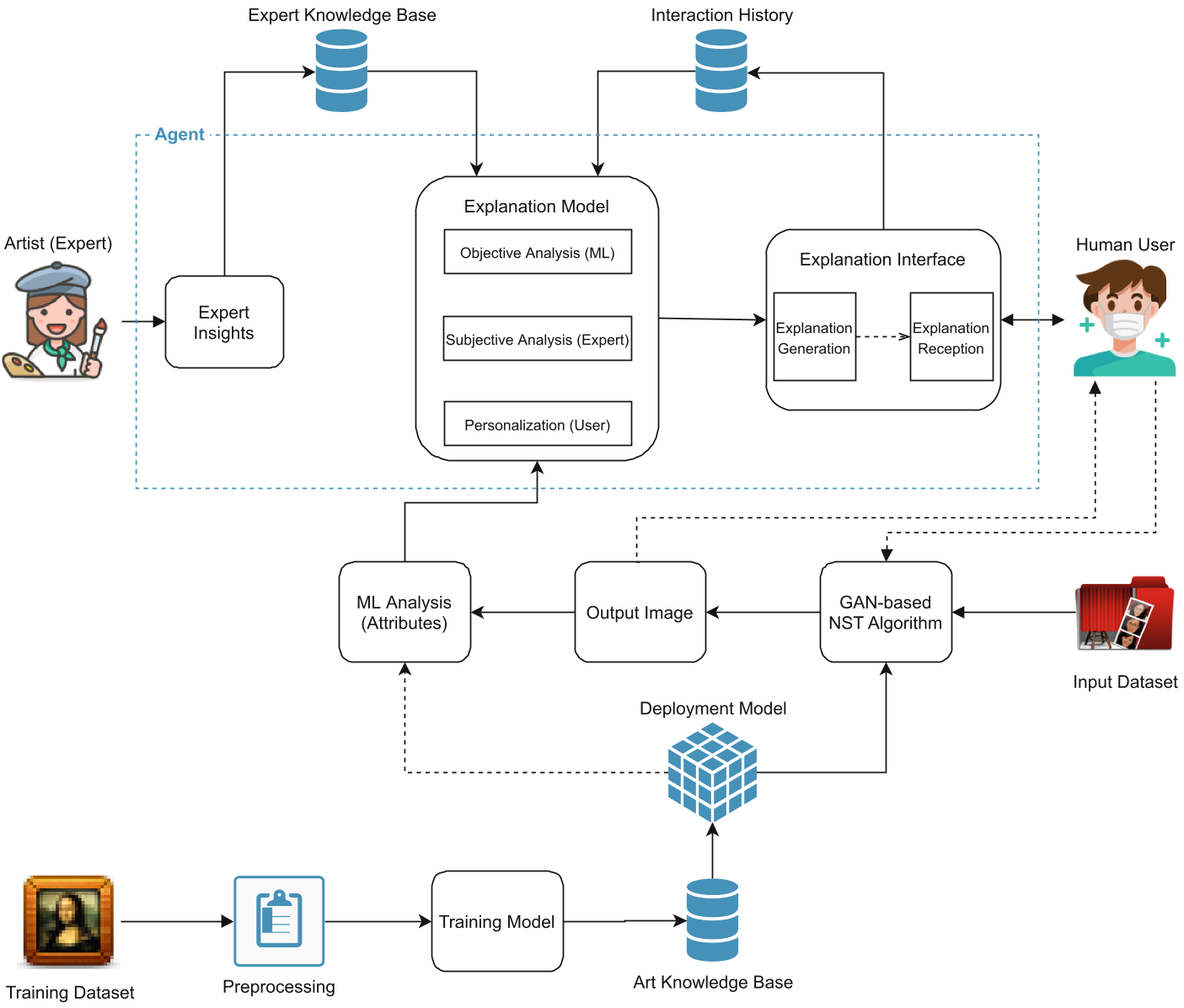
1. Neural Style Transfer (NST)
The system utilizes CycleGAN and StyleGAN. CycleGAN allows for unpaired image-to-image translation (training on a general style without needing specific "before/after" pairs), while StyleGAN provides finer control over the blending of source and target features.
2. The Explainable Agent
Instead of a simple output, an autonomous agent generates a multi-media presentation. It pulls from three distinct databases:
- Art Knowledge Base: Contains the ML features learned during training.
- Expert Knowledge Base: Subjective insights provided by professional artists (contextualizing the "Why").
- Interaction History Base: Personalized data to ensure the explanation matches the user's cognitive load and interest level.
3. Wölfflin’s Principles
To make "Machine Learning Analysis" understandable, the authors link neural network activations to Heinrich Wölfflin’s five visual principles. For example, the agent can point to blurred edges in an Impressionist output and explain it through the lens of "Painterly vs. Linear" forms.
Experiments & Results: Cultural Outreach
The project is deployed across several venues, including the Scienteens Lab and the AI & Art Pavilion in Luxembourg.
- Visual Fidelity: High-quality transformations using GAN architectures.
- Educational Impact: Preliminary workshops targeting high school students show increased engagement in both STEM (AI training) and Humanities (Art Styles).
- Interpretability: By using XAI to highlight specific "Wölfflin features" on the user's own face, the system successfully grounds abstract art concepts in a familiar context.

Critical Analysis & Conclusion
The Smart Photobooth project represents a significant step toward Human-AI Synergy. However, the authors acknowledge several open challenges:
- Neuro-symbolic Integration: Truly merging "sub-symbolic" pixel data with "symbolic" logical reasoning remains a technical hurdle.
- Accessibility: Current audiovisual formats may exclude users with visual or audio impairments.
- Gamification: While promising for engagement, the long-term educational benefits of gamified learning are still being studied.
Overall, this work demonstrates that the future of XAI lies not just in "debugging" models, but in enriching human culture by making complex expertise accessible through interactive, AI-driven storytelling.