
MOFDEM: Reimagining Electronic Dictionaries for the Age of Computational Linguistics
Integration of an XML electronic dictionary with linguistic tools for natural language processing
This paper introduces MOFDEM, a specialized XML schema for encoding Spanish electronic dictionaries tailored for Natural Language Processing (NLP). By decoupling semantic information from linguistic processes (like morphology and phonology), it achieves a lean, extensible data structure that maintains SOTA performance across 145,000 meanings.
TL;DR
This research presents MOFDEM, a rigorous XML-based formal model designed to transform static Spanish dictionaries into dynamic resources for Natural Language Processing (NLP). Unlike previous attempts that merely digitized printed entries, MOFDEM separates "what a word means" from "how a word behaves," allowing external high-performance linguistic tools to handle morphology and phonology.
Academic Positioning: This work bridges the gap between traditional lexicography and modern Computational Linguistics, moving away from the flexible (but often messy) TEI standards toward a strictly typed, machine-actionable XML Schema.
Problem & Motivation: The "Paper Limitation" Trap
Most electronic dictionaries suffer from a legacy hang-over: they are digital clones of paper books. This leads to two critical failures in NLP:
- Redundancy: Encoding gender, number, and conjugation for every entry bloats the database and creates maintenance nightmares.
- Lack of Coverage: If a user searches for an inflected diminutive like perrillo (puppy) or a complex verb form like precomiéndoselas, traditional dictionaries often return "Result Not Found" because they only store the canonical form (perro).
The authors argue that dictionaries should be data repositories, not comprehensive linguistic processors.
Methodology: The MOFDEM Architecture
The core innovation is the MOFDEM (Formal Model of the Mono-lingual Electronic Dictionary). It defines a hierarchy where a dictionary comprises Entries, which contain Articles, which in turn branch into Accepted Meanings and Expressions.
1. The Separation Principle
Instead of including fields for syllables or stress (which follow general rules in Spanish), MOFDEM omits them. Instead, it relies on Java-based linguistic tools to compute these values on-the-fly.
2. Structural Precision
The researchers opted for W3C XML Schema over DTDs to enforce "strongly typed" data. This ensures that every element (like <GrammarCategory> or <Usage>) follows a strict logic, making it far superior for XSL transformations and web-service dialogues.
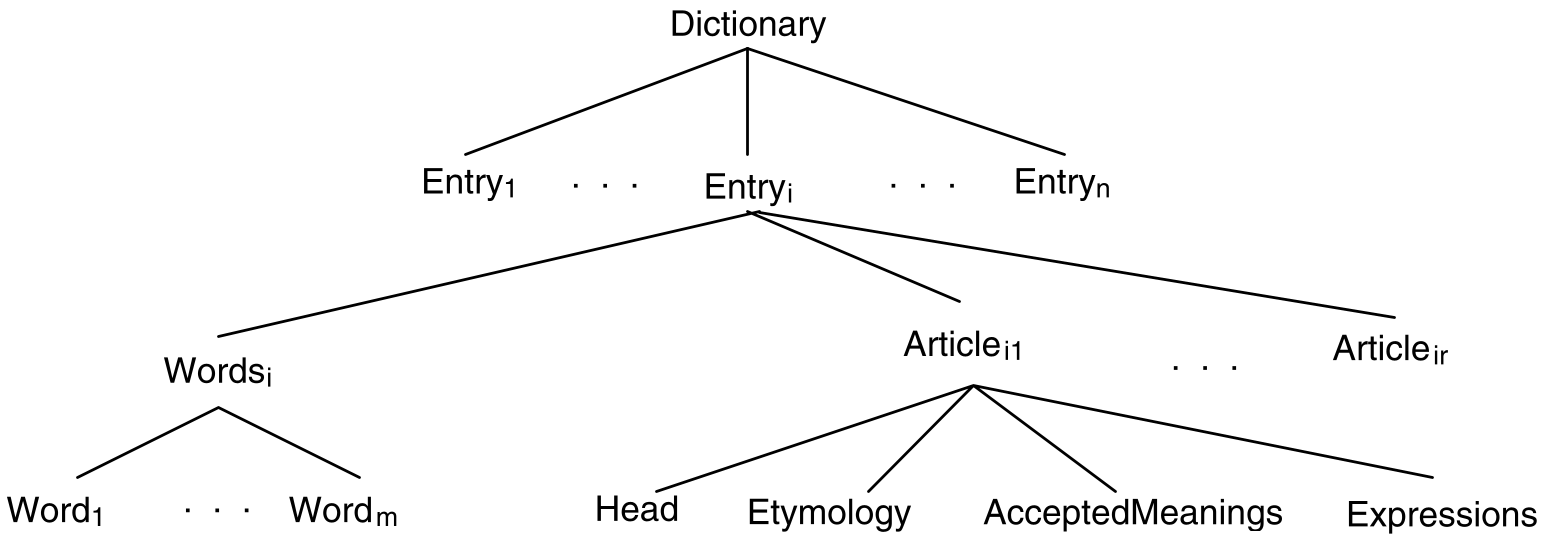 Figure 1: The hierarchical structure of an entry in the MOFDEM model.
MOFDEM vs. TEI: A Shift Toward Precision
The Text Encoding Initiative (TEI) is the gold standard for text digitization, but the authors highlight its weaknesses for NLP:
- Ambiguity: TEI allows tags to be combined in multiple ways (
entryvsentryFree), making it difficult to write efficient search algorithms (XQuery). - Irrelevance: TEI includes tags for human-centric formatting, which MOFDEM discards in favor of pure semantic data.
Validation & Results
The authors stress-tested MOFDEM by converting one of the largest Spanish dictionaries:
- Dataset: 67,000 entries, 145,000+ meanings.
- Outcome: The model successfully captured complex items, such as 18,406 compound expressions, which are often the "Achilles' heel" of dictionary encodings.
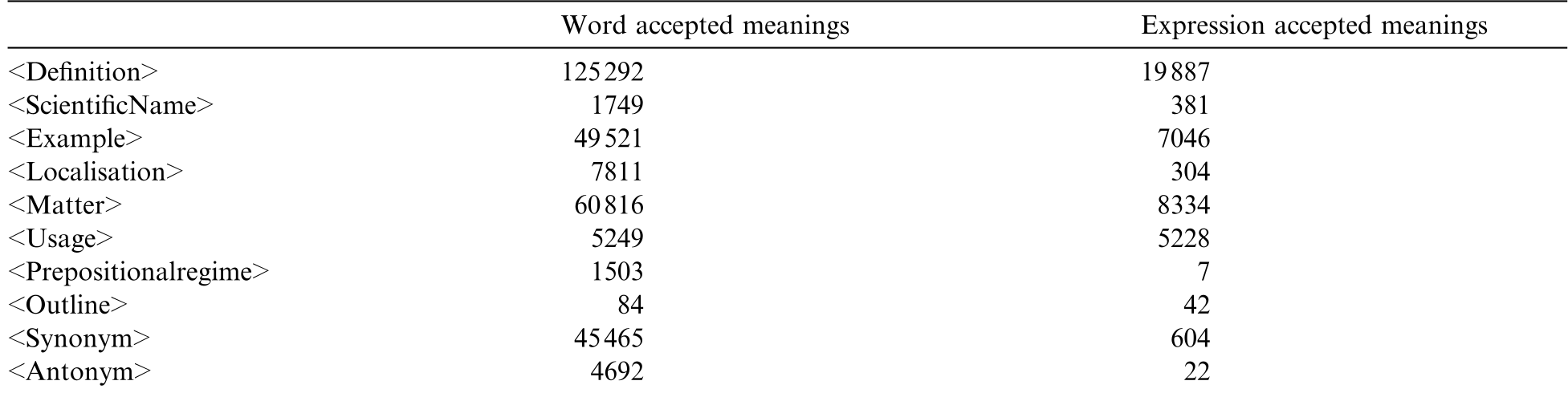 Table 1: Quantitative breakdown of XML elements validated during the study.
Critical Insight: Why This Matters Today
While this paper was written in the mid-2000s, its core philosophy is more relevant than ever in the era of Large Language Models (LLMs) and Retrieval-Augmented Generation (RAG).
By providing a clean, XML-searchable semantic backbone, MOFDEM-style architectures allow AI systems to retrieve precise dictionary definitions without the "hallucination" noise inherent in unstructured text. It proves that a well-structured XML schema is often more powerful than a massive, unstructured relational database.
Conclusion
MOFDEM represents a paradigm shift where the "Dictionary" is no longer a book, but a Semantic Service. By stripping away redundant linguistic data and enforcing strict XML schemas, the authors created a blueprint for lexical resources that are scalable, interoperable, and fundamentally "smarter."
Future Work: The authors envision expanding this to cross-linguistic morpholexical relationships, creating a global web of structured meaning.