
XSS Worms in Social Networks: How Community Structure and Selective Monitoring Can Save OSNs
A Study of XSS Worm Propagation and Detection Mechanisms in Online Social Networks
This paper presents a comprehensive study of Cross-Site Scripting (XSS) worm propagation in Online Social Networks (OSNs), identifying user behaviors and network topology as critical factors. It proposes the "Selective Monitoring" approach, leveraging OSN characteristics like high clustering to detect malware more efficiently than exhaustive scanning methods.
TL;DR
Researchers have found that the very structure of our social lives—hanging out in tight "cliques" and mostly visiting friends—actually acts as a natural quarantine for digital viruses. By exploiting this "highly clustered" nature of Online Social Networks (OSNs), we can move away from scanning every single post to a Selective Monitoring strategy that is significantly more resource-efficient and up to 80 times more effective than random sampling.
Academic Context: This work moves beyond simple epidemic models (like SI) by incorporating real-world OSN topological features (Small-World, Power-Law degree distribution) to design actionable defense mechanisms.
The "Exhaustive" Bottleneck
Modern OSNs like Facebook face a staggering challenge: scanning 25 billion posts daily. Exhaustive checking—where every read and write operation is monitored—consumes massive computational power.
The authors suggest a shift in intuition: If we can't watch everyone, who should we watch to catch a worm the fastest?
The Physics of Propagation: Why "Friends First" Matters
The paper identifies three variables that dictate how fast an XSS worm (like the infamous Samy worm) spreads:
- Visiting-Friends Probability (): Users are more likely to visit friends than strangers. This traps the worm in a local community for a longer duration.
- Clique Sizes: Smaller, isolated communities act as "quarantine zones."
- Clustering Coefficients: Digital "triangles" (if A knows B and C, B and C likely know each other) keep the infection local.
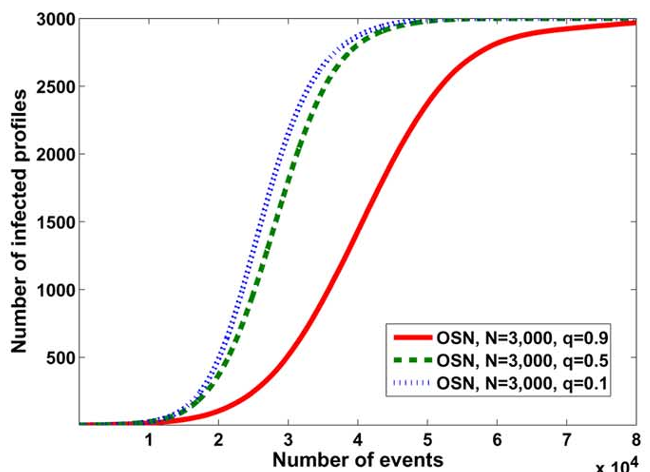 Fig 1: Notice how higher (visiting friends) radically flattens the infection curve in both analytical models and simulations.
Methodology: The Selective Monitoring Approach
Instead of monitoring 100% of nodes, the authors propose monitoring "Candidate Nodes." The core challenge is the selection metric. They compared five:
- Node Degree: Monitoring the "celebrities" (hubs).
- Closeness/Betweenness: Monitoring those who bridge different parts of the network.
- PageRank: Tracking the likelihood of a random walk (or worm) landing on a node.
- Cross-Clique Connectivity: A novel metric targeting individuals who belong to multiple distinct social groups.
Architecture of Detection
The system places "monitors" on ovih candidates. When a candidate's friend posts a message, the monitor checks for malicious signatures. Because OSNs have a "Small World" property, infecting any node quickly leads the worm to a "hub" where it can be detected.
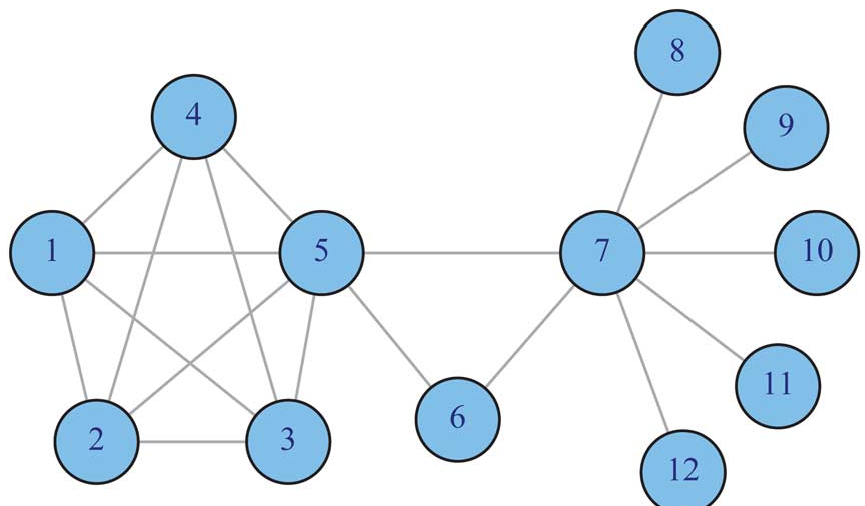 The study utilized a representative graph structure to calculate importance metrics.
Experimental Results: Quality over Quantity
The results confirm a massive efficiency gain:
- Strategic vs. Random: Using strategic metrics like Cross-Clique Connectivity or Node Degree caught worms 75-80x faster than picking nodes at random.
- Computation vs. Detection: While metrics like Closeness are computationally expensive to calculate, simple Node Degree and PageRank provided nearly identical detection performance with a fraction of the setup time.
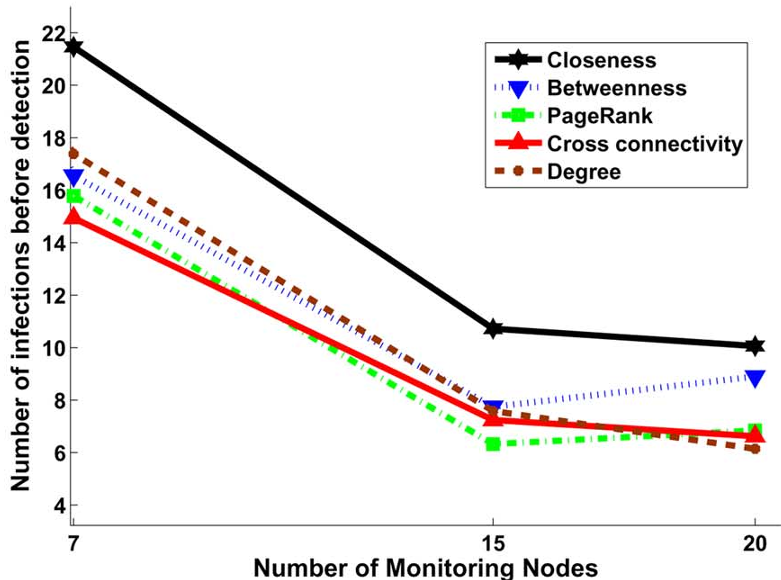 As the number of candidates increases, the number of users infected before detection drops sharply.
Critical Insight & Conclusion
Takeaway
The study proves that "Network Awareness" is a superpower in cybersecurity. By understanding that social networks are not random graphs but "Clustered Small Worlds," we can protect billions of users by watching just a few dozen strategic points.
Limitations & Future Work
The current model assumes an undirected graph (mutual friendship). However, platforms like Twitter/X use directed graphs (following), where propagation is asymmetrical. The authors plan to extend this math to those "Influence-style" networks and integrate real-world user activity data to replace uniform random click assumptions.
Final Thought: This research provides the theoretical foundation for "Smart Scanning"—allowing platforms to redirect their massive CPU budgets from redundant checks to high-intensity analysis of suspicious nodes.