
YOLO-World: Redefining Real-Time Object Detection for the Open World
YOLO-World: Real-Time Open-Vocabulary Object Detection
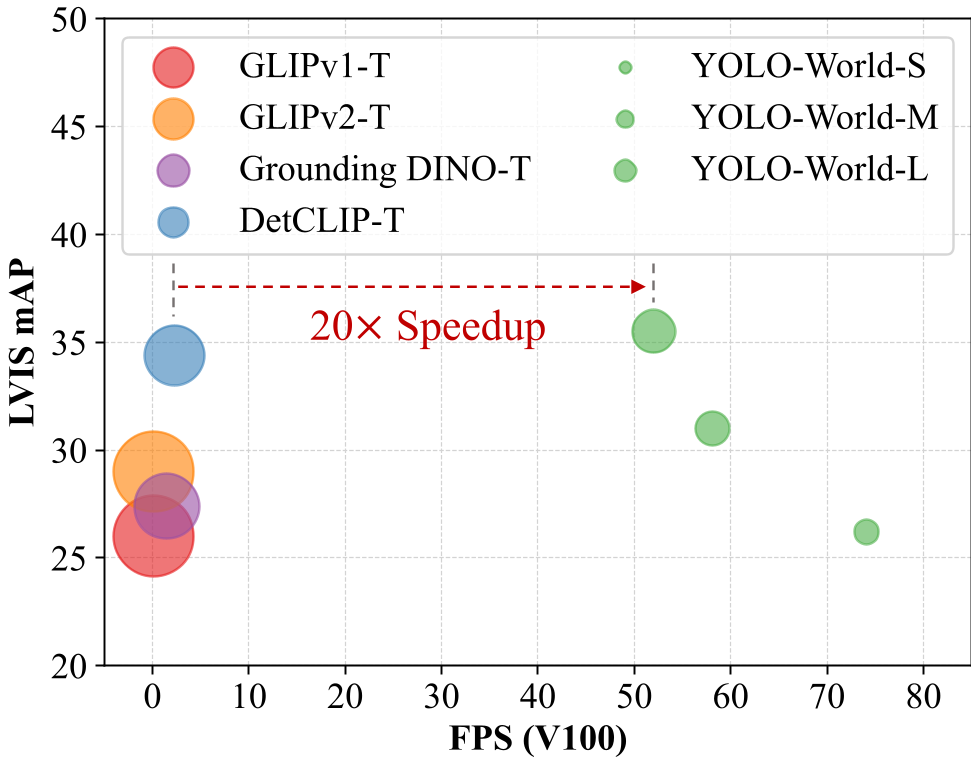
YOLO-World is a state-of-the-art, real-time open-vocabulary object detector that extends the YOLO architecture with vision-language modeling. By introducing the RepVL-PAN and pre-training on large-scale datasets, it achieves 35.4 AP at 52.0 FPS on the LVIS dataset in a zero-shot manner, setting a new benchmark for efficient open-set detection.
TL;DR
The "You Only Look Once" (YOLO) family has long been the king of real-time detection, but it has always been "blind" to anything outside its small, fixed vocabulary. YOLO-World changes the game. By marrying YOLO’s efficiency with CLIP’s linguistic intelligence, it can detect virtually any object described in text—from a "golden dog" to a "jumping person"—at lightning speeds (50+ FPS), even if it never saw those specific labels during supervised training.
Background: The "Fixed Vocabulary" Trap
In traditional computer vision, if you train a model on COCO, it knows 80 things. To make it know 81, you often need new labels and a full retraining session. Previous Open-Vocabulary Detection (OVD) attempts, like GLIP or Grounding DINO, solved the "80 things" problem by using massive Transformers. However, they were slow—averaging 1-2 FPS. YOLO-World bridges this gap, aiming for the "Open-Vocabulary + Real-Time" sweet spot.
Methodology: How YOLO "Talks" to Text
The genius of YOLO-World lies in how it integrates language without ruining its hardware-friendly nature.
1. Re-parameterizable Vision-Language PAN (RepVL-PAN)
Instead of just sticking a text encoder at the end, the authors redesigned the Path Aggregation Network.
- Text-guided CSPLayer: Injects linguistic cues directly into the image features using max-sigmoid attention.
- Image-Pooling Attention: Updates the text embeddings with visual context, ensuring that the word "dog" in the prompt actually aligns with the visual features of "dog" in that specific image.
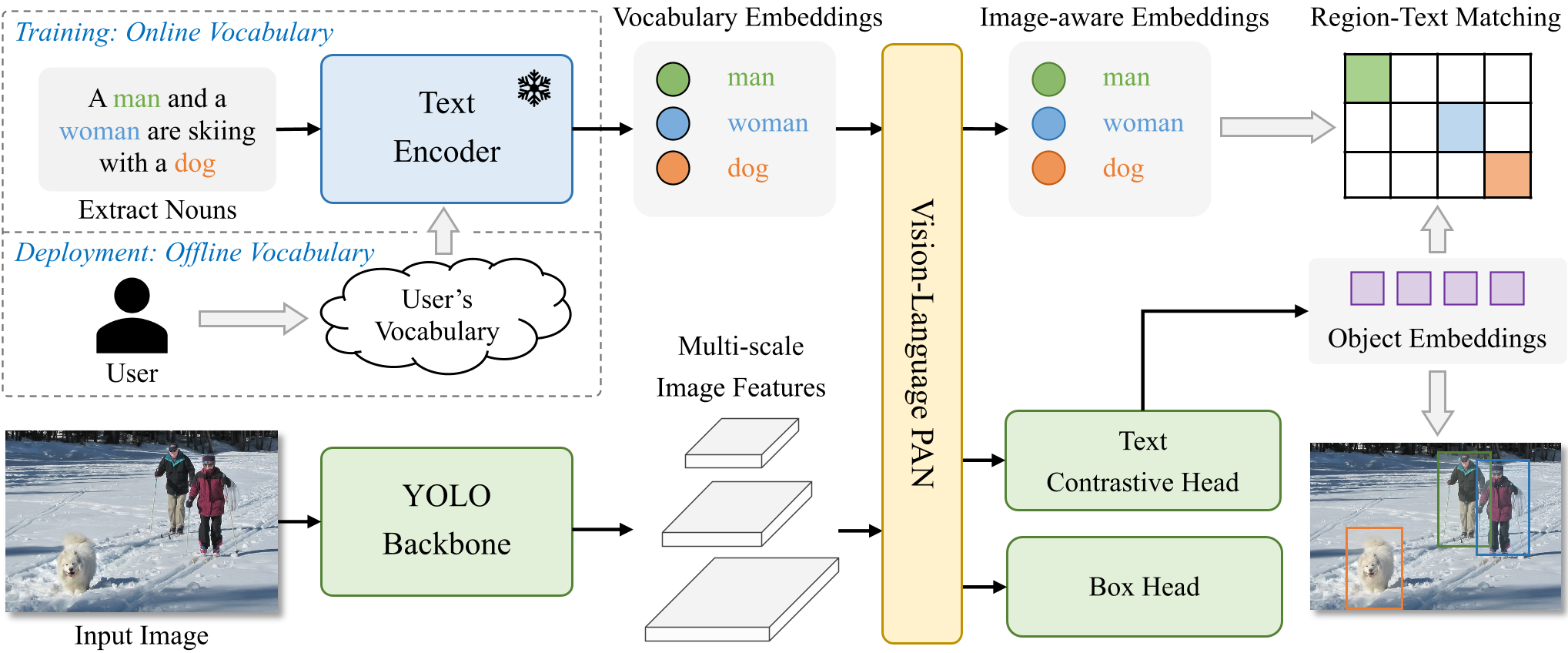
2. The "Prompt-then-Detect" Paradigm
Most OVD models require a heavy text encoder (like BERT or CLIP-ViT) to run alongside the image model. YOLO-World realizes that for a specific task, the vocabulary is often static during the session. They pre-calculate the text embeddings and re-parameterize them into the 1x1 convolution weights of the RepVL-PAN.
Why this matters: During inference, the text encoder is deleted. Use only the visual backbone. Result? Zero overhead for being "open-vocabulary."
Experiments: Speed Meets Accuracy
The evaluation on the LVIS minival (which has 1200+ categories) is the ultimate test of "open-set" capability.
- Efficiency: YOLO-World-L hits 35.4 AP at 52 FPS. Competing models with similar accuracy often struggle to hit 2-5 FPS.
- Scalability: The paper shows that even the "Small" version (YOLO-World-S) can achieve 26.2 AP, proving that small models have enough capacity to learn from large-scale vision-language data.
Deep Insight: Beyond Boxes
YOLO-World isn't just for bounding boxes. The authors demonstrated its versatility in:
- Open-Vocabulary Instance Segmentation: By adding a mask head, it can segment rare objects it wasn't explicitly trained to segment.
- Referring Expression Detection: It can find "the person in red" or "the tallest person," behaving like a grounding model.
Critical Analysis & Conclusion
Takeaway
The core contribution is the RepVL-PAN. It proves that we don't need heavy cross-attention layers throughout the whole network to achieve multi-modal alignment. Moving the "fusion" to the neck/head and using re-parameterization is a blueprint for future industrial AI applications.
Limitations
While YOLO-World is fast, it still relies on a pre-trained CLIP encoder for its semantic "base." If CLIP hasn't seen a very niche concept, YOLO-World likely won't detect it either. Furthermore, "Pseudo-labeling" on CC3M data (using a larger model to label a smaller one) is still a bottleneck in the training pipeline.
Future Outlook
YOLO-World paves the way for "Foundational Detection Models" that are small enough to run on your phone or a drone, but smart enough to understand any natural language command.