
The YouTube Lens: How Nonverbal Cues Predict Your Personality in Vlogs
The YouTube Lens: Crowdsourced Personality Impressions and Audiovisual Analysis of Vlogs
This paper presents "The YouTube Lens," a comprehensive framework for analyzing crowdsourced personality impressions of vloggers using multimodal nonverbal behavior. By leveraging Amazon Mechanical Turk and automated audiovisual analysis on 442 vlogs, it achieves a significant SOTA milestone in predicting Big-Five personality traits (Extraversion R² up to 36%) from social media video.
TL;DR
Researchers Joan-Isaac Biel and Daniel Gatica-Perez have developed a "multimodal lens" through which we can understand how YouTube vloggers are perceived by their audience. By combining crowdsourced human impressions from Amazon Mechanical Turk with automated audio and video analysis, the study demonstrates that nonverbal behavior—how you talk and move—can predict personality impressions with high accuracy, particularly for Extraversion, and that these traits directly impact a vlogger's success in terms of views and likes.
Background: Beyond Text and Profiles
Until recently, the AI study of personality in social media was "blind" and "deaf," focusing almost exclusively on text-based blogs or Facebook profile metadata. However, the rise of vlogging introduced a massive stream of conversational data where nonverbal behavior (prosody, gaze, and kinetic energy) conveys information that words simply cannot capture.
The researchers occupied a unique position in the academic coordinate system: transitioning from controlled laboratory experiments to the "wild" and noisy environment of YouTube.
The Problem & Research Intuition
Why is this difficult? Traditional lab studies use high-quality cameras and professional actors. YouTube vlogs are diverse, often low-resolution, and feature spontaneous behavior. The authors' insight was that "thin slices" (first 60 seconds) are enough for human observers to form consistent impressions—and if humans can do it, a machine learning model trained on the right nonverbal features can do it too.
Methodology: The Technical Breakdown
The study pipeline consists of three core stages:
1. The Crowdsourcing Engine
They used 442 vlogs and 2,210 annotations from Mechanical Turk. Unlike professional psychiatrists, these workers are "ordinary people," mirroring the actual YouTube audience. They used the TIPI (Ten-Item Personality Inventory) to measure the Big-Five: Extraversion, Agreeableness, Conscientiousness, Emotional Stability, and Openness.
2. Multi-Channel Feature Extraction
The model looks at three distinct behavioral channels:
- Audio: Speech activity (how much they talk) and Prosody (pitch, energy, and loudness).
- Video: Looking and Pose (gaze persistence) and Visual Activity (Weighted Motion Energy Images - wMEI).
- Multimodal: The intersection of gaze and speech (e.g., looking at the camera while speaking).
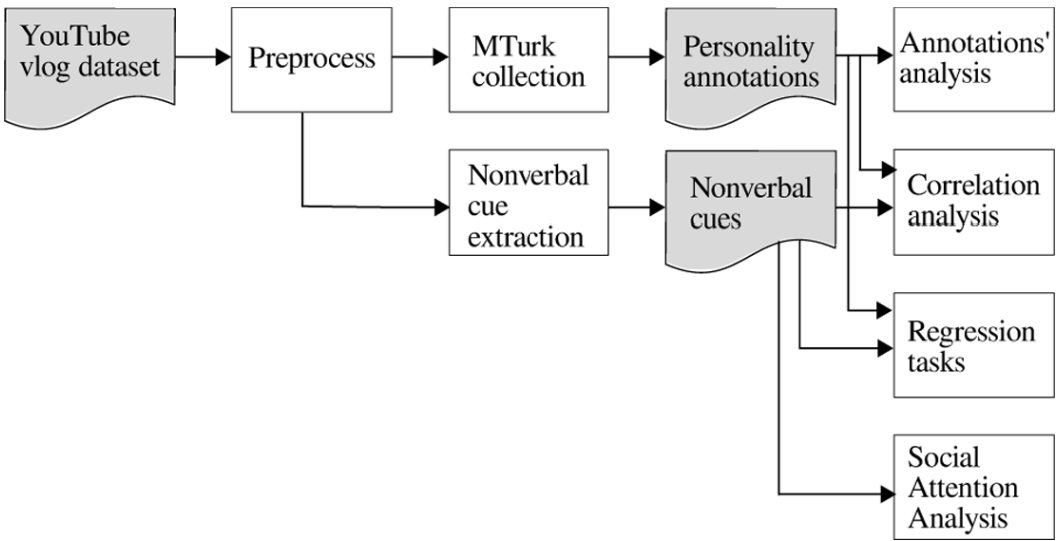 Fig 1. Schematic of the research framework: from video slices to personality prediction.
Experiments and Results
The study yielded two breakthrough findings:
Personality as a Driver for Social Attention
There is a measurable link between perceived personality and channel growth.
- Extraversion, Openness, and Conscientiousness have a linear relationship with view counts.
- Agreeableness showed a "U-shaped" relationship, meaning extremely agreeable or extremely disagreeable ("edgy") vloggers tend to get more attention.
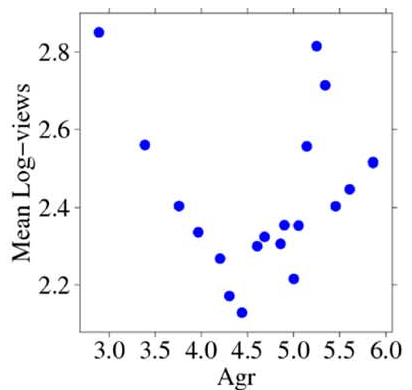 Fig 2. The correlation between vlogger personality scores and YouTube views.
Machine Learning Performance
Using an SVM regressor with an RBF kernel, the authors achieved an R² of up to 36% for Extraversion. While predicting "Emotional Stability" remains a challenge for machines (low cue utilization), the prediction of "Conscientiousness" and "Openness" also showed significant improvements over the baseline.
| Feature set | Extraversion (R²) | Conscientiousness (R²) | Openness (R²) |
|---|---|---|---|
| Audio alone | 31% | 7% | 6% |
| Audio + Video | 36% | 10% | 10% |
Deep Insights & Future Outlook
This work confirms that Extraversion is the most "observable" trait in digital video, largely due to talkativeness and high motion energy.
The Takeaway: If you are building a recommendation engine or a talent sourcing tool for influencers, monitoring nonverbal behavior—rather than just transcripts—is critical.
Limitations: The study relies on hand-crafted features. Today, we might use Deep Representation Learning (like ResNet or Transformers) to extract features directly from frames, potentially uncovering subtle "micro-expressions" that this study's broad motion energy cues might miss. However, for a foundational study, "The YouTube Lens" provided the blueprint for how AI perceives human character in the digital age.