
ZebraLancer: Solving the Privacy-Transparency Paradox in Decentralized Crowdsourcing
ZebraLancer: Private and Anonymous Crowdsourcing System atop Open Blockchain
ZebraLancer is a decentralized crowdsourcing system built on Ethereum that ensures data confidentiality and participant anonymity through a novel "outsource-then-prove" methodology and common-prefix-linkable anonymous authentication. It achieves SOTA privacy protections without relying on a central arbiter.
TL;DR
ZebraLancer is the first decentralized crowdsourcing system to achieve both data confidentiality and accountable anonymity on an open blockchain. By combining zk-SNARKs with a novel linkable authentication primitive, it allows requesters and workers to interact without a middleman, ensuring that data stays secret from the public and users remain anonymous—unless they try to cheat by submitting multiple times to the same task.
Background: The Limits of Transparency
Crowdsourcing platforms like Amazon Mechanical Turk (MTurk) are plagued by several issues: high fees, biased dispute resolution, and catastrophic privacy breaches (e.g., the Uber data leak).
Blockchain seems like the perfect solution due to its immutability and lack of a central authority. However, current blockchain-based crowdsourcing suffers from two fatal flaws:
- Transparency vs. Confidentiality: If you submit data to a public ledger, everyone sees it. Distrustful workers can simply copy others' answers (Free-riding).
- Anonymity vs. Accountability: If users are fully anonymous, they can create "Sybil" identities to claim rewards multiple times. If they are not anonymous, their participation history reveals sensitive location or behavioral traces.
The Core Insight: Outsource-then-Prove
ZebraLancer resolves the conflict between blockchain transparency and data privacy using a methodology the authors call Outsource-then-Prove.
Instead of the smart contract calculating rewards (which would require it to see the raw data), the process is split:
- Step 1: Workers submit encrypted data to the contract.
- Step 2: The requester decrypts the data off-chain.
- Step 3: The requester submits the reward distribution along with a zk-SNARK proof.
The zk-SNARK proves that the rewards were calculated exactly according to the pre-defined policy without revealing the underlying data.
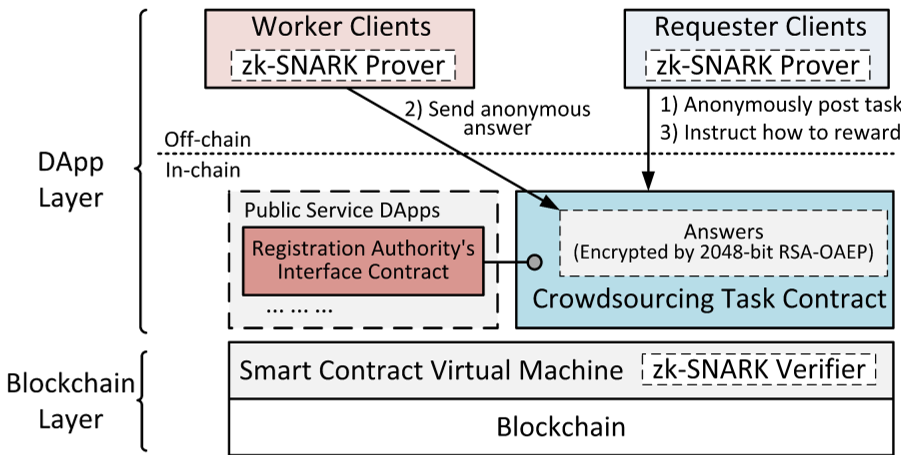 Fig 1. The high-level architecture of ZebraLancer, bridging off-chain computation with on-chain verification.
Methodology: Common-Prefix-Linkable Anonymous Authentication
To solve the "double submission" problem while maintaining anonymity, the authors propose a new cryptographic primitive. The intuition is a subtle linkability:
- Unlinkable: A worker participating in "Task A" and "Task B" cannot be linked. Their privacy is preserved across the platform.
- Linkable: If a worker submits two answers to "Task A," the "Common Prefix" (the Task ID) allows the system to detect that the submissions came from the same person.
This ensures accountability (one person, one vote/submission) without a centralized Registration Authority knowing who is doing what.
Experimental Results & Performance
The authors implemented ZebraLancer on Ethereum, modifying the Ethereum Virtual Machine (EVM) to support optimized zk-SNARK verification.
Key Technical Metrics:
- Verification Speed: On a standard PC, verifying a worker's identity or a reward policy takes less than 20ms.
- Storage Efficiency: Even with 11 workers, the keys and proofs required on-chain total only ~40KB—well within the limits of practical block sizes.
- Worker Effort: Generating the anonymous proof takes ~60-70 seconds. While heavy for a mobile device, it is a small price for workers who value ultimate privacy.
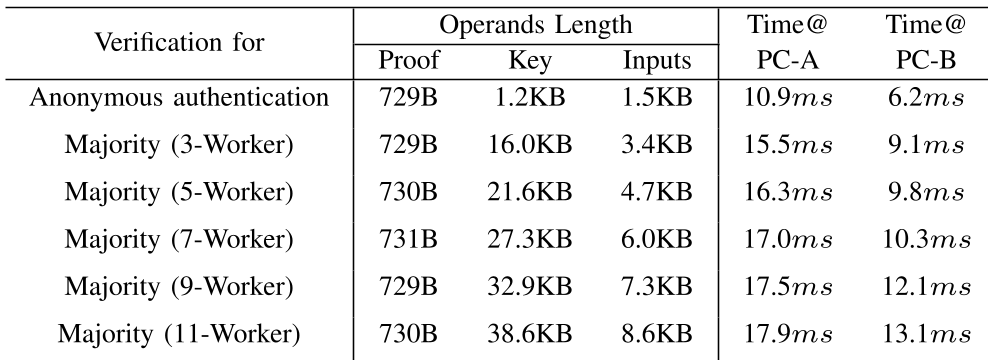 Table 1. On-chain execution time and storage requirements for various task sizes.
Critical Analysis & Future Outlook
ZebraLancer is a major step forward, but it opens new questions:
- Scalability: While 11-worker tasks are efficient, how does this scale to millions of images (like ImageNet)? The authors suggest integrating off-chain storage like IPFS or Swarm.
- The RA Gap: The system still relies on a Registration Authority to weed out bots initially. Removing this last vestige of centralization remains an open challenge.
Conclusion
ZebraLancer demonstrates that the "Privacy vs. Utility" trade-off is not a zero-sum game. Through clever protocol design and Zero-Knowledge Proofs, we can build fair, anonymous, and decentralized marketplaces that protect both the buyer's pocket and the worker's identity.