
Zero-Cost Shop Localization: Turning Mobile Payments into Precision Indoor Maps
Zero-cost and map-free shop-level localization algorithm based on crowdsourcing fingerprints
This paper introduces a zero-cost, map-free shop-level indoor localization algorithm that leverages crowdsourcing fingerprints (Wi-Fi and opportunistic GPS) collected during mobile payments. By employing a two-level hierarchical ensemble learning architecture, the system achieves over 92% accuracy in identifying specific shops within large malls.
TL;DR
Indoor localization usually requires a painful choice: high-precision manual fingerprinting (expensive) or low-precision GPS/Cell-ID (free but useless indoors). This paper presents a third way: a zero-cost, map-free system that harvests Wi-Fi and GPS data during mobile payment events. By combining a two-level classification hierarchy with behavioral features like "repurchase probability" and "payment time peaks," the authors achieve a staggering 92.81% shop-level accuracy without ever stepping foot in the mall for a site survey.
The Problem: The High Cost of "Indoor Visibility"
Most indoor positioning systems (IPS) rely on a Radio Map. Creating this map involves engineers walking through every shop with specialized equipment to record Wi-Fi signal strengths (RSSI). This is labor-intensive and becomes obsolete the moment an Access Point (AP) is moved or a shop changes its layout.
The authors identify three core pain points:
- Dependency on Maps: Requires accurate CAD floor plans.
- Labor Burden: Professional site surveys are non-scalable.
- Signal Instability: RSSI oscillates wildly due to human traffic and environmental changes.
Methodology: The Hierarchical Approach
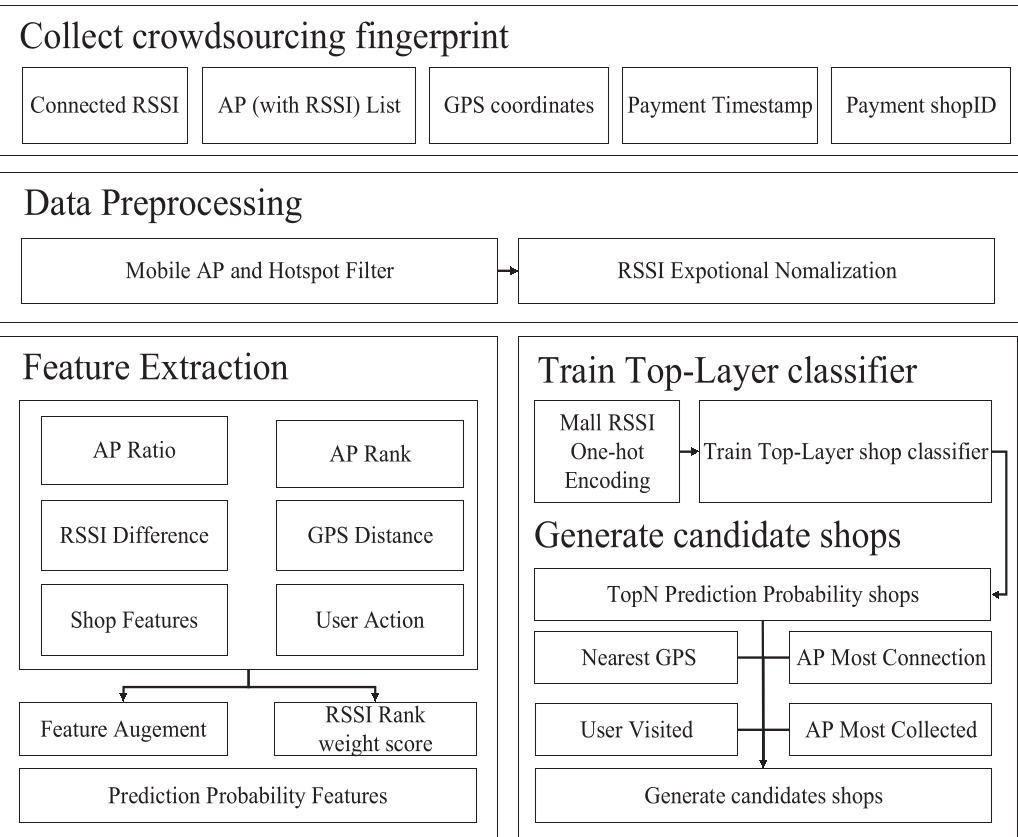
To solve these issues, the paper proposes a "Two-Level" architecture that balances speed and precision.
1. Preprocessing & Filtering
Instead of using every visible Wi-Fi signal, the system filters for "stable" APs—those appearing consistently over several days and users. They use an Exponential Normalization for RSSI, which maps negative dBm values to a (0,1) interval, allowing "unseen" APs to be naturally represented as zero without skewing the model.
2. The Two-Level Classifier
- Top-Level (Candidate Selection): A coarse classifier acts as a filter, narrowing down hundreds of shops to a small set of ~10 candidates. It uses pure Wi-Fi features to ensure computational efficiency.
- Bottom-Level (Refined Classification): This is where the "magic" happens. For the 10 candidates, the system extracts rich features—not just signals, but human behavior.
Feature Engineering: Beyond Radio Signals
What makes this paper stand out is the use of Non-Radio Features to disambiguate shops with similar Wi-Fi signatures:
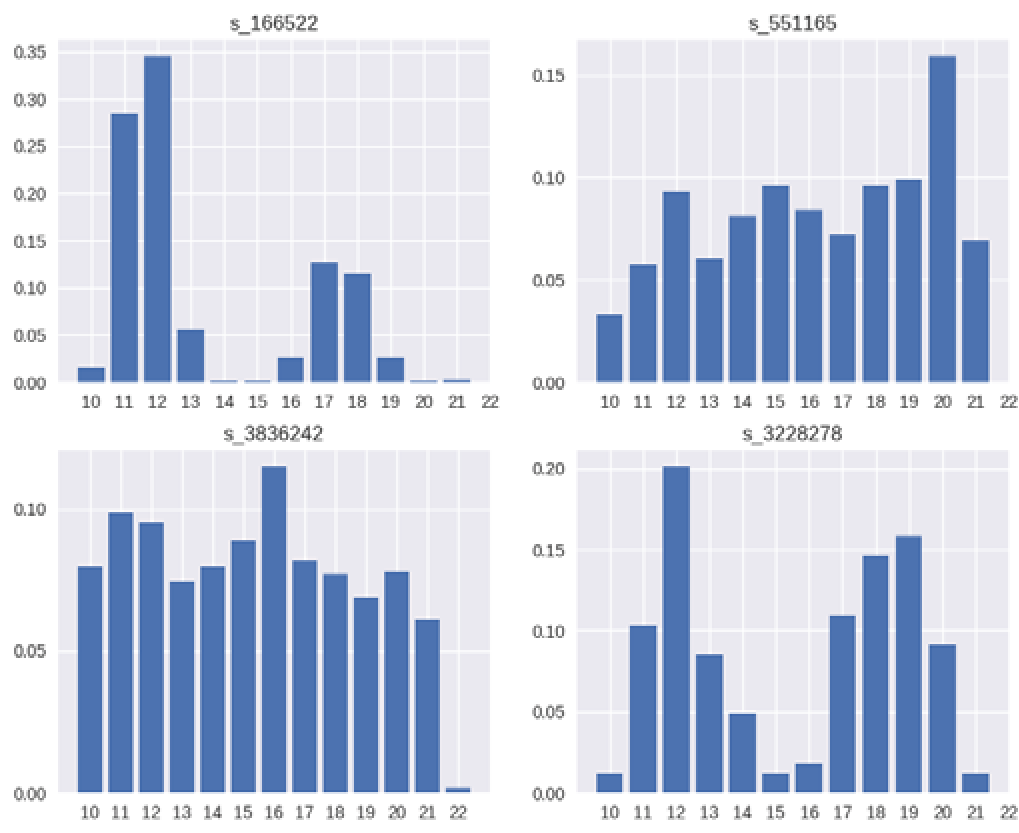
- Payment Time Distribution: A restaurant peaks at 12:00 PM; a clothing store is steady all afternoon.
- Shop Competitiveness: High-volume shops are statistically more likely targets.
- User Preference: If a user has paid at "Shop A" before, the probability of them being there again increases (Individual Repurchase Behavior).
- GPS Median Smoothing: Since indoor GPS is noisy, they calculate the "median coordinate" of all previous payments in a shop to create a more stable "anchor point" for distance calculations.
Experiments & Results
The authors tested their approach on the 2017 CCF Shop Localization dataset, featuring nearly 1 million records.
Key Findings:
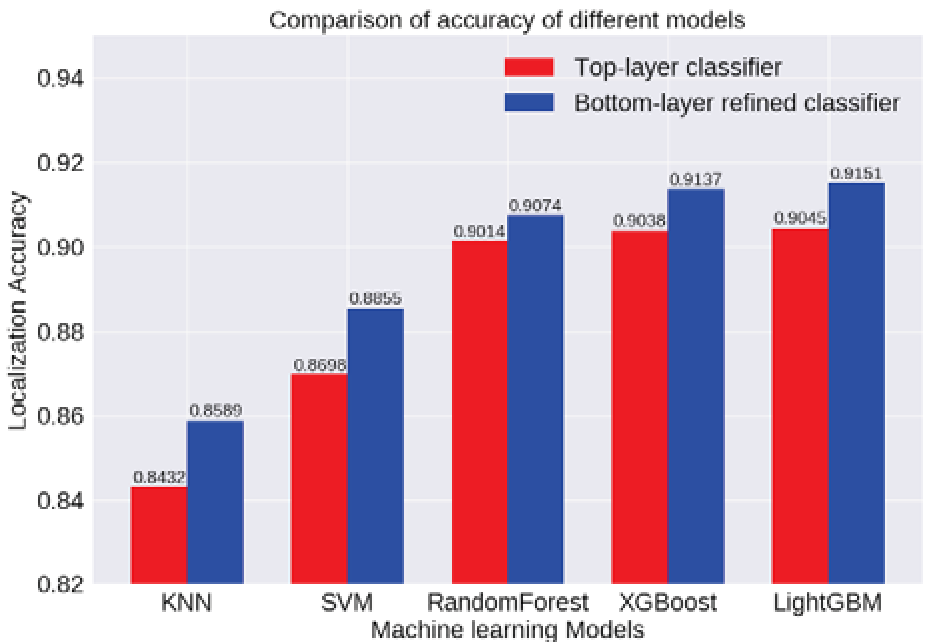
- Model Performance: Gradient Boosting Decision Trees (LightGBM/XGBoost) significantly beat traditional KNN and SVMs.
- Ensemble Gain: By using a Confidence-Weighted Ensemble (multiplying model probability by its historical accuracy), they pushed accuracy beyond 92%.
- Feature Importance: While Wi-Fi remains the primary signal (67% of importance), the top-layer prediction probability and GPS-median distance were crucial for the final 5-10% accuracy boost.
Critical Insight & Conclusion
This research proves that context is king. In a dense shopping mall, Wi-Fi signals from neighboring shops often look identical. The "Physical" signal alone is not enough. By treating localization as a behavioral classification problem rather than just a signal-triangulation problem, the authors have created a system that is not only more accurate but also entirely self-sustaining through crowdsourcing.
Limitations: The system relies on "payment events," meaning it can only localize users precisely when they use a payment app, or it must rely on background scanning which may be restricted by modern mobile OS privacy policies (iOS/Android). Future work would need to address these privacy-induced data sparsity issues.