
Zero-Day Evasion: The Escalating Arms Race in DNN Security
POSTER: Zero-Day Evasion Attack Analysis on Race between Attack and Defense
This paper investigates "Zero-Day" evasion attacks on Deep Neural Networks (DNNs) using the state-of-the-art Carlini-Wagner (C&W) attack and adversarial training. It explores the dynamic "race" between attackers and defenders through various scenarios involving fixed and adaptive target models on the MNIST dataset.
TL;DR
The security of Deep Neural Networks (DNNs) is often a "cat-and-mouse" game. This paper explores Zero-Day Adversarial Examples—attacks using previously unseen data—and evaluates how Adaptive Target Models (which update their weights in real-time) can thwart even state-of-the-art attacks like the Carlini-Wagner method. The findings suggest that "moving target" defenses are effective but may degrade performance on clean data.
Problem & Motivation: The Static Defense Trap
Most current defenses against adversarial attacks are static; they are trained once and deployed. However, in a real-world "Zero-Day" scenario, attackers can generate new perturbations that the model has never encountered.
The authors identify a critical gap: we don't fully understand the dynamic race between an attacker who updates their strategy based on the model and a defender who updates the model based on the attacks. If an attacker has white-box access to a static model, the battle is essentially over. The question is: Can real-time adaptation save the model?
Methodology: Adaptive vs. Fixed Models
The study categorizes the conflict into several scenarios, primarily differentiating between:
- Fixed Target Models: The model remains unchanged after deployment.
- Adaptive Target Models: The model undergoes Adversarial Training in real-time as new attacks are detected.
The Attack & Defense Toolkit
- Attack: The Carlini-Wagner (C&W) Method. It uses a sophisticated objective function to minimize distortion () while maximizing misclassification. It is widely considered one of the hardest attacks to defend against.
- Defense: Adversarial Training. The model is re-trained using adversarial examples to "learn" the distribution of the noise.
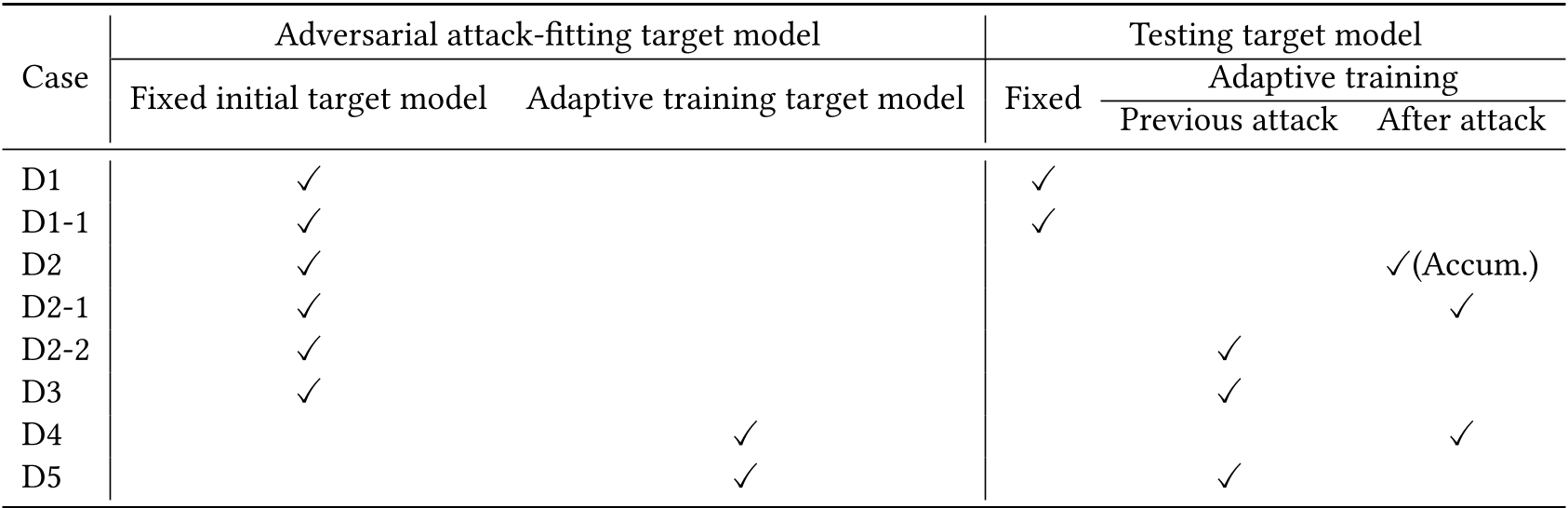 Table 1: Description of fixed vs. adaptive experimental scenarios.
Experimental Insights: Who Wins the Race?
1. The Power of Real-Time Adaptation
In Scenario D5, where the attacker knows the model but the defender performs real-time adversarial training before the next attack, the success rate of the attack dropped significantly compared to a pure white-box attack (D4). This proves that frequently changing the model's internal parameters creates a "moving target" that is harder to hit.
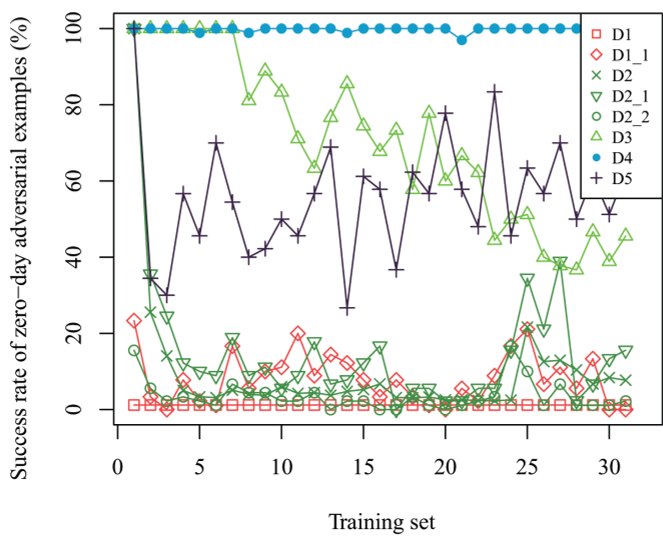 Figure 1: Success rate of zero-day adversarial examples per training set. Note how D5 maintains resistance even against adaptive attackers.
2. The Cost of Defense: Distortion and Accuracy
To overcome adaptive defenses, attackers must inject higher levels of distortion. While this makes the attack harder, the paper notes a side effect: as the model learns these highly distorted images, its ability to recognize original, clean samples actually decreases (as shown in Figure 3 of the paper).
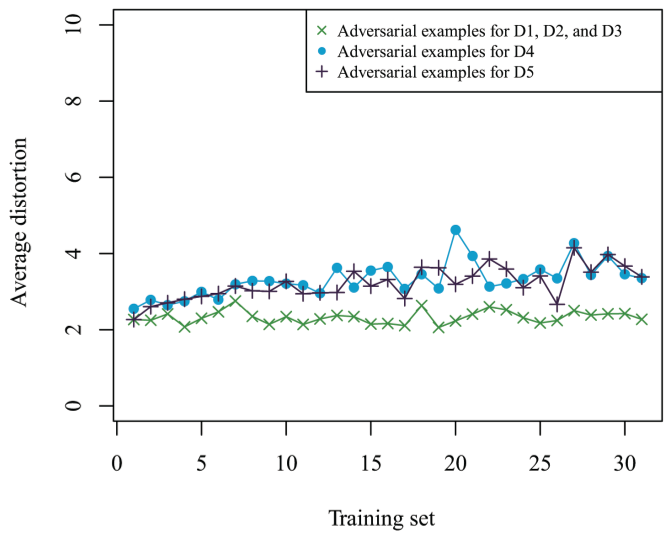 Figure 2: Average distortion. Adaptive models (D4, D5) force attackers to use more noise, making the attack more "expensive."
Critical Analysis & Conclusion
The value of this work lies in its realistic admission that security is not a state, but a process.
Key Takeaways:
- Proactive Defense: If a defender can anticipate the attack method, they can achieve near 100% defense (Scenarios D1, D1-1).
- Parameter Shifting: Real-time updates to model weights provide a significant buffer (approx. 45% resistance) even when the attacker is trying to keep up.
- The Trade-off: There is no free lunch. Defending against high-noise adversarial examples potentially pollutes the model’s understanding of "clean" data.
Limitations & Future Work
The study is limited to the MNIST dataset and handwritten digits. Future research must determine if these real-time adaptive strategies scale to high-dimensional datasets like ImageNet or complex tasks like Large Language Models (LLMs), where frequent re-training is computationally prohibitive.
In conclusion, "Zero-Day" protection for AI requires moving away from static weights toward dynamic, evolving architectures that change as quickly as the threats they face.