
Zero-Determinant Strategy: Enforcing High-Quality Cooperation in Crowdsourcing
Zero-Determinant Strategy for Cooperation Enforcement in Crowdsourcing
This paper introduces the Zero-Determinant (ZD) strategy into crowdsourcing systems, modeling worker interactions as an iterated Snowdrift game. By applying ZD-strategies, a single worker can unilaterally enforce a desired level of social welfare and maintain high-quality service contributions regardless of the opponents' strategies.
TL;DR
In the world of crowdsourcing, "selfishness" is the enemy of efficiency. This paper addresses the "free-rider" problem by applying Zero-Determinant (ZD) strategies to an iterated game model. The authors prove that a single worker can unilaterally control the system's social welfare, forcing the environment into a state of high-effort cooperation, even when facing purely selfish opponents.
Background: The Crowdsourcing Dilemma
Crowdsourcing relies on the "collective intelligence" of a crowd. However, because workers are rational and profit-driven, they often default to the lowest possible effort (free-riding) if they can still claim a share of the reward.
The authors model this as a Snowdrift Game. Unlike the Prisoner's Dilemma, where "Defect" is the dominant strategy, the Snowdrift game has Nash Equilibria where one person works high (H) while the other works low (L). This leads to suboptimal social welfare. The challenge is: How can we move the system to (H, H) for everyone without a central "task police"?
The Insight: The Power of Short Memory
The core of this paper lies in the mathematical elegance of ZD-strategies. Typically, one might think that more history (long memory) leads to better decisions. However, ZD-strategies prove that a memory-one player (who only looks at the previous round) can dictate the game's outcome.
By adjusting the probabilities of choosing High effort based on the four possible outcomes of the previous round ( for HH, for HL, etc.), a worker can "link" their payoff to their opponent's payoff through a linear equation:
Methodology & Architecture
The authors propose two specific ZD variations:
- Social Welfare ZD: Aims to stabilize the total benefit of all participants.
- Opponent-Control ZD: Unilaterally restricts the opponent's payoff to a range that makes "High effort" their only rational choice for long-term survival.
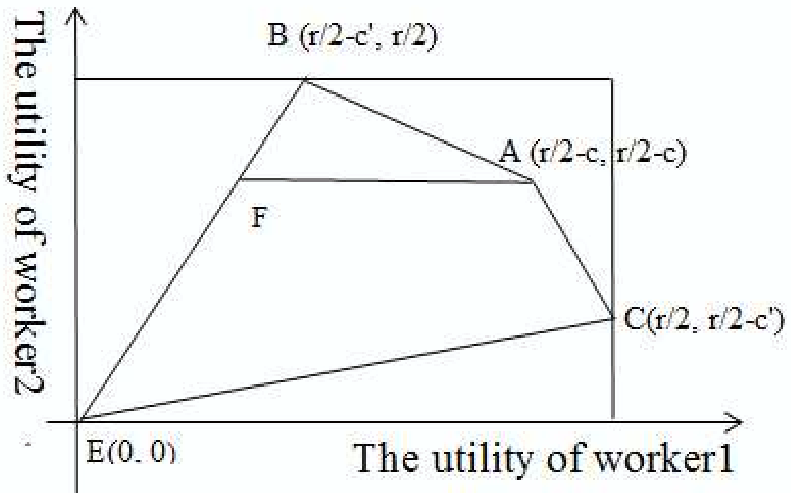 Fig 1: The utility relations. The ZD-strategy allows a player to fix the relationship along the lines AF or AC, effectively steering the "game" toward Point A (the social optimum).
Experimental Validation
The paper compares ZD against two heavyweights in game theory:
- Tit-for-Tat (TFT): Reciprocal but reactive.
- Pavlov (Win-Stay, Lose-Shift): Good at correcting errors but slow to converge.
The simulations reveal a stark contrast:
- Convergence: ZD-strategies reach the stable "High effort" state much faster than Pavlov.
- Stability: Unlike TFT, which can be trapped in cycles of mutual low effort, ZD maintains a high and stable value of social welfare.
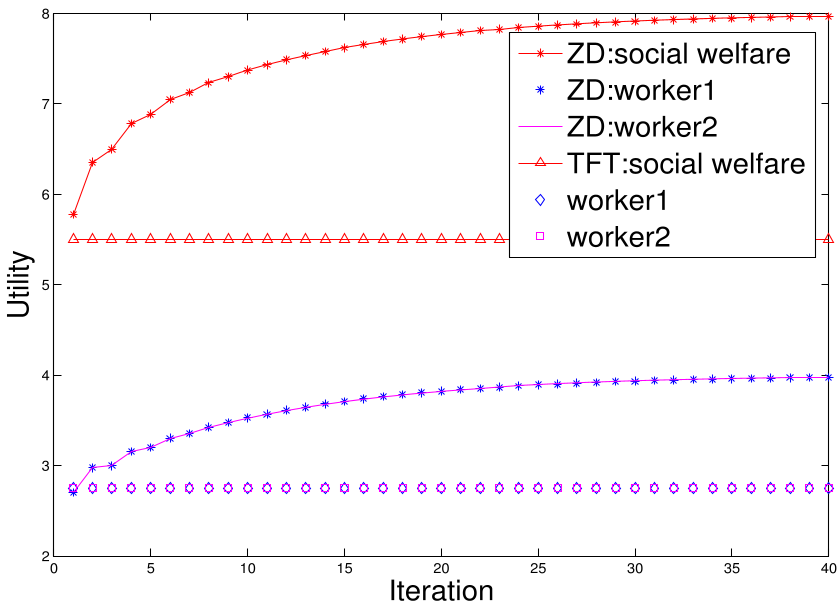 Fig 2: Comparison of ZD-strategy (11) and TFT. ZD maintains significantly higher social welfare (SOTA performance) compared to the erratic performance of TFT.
Critical Insights & Future Outlook
Why is this significant? Most incentive mechanisms require a "Central Bank" or a "Reputation Ledger." This work shows that if even a fraction of workers are programmed with ZD logic, they can act as "enforcers" for the entire system's health.
Limitations: The current model focuses on 2-player interactions. While the authors suggest extensions to multi-player scenarios, the complexity of calculating the transition matrix increases exponentially. Furthermore, it assumes workers are "rational" in a mathematical sense; human irrationality (spite or confusion) remains a variable to be tested.
Takeaway for Tech Leaders: If you are building a decentralized platform (Web3, P2P, or Gig Economy), ZD-strategies provide a mathematical blueprint for "Algorithmic Governance" that is resilient to selfish exploitation.