
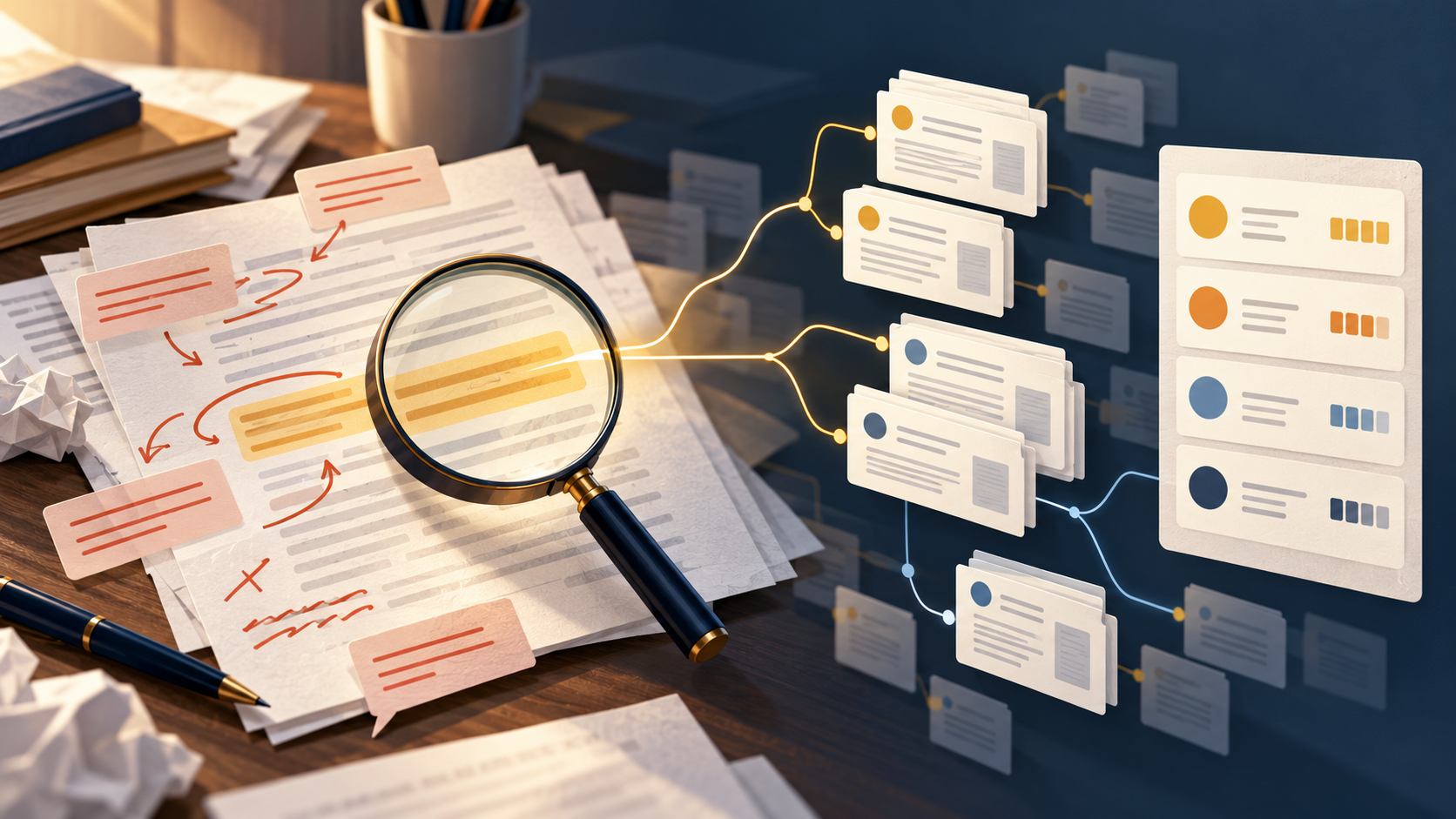
How to Turn Reviewer Comments into a Targeted Evidence Search
A reviewer's comment is rarely a request for more words. It is usually a request for a specific piece of evidence that the current draft does not yet carry. The fastest way to satisfy it is to convert the comment into a

How to Update a Literature Review Without Starting Over
An update to a literature review is a controlled comparison, not a fresh project. You keep the original argument, freeze the search that produced it, define a defensible window for new evidence, rerun the core searches,

How to Update a Search Log After the Research Question Changes
A research question rarely stays fixed. A supervisor narrows your scope, a rubric rewards a sharper comparison, or a pilot search shows that your original wording pulls in the wrong population. When that happens, the sea

How to Use Backward and Forward Citation Chaining Without Getting Lost
Citation chaining is a bounded search technique, not an open-ended reading project. You start from a seed paper, walk backward through its reference list, and walk forward through the works that cite it. The method works
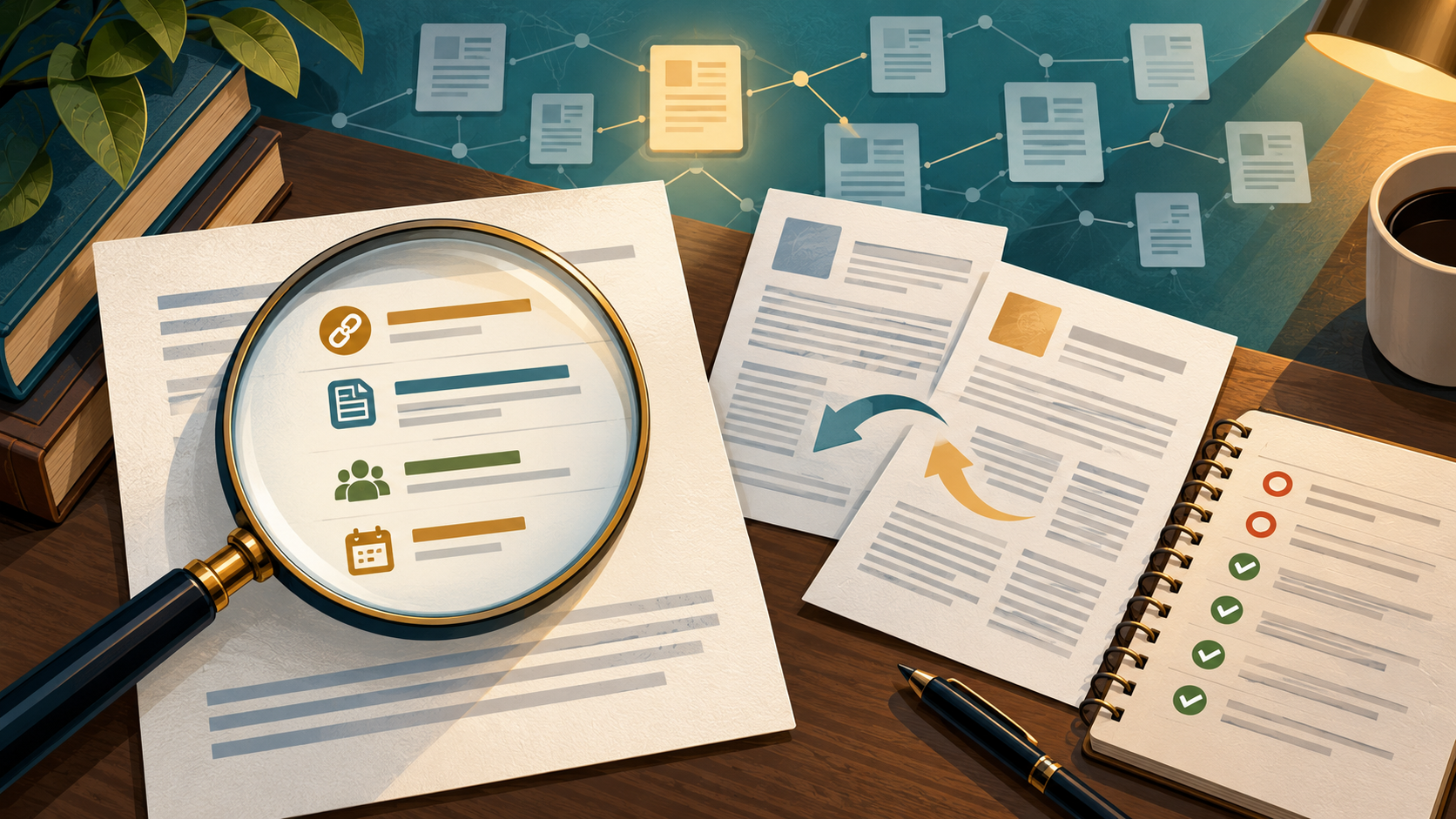
How to Verify a DOI, Title, Author List, and Publication Year
A bibliography error usually enters at one of four fields: the DOI, the title, the author list, or the publication year. The practical fix is not to re-type the citation from memory but to run a short verification sequen

Keyword Search vs. Citation Chaining for Finding Missing Papers
When a manuscript's related-work section has a hole, or a reviewer names a body of literature you have not cited, you face a choice: run more keyword queries, or walk the citation graph outward from a paper you already t

Literature Review Evidence Management: From Search Results to Synthesis
A literature review is not a pile of PDFs. It is a chain of decisions: what to search, what to keep, what to read first, what to extract, how to compare studies, and how to turn those comparisons into an argument. When t

Manual Screening vs. AI Prioritization: How Should You Divide the Work?
Divide the work by what each side can actually be held to. Judgment, eligibility decisions, and the final record belong to the reviewer; speed, first-pass ordering, and recall support are where AI prioritization earns it

Medical Evidence Search: From PICO to Applicable Studies
A focused clinical question rarely fails because there are no papers. It fails because the search, the study designs, and the patient in front of you drift apart. This guide connects those pieces: turning a question into

One Database vs. Multiple Databases for a Literature Review
If you are choosing between one database and several for a literature review, the practical answer is: start with one database to build your search vocabulary and eligibility criteria, then add sources until new searches