

Backward citation searching follows a paper's reference list into the work it builds on. Forward citation searching follows the papers that later cite it. On the same task — assembling a defensible evidence base for a time-sensitive decision memo — the two directions answer different questions. Backward searching tells you what a claim rests on; forward searching tells you what happened to that claim after publication. Neither direction, on its own, tells you whether a specific sentence in your draft is supported by the source you attached to it.
This article compares the two directions on one concrete task, shows where each fails, and gives a decision table plus a combined workflow that keeps provenance and confidence visible. WisPaper appears only at the steps where its tools genuinely support the work.
The comparison task: a due-diligence memo on a contested claim
Imagine your team must brief an investment committee on whether a widely repeated research finding still holds. The memo needs three things: the foundational studies behind the claim, the later work that replicated or challenged it, and a confidence level attached to each assertion. Every sentence in the memo should trace to a source you can name.
That framing matters because the two search directions map onto two different memo sections. Backward searching populates the "what the claim is built on" section. Forward searching populates the "what happened next" section. A memo that only does one of these is structurally incomplete — it either presents old foundations as if they were current, or presents later commentary without knowing what it was responding to.
What backward citation searching reveals
Backward searching starts from a seed paper and walks its reference list. What you recover is the intellectual lineage: the methods a study borrowed, the datasets it relied on, the prior results it treats as established. For a due-diligence memo, this is how you check whether a headline finding rests on a single small study or on a body of converging work.
Backward searching is also where you catch inherited assumptions. If three foundational papers all cite the same earlier measurement, the later studies may not be independent confirmations at all. Reading the reference lists side by side surfaces that shared ancestry.
Crossref's REST API exposes publisher-deposited metadata — titles, authors, venues, dates, identifiers, licenses, funding, ORCID and ROR identifiers, and abstracts when deposited — which makes it useful for confirming that a cited work is what you think it is before you build on it. Metadata confirms identity; it does not confirm that the citing paper used the source correctly.
What forward citation searching reveals
Forward searching inverts the direction: you start from a paper and look for later works that cite it. This is where replication, criticism, and uptake appear. A foundational result that has been quietly superseded will show later papers citing it mainly to note its limits. A result that has held up will show later papers building on it directly.
Google Scholar's documented features support this direction well: Cited by lists, Related articles, date sorting and date limits, and email alerts for new citations. Date limits are especially useful in a time-sensitive memo, because you can isolate post-publication commentary from the original era.
Forward searching also reveals how a claim traveled. A finding may be cited far outside its original field, which is worth flagging in a memo: cross-field uptake can signal robustness, or it can signal that the claim was imported without the caveats that accompanied it at home.
Where backward searching fails
Backward searching cannot see anything published after your seed paper. If the seed is a decade old, its reference list is a decade old, and the memo built only from it will read as current when it is not. This is the most common failure in fast-turnaround briefs.
It also fails on self-citation and citation cartels. A reference list can look like a rich foundation while actually circling a narrow group of authors. Backward searching alone gives you no signal about that pattern, because you never leave the seed's own citation neighborhood.
Finally, backward searching inherits the seed's framing. If the seed paper mischaracterized an earlier study, walking its references will reproduce that mischaracterization unless you read the cited work directly.
Where forward searching fails
Forward searching cannot tell you what a paper was responding to. A critical citation and a supportive citation can look similar in a list until you read the citing text. Volume of citations is not evidence of correctness — a heavily cited paper may be heavily cited precisely because it is contested.
It also fails on coverage. Google Scholar's help documentation describes locating alternative versions of a work, which is useful, but citation lists depend on what the index has captured. Absence of later citations in one tool is not proof that no later work exists.
And forward searching is noisy for a decision memo. A Cited by list mixes methodological critiques, brief mentions, and tangential references. Without a screening step, the memo team spends its time triaging rather than deciding.
Comparing the two directions on the same criteria
| Criterion | Backward searching | Forward searching |
|---|---|---|
| Question answered | What does this claim rest on? | What happened to this claim after publication? |
| Direction | Seed paper → its references | Seed paper → papers citing it |
| Best memo section | Foundations and inherited assumptions | Replication, criticism, and uptake |
| Blind spot | Nothing after the seed | Nothing before the seed |
| Noise profile | Narrow but potentially circular | Broad but potentially tangential |
| Metadata support | Crossref fields confirm cited-work identity | Google Scholar Cited by and date limits organize later work |
| Failure mode | Presents old foundations as current | Presents citation volume as validation |
Read the table as a division of labor, not a ranking. Each direction is strong exactly where the other is blind.
A bounded two-direction workflow for the memo
Step 1 — Fix the seed set. Choose two or three papers that state the claim most directly. Confirm each one's identity through its DOI: a DOI resolves through doi.org to the current destination registered for that identifier, which locates the work, while the bibliographic fields and source text still need checking for identity and claim support. Record the DOI, the version you read, and the date you checked it.
Step 2 — Run backward from each seed. Pull the reference lists and tag each cited work as foundation, method, or context. Flag any work cited by more than one seed — that shared ancestry is what you will scrutinize first.
Step 3 — Run forward from each seed. Use Cited by lists with a date limit set to the period after the seed's publication. Tag each citing work as replication, critique, extension, or passing mention. Read the citing sentence, not just the title.
Step 4 — Screen the candidate pool. This is where a scholarly search interface earns its place. You can run the seed and follow-on queries through WisPaper search to find academic papers and pull the results into one working set rather than juggling tabs. For readers who want a public entry point first, WisPaper Scholar Search explains the paper-finding route before you commit to a query strategy.
Step 5 — Organize with provenance attached. Save the screened papers to My Library so the seed set, the backward foundations, and the forward critiques stay in one organized place. Attach your own note to each item recording which direction found it and what role it plays in the memo.
Step 6 — Interrogate the saved set. Once the papers are in the library, Library QA lets you ask questions based on papers uploaded to My Library or added from search results. Use it to check whether a specific claim appears in the saved sources and how those sources frame it — then verify the answer against the source text before it enters the memo.
Step 7 — Assign confidence levels. For each memo assertion, record: the foundational source, the later uptake or critique, and a confidence label (high, moderate, low) with a one-line reason. A claim with converging foundations and replication gets high confidence. A claim with a single foundation and no forward uptake gets low confidence and an explicit note that the search was bounded.
Step 8 — Check the citation layer. Before the memo circulates, screen the BibTeX against real academic databases with TrueCite, which flags hallucinated references. This catches fabricated entries that slipped in during drafting; it does not tell you whether a real reference actually supports the sentence it is attached to.
Worked example: confidence levels in a client briefing
Suppose the memo's central claim is that a particular intervention improves a measured outcome. Backward searching finds two foundational studies, both citing the same earlier measurement instrument. Forward searching finds one replication with a larger sample and two critiques questioning the instrument's validity in a different population.
The memo should not say "research shows the intervention works." It should say: two foundational studies support the claim; one later replication is consistent; two later critiques question measurement validity in a different population; confidence is moderate, and the instrument question is the open item for the committee. That sentence is traceable in both directions and carries an explicit confidence level.
If the team needs to go further — for example, to plan whether the foundational study's method could be reproduced on your own data — that is a different task from citation searching. PaperClaw supports research-paper reproduction planning from an uploaded PDF and reproduction instructions, which is the natural next step when the memo's recommendation depends on whether the original method actually works.
Keeping provenance visible when the deadline is tight
Time pressure is what collapses the two directions into one. Under deadline, teams run a single search, cite whatever appears, and label the result "evidence." The fix is procedural, not technical: keep the direction tag on every source from the moment it enters the library, and never let a forward-found critique be filed as if it were a foundation.
A simple convention works. Prefix each note with B (backward), F (forward), or S (seed). When you draft, every claim sentence should be able to name its B source and, where relevant, its F source. If a sentence has only a B source, the confidence label should say so.
For longer memos that need a literature review section rather than a citation map, Scholar Agent fits longer research tasks in WisPaper's literature review, inspiration, or reproduction use cases. Keep the direction tags when you move material into that workflow so the provenance survives the handoff.
FAQs
Keep Reading

Broad Search vs. Narrow Search: Which One Finds the Evidence You Need?
Under a deadline, the question is rarely "should I search broadly or narrowly?" It is "which move gets me to defensible evidence fastest?" Broad recall and narrow precision are not rival philosophies; they are two ends o
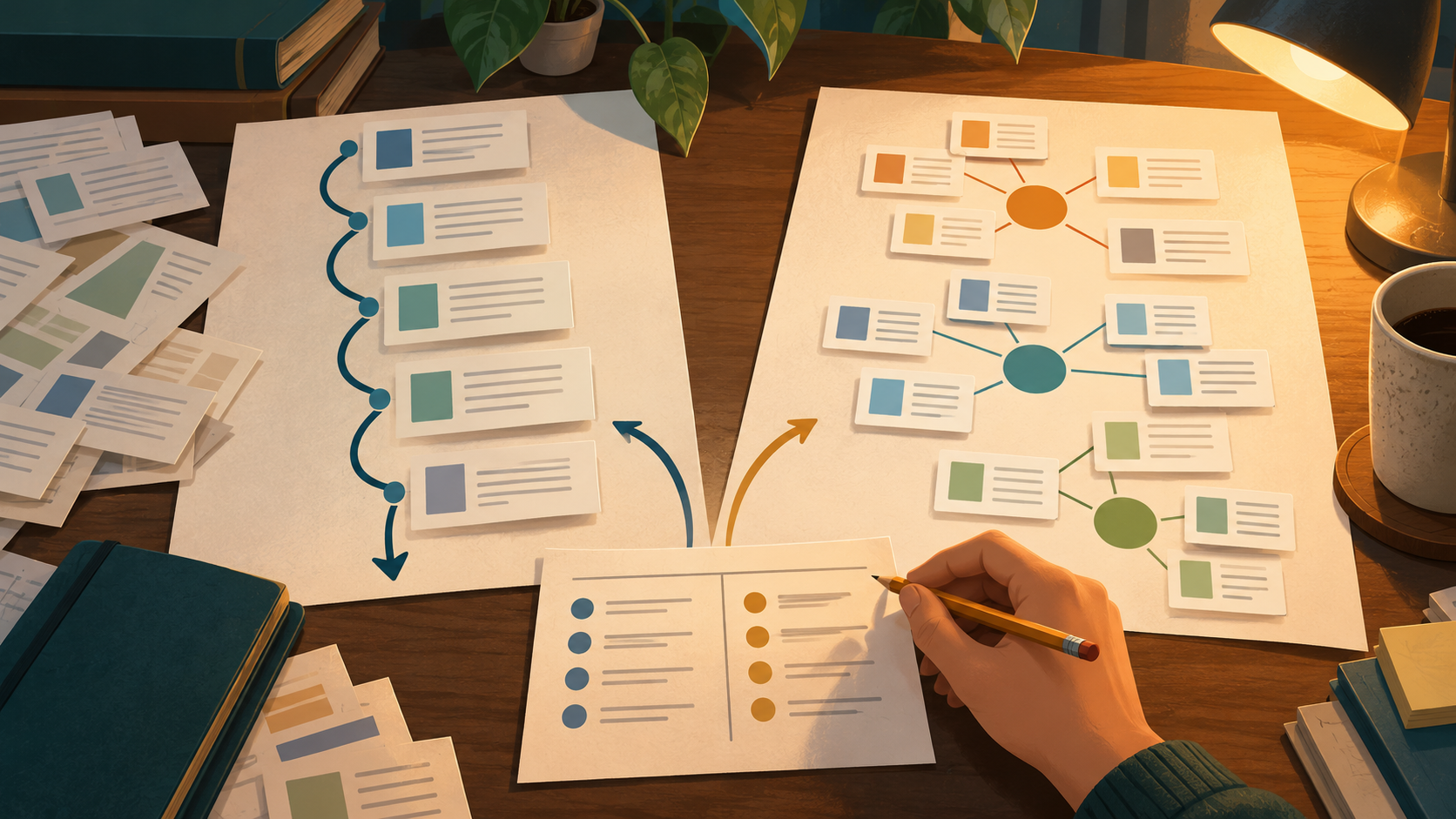
Chronological vs. Thematic Literature Review Structure: Choosing by Question and Evidence
A literature review can be organized in two common ways. A **chronological** structure follows how a field developed over time. A **thematic** (argument-centered) structure groups studies by the ideas, debates, or mechan

Citation Verification: A Complete Pre-Submission Workflow
Citation verification is the practice of confirming, for every reference in a manuscript, that the work exists, that its metadata is correct, that you are citing the right version, that its correction status is known, th