

A Guideline Recommendation Does Not Match the Studies You Found
You are preparing a short evidence brief for a team discussion. The guideline says one thing; the studies you pulled say something narrower, older, or aimed at a different population. The instinct is to force a match — e

A New Project Starts Monday and Nobody Has Built the Reading List
A new project starts Monday, and the reading list does not exist yet. Maybe you have a folder of PDFs from a winter-break cleanup, a supervisor's margin comments on a draft chapter, and a vague sense that the literature
A Reviewer Asks for Newer Evidence After Your Search Is Closed
Your manuscript is submitted, your search log is archived, and then a reviewer writes: the evidence base looks dated. Perhaps the review was screened months ago, or the reviewer points to a recent paper you did not captu

Abstract-First Reading vs. Methods-First Reading: Choosing a Strategy for Your Next Paper
When you are finishing a course paper, a thesis chapter, or a first manuscript, the pile of papers you need to read can feel like the real bottleneck. The practical question behind "abstract-first vs. methods-first" is n

AI-Generated Reading List vs. Curated Seed Library
You have a topic, a deadline, and a blank reference list. The question is how to fill it: let an AI tool generate a reading list from your topic description, or start from a curated seed library of papers you already tru

An AI-Written Background Section Sounds Convincing but Has No Evidence Map
A background section can read smoothly and still leave you unable to answer the one question a supervisor or examiner will ask: *which claim rests on which study, and how do you know?* That is the gap this article addres
Broad Topic Search vs. Feasibility Search for a New Project
You have a topic, a deadline, and a vague sense that the literature is either too large to enter or too thin to support a project. The practical question is not which search is "better" but which one you should run first

Building a Reusable Research Knowledge Base
A reusable research knowledge base is a set of records, files, and decisions you can carry from one project into the next without rebuilding your reading from scratch. It answers four questions at any moment: what have I

Citation Count vs. Method Quality: Which Signal Matters More?
When you are finishing a course paper, a thesis chapter, or a first manuscript, the pressure to lean on citation counts is real. A paper with hundreds of citations feels safe to cite; a paper with three feels risky. But
Clinical Evidence Briefing: From Question to Team-Ready Summary
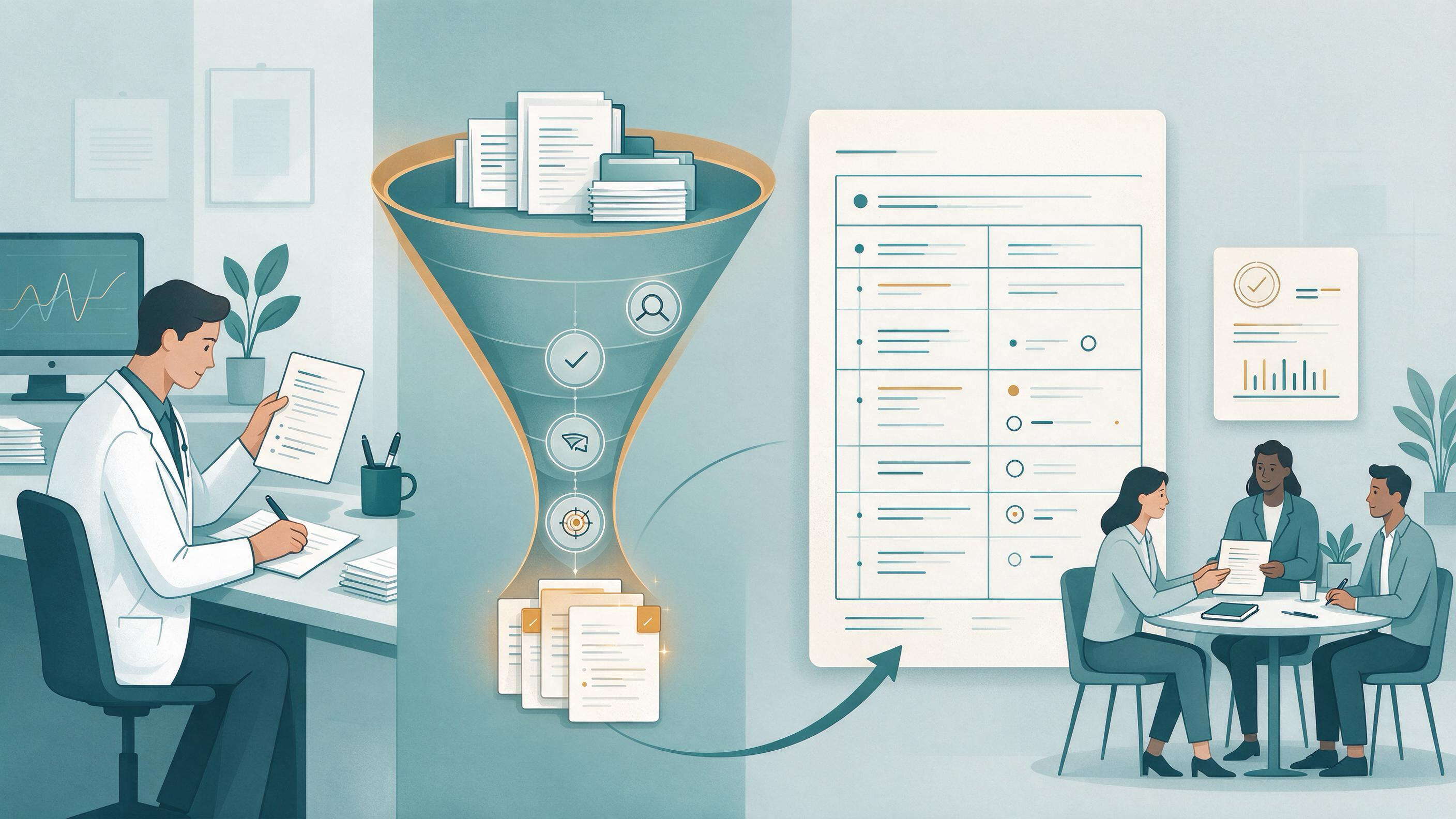
A clinical evidence briefing turns a focused question into a short, defensible summary that a care team or research group can discuss together. The work is less about finding one decisive paper and more about building a