

How to Build a Literature Review Outline That Follows an Argument
A literature review outline that follows an argument is not a list of papers grouped by theme. It is a claim-by-claim structure in which every section exists to advance a position, and every cited study has a defined job

How to Build a Reading Queue That Matches Your Next Decision
A reading queue is not a reading list. A reading list is a pile of things you intend to read. A reading queue is ordered, bounded, and tied to a decision you actually have to make — a client deck, a decision memo, a team

How to Build a Research Handoff That Someone Else Can Use
A research handoff fails in a predictable way: the person who did the work still holds the context in their head. The deck opens, the memo circulates, the project closes, and the next reader cannot tell which claims are

How to Build a Research Vocabulary Before Searching Databases
You sit down to search a database, type your topic into the box, and get either a flood of irrelevant records or almost nothing. The problem is usually not the database. It is that you are searching with the words you ha

How to Build a Shared Evidence Folder for a Research Team
A shared evidence folder is the team-level record of what you searched, what you kept, why you kept it, and how each item bears on a defined question. It is not a pile of PDFs. It is a small, governed system: a question

How to Build a Source-Checked Research Memo for a Client
A source-checked research memo is a short client-facing document in which every substantive claim can be traced to a specific source, and every source carries an explicit confidence level. The work is less about writing

How to Check Whether Your Discussion Overstates the Evidence
Your Discussion section is where a study's findings become a claim about practice, mechanism, or future research. That is also where overstatement creeps in: a single trial's result becomes "the evidence shows," a surrog

How to Clean Up Research Notes Over Winter Break
Winter break is the rare stretch when you can stop producing new notes long enough to make the ones you already have usable. If you are finishing a course paper, a thesis chapter, or a first manuscript, the goal of a cle

How to Close a Research Project Without Losing the Evidence
Closing a research project is not the same as finishing the writing. The writing can be done while the evidence that supports it is scattered across browser tabs, downloaded PDFs, exported citation files, and half-rememb
How to Compare Treatment Studies with Different Follow-Up Times
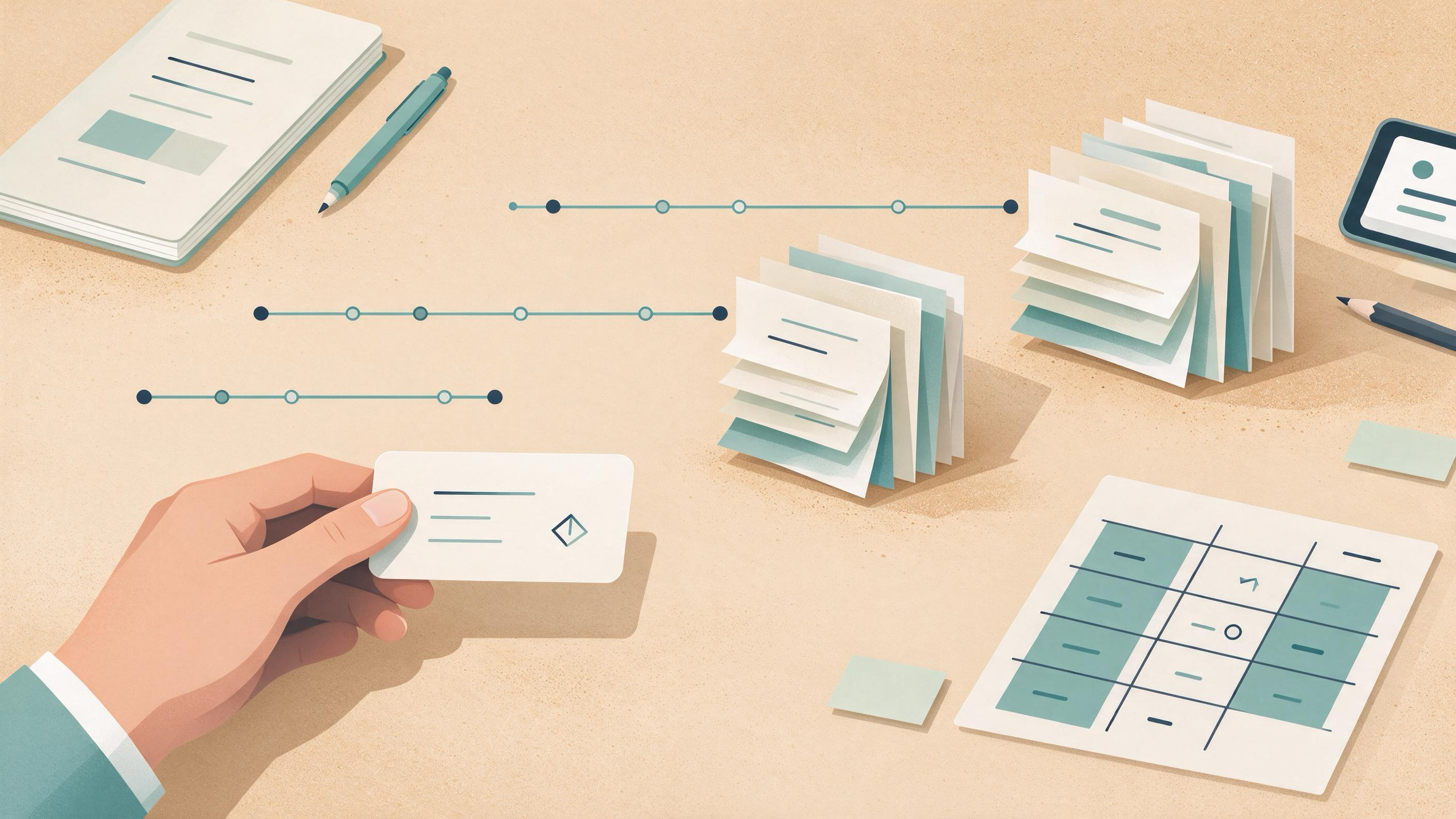
Comparing treatment studies with different follow-up times is a matching problem before it is a statistics problem. Two trials can report the same outcome label yet answer different questions because one measures events